BCA After Commerce Without Mathematics: Eligibility, Fees, Admission and Career Scope
Yes, students from the Commerce stream can pursue a Bachelor of Computer Applications (BCA) without Mathematics in Class 12 at many universities and colleges in India. However, eligibility requirements differ by institution. Some colleges accept students from any stream who meet the minimum qualifying marks, while others require Mathematics, Computer Science, or another specified subject. Students should verify the latest eligibility criteria, entrance examination requirements, and subject combinations before applying. Admission Dakhila helps students explore BCA colleges, compare course fees, understand admission requirements, and identify suitable undergraduate computer application programmes.
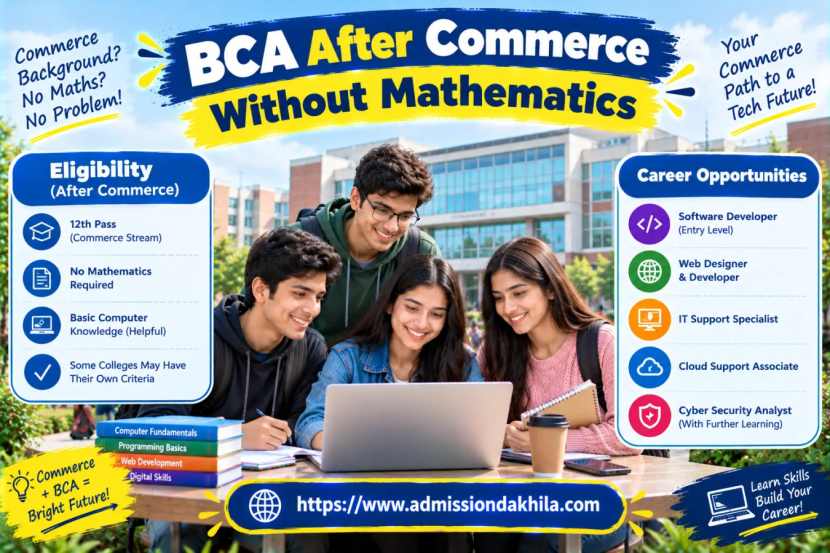
BCA After Commerce Without Mathematics
| Particular | Details |
|---|---|
| Course name | Bachelor of Computer Applications (BCA) |
| Eligibility | Class 12 pass; subject requirements depend on the institution |
| Eligible stream | Commerce without Maths at eligible colleges |
| Course duration | Usually 3 or 4 years, depending on the university and programme structure |
| Admission method | Merit-based, entrance-based, or another approved process |
| Minimum marks | Often around 45%–50%, but the actual requirement varies |
| Mathematics requirement | Not compulsory at every college |
| Main subjects | Programming, databases, web development, computer systems and software |
| Career options | Junior software developer, web developer, IT support professional, QA tester and related roles |
| Further education | MCA, MBA, postgraduate diplomas and relevant certifications, subject to eligibility |
| Admission guidance | Admission Dakhila |
BCA After Commerce Without Mathematics
Introduction
Choosing the right undergraduate course after Class 12 is an important decision, especially for students who want to build a career in technology but have studied Commerce without Mathematics. Traditionally, many students associate computer-related degrees with the Science stream and assume that Mathematics is compulsory for every computer application programme. This assumption can discourage Commerce students from exploring opportunities in software development, web technologies, databases, information systems, and other areas of the IT industry.
The good news is that BCA after Commerce without Mathematics is possible at many colleges in India, provided the student satisfies the admission requirements of the selected institution. The Bachelor of Computer Applications, commonly known as BCA, is an undergraduate programme designed to introduce students to computing, programming, software applications, databases, and technology-based problem-solving.
For Commerce students, BCA can be an attractive option because it combines technical education with opportunities to develop analytical thinking, communication, and business awareness. Students who have studied Accountancy, Business Studies, Economics, or related subjects may also find applications of technology in business operations, financial software, enterprise systems, e-commerce, and digital services interesting.
However, eligibility is not identical across all universities. Some colleges allow students from Arts, Commerce, and Science backgrounds to apply without Mathematics. Others require Mathematics, Computer Science, Information Practices, or another subject specified in their admission rules. A student must therefore distinguish between the general possibility of pursuing BCA and the exact eligibility requirements of an individual college.
This guide explains BCA eligibility without Mathematics, course duration, admission procedures, subjects, fees, college selection, career opportunities, salary expectations, higher education, and preparation strategies. It also explains how Admission Dakhila can help students research relevant colleges and make a more informed admission decision.
Yes, you may be able to pursue BCA after Commerce without Mathematics. Many colleges accept Commerce students without Maths, but some universities make Mathematics or another specified subject compulsory. Check the eligibility criteria of your preferred college before applying. For help comparing BCA colleges, admission requirements, and fees, visit Admission Dakhila at https://www.admissiondakhila.com.
1. What Is BCA?
Bachelor of Computer Applications is an undergraduate degree focused on computer applications, programming, software tools, databases, and related technologies. The course helps students understand how computer systems and software applications are designed, developed, used, and maintained.
Unlike programmes that concentrate mainly on theoretical computer science or engineering, BCA generally places substantial emphasis on practical computer applications and programming skills. The exact balance between theory, practical work, mathematics, and specialised subjects depends on the university curriculum.
A typical BCA programme may introduce students to:
-
Programming fundamentals
-
Computer organisation and architecture
-
Database management systems
-
Web development
-
Operating systems
-
Software engineering
-
Computer networks
-
Data structures
-
Information security
-
Cloud computing or emerging technologies
-
Project work and internships
Not every college teaches all these subjects in the same semester or with the same level of depth. Some institutions offer electives or specialised tracks in areas such as data science, artificial intelligence, cybersecurity, or full-stack development.
For Commerce students without Mathematics, BCA offers a potential pathway into the technology sector without necessarily requiring a Science background. The important condition is that the chosen institution must accept the student's Class 12 subject combination.
2. Can You Do BCA After Commerce Without Mathematics?
Yes. Students who have completed Class 12 in Commerce without Mathematics can apply to BCA programmes at institutions whose admission rules permit their subject combination.
There is no single admission rule that applies uniformly to every BCA college in India. Universities set eligibility requirements according to their programme regulations, academic policies, and applicable admission guidelines.
Some institutions accept candidates from any recognised stream, while others specify particular subjects or minimum marks. A few may require Mathematics or an equivalent subject at the Class 12 level.
2.1 Colleges That Accept Students Without Maths
Some BCA programmes accept students from Commerce, Arts, or Science backgrounds without making Mathematics compulsory. Such programmes can be suitable for students who want to learn programming and computer applications despite not having studied Maths in school.
Before applying, confirm:
-
Whether Commerce students are eligible.
-
Whether Mathematics is compulsory in Class 12.
-
Whether Computer Science or Information Practices can satisfy a subject requirement.
-
The minimum aggregate marks.
-
Whether an entrance test is required.
-
Whether admission is based on merit, an entrance examination, or another approved route.
Never assume that a college accepts students without Maths simply because its website advertises a BCA course. Review the official admission brochure for the relevant academic year.
2.2 Colleges That Require Mathematics
Some universities require Mathematics in Class 12 for BCA admission. Others may accept a specified combination of Mathematics, Computer Science, Informatics Practices, or related subjects.
If a university requires Mathematics and you did not study it in Class 12, you may not qualify for that particular programme under its standard eligibility rules.
In this situation, explore other recognised institutions that explicitly permit Commerce students without Mathematics. Do not rely on verbal assurances alone; request written confirmation from the official admissions department.
2.3 Does Commerce Background Create a Disadvantage?
Not necessarily. Students from Commerce may initially be unfamiliar with programming terminology, algorithms, or computer science concepts. These subjects can be learned through consistent practice.
Commerce students may already have experience with numerical information, business processes, accounting systems, data interpretation, and commercial decision-making. These experiences can be useful when learning about business applications, financial technology, enterprise software, and data management.
The main requirement is a willingness to practise technical concepts regularly. Previous exposure to coding is helpful but is not a universal admission requirement.
3. BCA Eligibility Criteria After Class 12 Commerce Without Maths
Eligibility must be checked carefully because a student can meet the general academic requirements of one college and still be ineligible for another.
3.1 Educational Qualification
Most BCA programmes require students to have passed Class 12 or an equivalent examination from a recognised board.
Depending on the institution, eligible qualifications may include CBSE, CISCE, recognised state boards, or other accepted equivalents.
Commerce students without Mathematics may qualify if the college accepts candidates from all streams. Students awaiting their Class 12 results may also be permitted to apply provisionally at some institutions, subject to their admission rules.
3.2 Minimum Percentage
Minimum qualifying marks vary between universities and colleges. Some institutions may require approximately 45% or 50% aggregate marks, while others set different thresholds.
The required percentage may also vary according to the applicant's category, the admission route, or specific university regulations.
Students should check whether the college calculates eligibility using total aggregate marks, specified subjects, or another formula. Meeting the minimum percentage does not automatically guarantee admission.
3.3 Subject Requirements
This is the most important eligibility condition for students without Mathematics.
A college may accept:
-
Commerce without Mathematics
-
Commerce with Computer Science or Informatics Practices
-
Any recognised Class 12 stream
-
Candidates with particular combinations of subjects
Another college may require Mathematics as a compulsory subject. Students must verify the precise wording of the current eligibility notice.
3.4 Age and Other Conditions
Some universities may specify age-related or documentation requirements, although these are not uniform across all BCA programmes. Students with gaps in education, qualifications from alternative boards, or special admission circumstances should seek clarification directly from the institution.
3.5 Entrance Examination Requirements
Certain colleges admit students based on Class 12 marks. Others use entrance examinations, interviews, aptitude assessments, or a combination of selection methods.
The entrance examination may test general aptitude, reasoning, English, computer awareness, or other subjects. Its content depends on the institution.
Eligibility checklist: Before paying an application fee, confirm that your board is recognised, your marks meet the requirement, Mathematics is not compulsory for your selected programme, and you can meet the entrance and documentation conditions.
4. Why Choose BCA After Commerce Without Mathematics?
BCA can be a practical choice for students who want to combine their education in Commerce with technical skills.
4.1 Opportunity to Enter the IT Sector
BCA introduces students to programming, software applications, databases, web development, and computer systems. With additional practice and project experience, graduates may apply for suitable entry-level technology roles.
A degree alone does not guarantee employment. Employers often assess technical ability, problem-solving skills, communication, project work, and familiarity with the tools used in their organisations.
4.2 Combination of Business and Technology
Modern organisations rely on technology for accounting, customer management, inventory, online transactions, reporting, and decision-making.
Commerce students who gain technical knowledge may eventually explore roles involving business software, application support, data operations, enterprise systems, and financial technology.
4.3 Multiple Career Directions
After BCA, students can explore software development, website development, testing, technical support, database-related work, or further education.
Specialisation usually develops through electives, internships, independent projects, certifications, or postgraduate study.
4.4 Further Education Options
BCA graduates may consider an MCA, MBA, postgraduate diploma, or other relevant programmes, subject to the specific eligibility criteria.
Students considering MCA should check the target university's rules early. Some programmes require Mathematics at Class 12 or graduation level, while others may prescribe bridge courses or alternative requirements.
4.5 Learning Practical Skills
A good BCA programme should provide practical exposure through programming assignments, laboratory sessions, database projects, presentations, internships, or a final-year project.
Students should compare actual curriculum and laboratory opportunities rather than choosing a college based only on the course title.
5. BCA Course Duration and Academic Structure
BCA duration depends on the university and programme structure.
Many traditional BCA programmes have a duration of three years, divided into six semesters. Some universities offer four-year undergraduate structures under their academic framework, with programme options and exit provisions determined by the institution's regulations.
Students should verify the exact duration, degree award, credit structure, and exit rules before enrolling.
5.1 First Year
The first year usually builds foundational knowledge. Students may study computer fundamentals, programming basics, mathematics or quantitative subjects where included, communication skills, and introductory information technology.
A student without Mathematics should pay particular attention to the curriculum's quantitative requirements. Being eligible for admission does not necessarily mean that the programme contains no mathematical content.
5.2 Second Year
The second year often moves toward more detailed technical subjects, such as object-oriented programming, data structures, database management, operating systems, software engineering, and web technologies.
The exact subjects and sequence vary across universities.
5.3 Final Year
The final year commonly includes advanced electives, practical assignments, internships, seminars, or a major project. Depending on the curriculum, students may encounter mobile applications, cloud technologies, cybersecurity, data analytics, or other areas.
Students should use this stage to build a portfolio demonstrating their skills.
6. BCA Subjects for Commerce Students Without Maths
A BCA curriculum can include both programming and quantitative concepts. Students should review the syllabus of the college they plan to join.
6.1 Programming Fundamentals
Programming teaches students how to give instructions to a computer using a programming language. Depending on the curriculum, languages may include C, C++, Java, Python, or others.
Students learn variables, data types, conditional statements, loops, functions, and problem-solving methods.
Commerce students can begin with simple exercises and gradually progress to more complex programmes.
6.2 Database Management Systems
Database subjects explain how information is organised, stored, retrieved, and maintained.
Students may learn relational database concepts, tables, queries, relationships, and SQL. These skills are useful in business software, inventory management, customer records, and reporting systems.
6.3 Web Development
Web development introduces students to technologies used to create websites and web applications. Depending on the curriculum, students may study HTML, CSS, JavaScript, server-side development, and databases.
Building a small website is a practical way to apply classroom knowledge.
6.4 Data Structures and Algorithms
Data structures explain how information can be organised for efficient processing. Algorithms provide step-by-step approaches to solving problems.
These subjects can involve logical and mathematical reasoning. Students who have not studied Mathematics recently should be prepared to revise basic arithmetic, logical operations, and problem-solving techniques.
6.5 Computer Networks and Operating Systems
Computer networks explain how devices communicate and share information. Operating systems manage computer hardware, memory, files, processes, and applications.
These subjects help students understand how software operates within a wider computing environment.
6.6 Mathematics and Quantitative Subjects
Some BCA programmes include discrete mathematics, statistics, business mathematics, numerical methods, or other quantitative subjects. The depth varies significantly.
Students without a Mathematics background should inspect the course syllabus before admission and identify any additional learning support that may be useful.
7. Is BCA Difficult Without Mathematics?
BCA can be manageable for Commerce students without Mathematics, but the experience depends on the student's preparation, interests, study habits, and curriculum.
Not every BCA subject requires advanced mathematics. However, programming, algorithms, data structures, statistics, and some specialised fields require logical reasoning and quantitative thinking.
Students should not confuse the absence of a Class 12 Mathematics requirement with an absence of mathematical concepts throughout the course.
7.1 Challenges You May Face
Common challenges include:
-
Learning programming syntax for the first time
-
Understanding algorithms and logical conditions
-
Solving unfamiliar technical problems
-
Managing practical assignments alongside theory
-
Learning mathematical concepts included in the curriculum
-
Preparing for examinations while completing projects
These challenges can be addressed through consistent practice and timely academic support.
7.2 How to Prepare Before College
Start with basic computer literacy and one beginner-friendly programming language. Learn how variables, loops, conditions, and functions work. Practise simple logical problems and revise percentages, ratios, basic algebra, and other foundational concepts where relevant.
Students can also use free learning materials, introductory programming exercises, and beginner projects. Avoid enrolling in expensive courses before deciding what you actually need.
7.3 The Importance of Consistency
Learning to code is a practical activity. Reading explanations without writing programmes is rarely sufficient.
A regular routine of short practice sessions, debugging, revision, and small projects can help students build confidence. Ask faculty members for support when a concept remains unclear rather than waiting until examinations.
8. BCA Admission Process After Commerce Without Mathematics
The admission process varies by institution, but students can follow a common sequence.
Step 1: Shortlist Suitable Colleges
Prepare a list of colleges offering BCA and explicitly accepting students from Commerce without Mathematics.
Compare course structure, accreditation or recognition, fees, location, laboratories, internships, student support, and placement information.
Step 2: Verify Official Eligibility
Read the current admission brochure. Check the minimum marks, accepted subjects, entrance requirements, application deadlines, and whether the institution accepts your specific board and subject combination.
If any condition is unclear, contact the admissions office.
Step 3: Complete the Application
Fill in the application form accurately. Use the name and academic details shown on your official documents.
Some institutions require an application fee. Review the refund policy and payment terms before completing the transaction.
Step 4: Submit Required Documents
Commonly requested documents may include:
-
Class 10 marksheet or certificate
-
Class 12 marksheet or provisional result
-
Transfer or school-leaving certificate, where required
-
Migration certificate, where required
-
Identity and passport-size photographs
-
Category or other supporting certificates, if applicable
-
Entrance examination scorecard, if applicable
The final list must be confirmed with the institution.
Step 5: Attend the Selection Process
If the college conducts an entrance examination, counselling, interview, or document verification, complete the required steps within the specified dates.
Step 6: Confirm the Offer and Pay Fees
Read the admission offer carefully. Confirm the programme name, academic year, total payable amount, refund conditions, and payment schedule.
Obtain an official receipt after payment and retain copies of the submitted documents.
9. BCA Fees in India for Commerce Students Without Maths
BCA fees vary according to the institution, location, course structure, facilities, and whether the programme is offered by a government-funded or private institution.
Government and public institutions may have relatively affordable tuition, while some private colleges charge more for infrastructure, facilities, specialised programmes, or additional services.
Students should not rely on a single nationwide fee estimate. The following table explains the main cost categories.
| Expense | What to Check |
|---|---|
| Tuition fees | Semester-wise and annual tuition |
| Admission charges | One-time registration or admission fees |
| Examination fees | Charges for examinations and assessments |
| Laboratory fees | Computer laboratory or practical charges |
| University fees | Registration, enrolment and other university charges |
| Hostel fees | Accommodation, deposits and meal plans |
| Transport | College bus or commuting expenses |
| Learning resources | Books, software or equipment where required |
| Additional training | Optional certifications, workshops or placement preparation |
9.1 How to Compare Total Course Costs
Ask the college for a written fee structure covering the complete duration of the degree. Calculate the expected tuition across all semesters and add compulsory fees, accommodation, transport, and other recurring costs.
Clarify whether the quoted amount is for tuition alone or represents the entire programme cost.
9.2 Scholarships and Financial Assistance
Students may qualify for institution-based scholarships, merit awards, or government schemes, subject to eligibility and availability.
Scholarship conditions can depend on academic marks, family income, category, domicile, attendance, and other criteria. Check official scheme notifications and application deadlines.
Do not assume that a scholarship is guaranteed simply because a college advertises financial assistance.
10. How to Choose the Right BCA College
A suitable college should match the student's eligibility, academic needs, budget, and career goals.
10.1 Verify Recognition and Degree Status
Check the institution's official status and the programme's applicable recognition or affiliation arrangements. Where relevant, verify the university or affiliating body's current records.
Avoid choosing an institution solely because its advertisement promises guaranteed jobs or unusually high salaries.
10.2 Review the Curriculum
Compare subjects semester by semester. Check whether the programme includes practical programming, databases, web development, project work, and subjects relevant to your interests.
For students without Mathematics, review any quantitative subjects and the support available to help students prepare.
10.3 Assess Laboratories and Practical Learning
Ask whether students receive regular laboratory sessions, individual access to computers, software tools, project supervision, and opportunities to practise outside class.
Hands-on learning can be important for students who want to enter technology roles after graduation.
10.4 Evaluate Placement Information
Request recent placement information for the BCA programme specifically, not only the overall institution.
Useful questions include:
-
How many BCA students were eligible for placement?
-
How many received offers?
-
What were the median and average salaries?
-
Which employers recruited BCA graduates?
-
Were the roles relevant to computing?
-
Were internships available?
Placement claims should be supported by transparent data. Outcomes vary with the economy, student skills, and employer requirements.
10.5 Consider Location and Living Expenses
Compare commuting time, accommodation, food, safety, transport, and access to internships. A college with slightly higher tuition may have lower overall costs if it allows students to live at home.
10.6 Explore Admission Guidance
Admission Dakhila can be used as a starting point for researching colleges, understanding admission processes, and comparing available options. Students should confirm final eligibility, fees, and admission offers through official college sources before making a decision.
11. BCA Colleges and Options in Delhi NCR
Delhi NCR attracts students seeking undergraduate computer application programmes because the region has a broad higher-education ecosystem and access to technology-oriented businesses.
However, the right choice depends on the individual institution rather than the location alone.
When comparing BCA colleges in Noida, Greater Noida, Ghaziabad, Delhi, and nearby areas, check the following:
-
Whether the BCA programme accepts Commerce students without Mathematics.
-
Whether the university requires a particular entrance examination.
-
The total tuition and additional fees.
-
The quality of computer laboratories and practical teaching.
-
The availability of internships, projects, and career guidance.
-
The programme-specific placement record.
-
Hostel, transport, and commuting costs.
-
The institution's current recognition and affiliation status.
11.1 Noida and Greater Noida
Students considering Noida and Greater Noida should compare colleges on eligibility, curriculum, practical learning, fees, and commute. Do not assume that all colleges in the same city follow identical admission rules.
11.2 Ghaziabad and Delhi
Students may also explore programmes in Ghaziabad and Delhi. Check travel requirements and the full cost of attendance, particularly if daily commuting or accommodation will be necessary.
11.3 How Admission Dakhila Can Help
Visit Admission Dakhila at https://www.admissiondakhila.com to explore education and admission-related information. Use the information to develop a shortlist, then verify the latest BCA eligibility and fee details directly with each selected institution.
12. Career Opportunities After BCA
BCA can provide a foundation for several technology-related career paths. The role a graduate can secure depends on technical ability, practical experience, communication, employer requirements, and the quality of their portfolio.
12.1 Junior Software Developer
Junior developers assist with writing, testing, debugging, and maintaining software applications. They may work under senior developers and contribute to specific features or modules.
Useful skills include programming fundamentals, version control, debugging, databases, and basic software development practices.
12.2 Web Developer
Web developers build and maintain websites and web applications.
Frontend roles involve the parts of an application users interact with, while backend roles focus on server-side logic, data handling, and application services. Full-stack roles combine both areas.
Students can demonstrate their abilities through a portfolio containing functional websites and clearly documented projects.
12.3 Software Testing or QA Trainee
Quality assurance professionals help identify defects and assess whether applications meet expected requirements.
Entry-level work may involve manual testing, test-case writing, defect reporting, and learning automation tools. Attention to detail and clear communication are valuable skills.
12.4 IT Support Executive
IT support professionals help users troubleshoot hardware, software, account access, connectivity, and related issues.
This pathway can suit graduates who enjoy problem-solving and explaining technical information to others. Some roles require familiarity with operating systems, networking, and support tools.
12.5 Database Support or Junior Database Roles
Students with strong SQL and database fundamentals may pursue entry-level database support, reporting, or data operations roles.
Advanced database administration typically requires more specialised knowledge and practical experience.
12.6 Technical Support Analyst
Technical support analysts investigate technical problems, guide customers or employees, document solutions, and escalate complex issues.
Communication skills, structured troubleshooting, and product knowledge are particularly important.
12.7 Business and Application Support
Commerce students may be interested in roles involving enterprise applications, accounting software, customer relationship management systems, inventory platforms, or business reporting tools.
Such positions can benefit from a combination of business awareness and technical understanding, although each employer sets its own requirements.
12.8 Freelancing and Independent Projects
Students with marketable skills may build websites, maintain small-business applications, create simple software tools, or offer technical services.
Freelancing requires more than coding. Client communication, deadlines, contracts, pricing, and reliable delivery are also essential.
13. Salary After BCA Without Mathematics
There is no single salary that applies to every BCA graduate. Pay depends on the role, employer, location, technical skills, interview performance, experience, and the wider job market.
Entry-level graduates may begin in support, testing, web development, or trainee software positions. More advanced roles generally require stronger technical skills or relevant experience.
The following figures are illustrative planning ranges, not verified current salary averages or guaranteed offers. Actual offers may fall outside these ranges.
| Career path | Illustrative annual entry-level range |
|---|---|
| IT support or service desk | ₹2–4 lakh |
| Manual QA or testing trainee | ₹2–4.5 lakh |
| Junior web developer | ₹2.5–5 lakh |
| Junior software developer | ₹3–6 lakh |
| Database or application support | ₹2.5–5 lakh |
| Business application support | ₹2.5–5 lakh |
These estimates are broad examples to help students think about possible career paths. They are not specific to graduates without Mathematics and should not be treated as current market statistics.
13.1 Factors That Affect Salary
Technical skills: Programming, databases, debugging, testing, and relevant development tools can influence hiring decisions.
Project portfolio: Practical projects give employers evidence of what a candidate can build.
Internships: Relevant experience can help students understand professional workflows and demonstrate workplace readiness.
Communication: Technical employees often need to explain issues, collaborate with colleagues, and document their work.
Location and employer: Salary structures vary between cities, companies, industries, and job types.
13.2 How to Improve Earning Potential
Build projects throughout the degree rather than waiting until the final semester. Practise coding interviews where relevant, learn Git, strengthen SQL, improve professional communication, and seek internships.
Choose specialised skills according to genuine interest and employer demand rather than chasing every new technology.
14. Skills Commerce Students Should Develop During BCA
A degree provides the academic foundation, but career preparation should also include practical skills.
14.1 Programming
Learn at least one language well enough to write, test, and debug small applications. Python, Java, C++, and other languages may be useful depending on the curriculum and target role.
14.2 SQL and Databases
Learn to create tables, retrieve records, filter results, join tables, and understand basic database design.
These skills can support development, testing, reporting, and application support work.
14.3 Web Technologies
HTML, CSS, JavaScript, and relevant frameworks can help students build websites and demonstrate practical ability.
Start with small projects and progress gradually.
14.4 Git and Version Control
Version-control tools help developers track changes, collaborate, and maintain project history. Students can use Git to organise projects and build a portfolio.
14.5 Communication and Teamwork
Technical work frequently involves discussing requirements, documenting problems, presenting projects, and working with people from different backgrounds.
Practise written communication and learn to explain technical concepts clearly.
14.6 Problem-Solving
Work through programming exercises, debug errors, and learn to break large tasks into smaller steps. Logical thinking improves with repeated practice.
15. Certifications and Short Courses Alongside BCA
Short courses can complement a BCA degree when they develop relevant, demonstrable skills. A certificate alone does not guarantee a job.
Depending on the intended career, students may explore:
-
Introductory Python or Java programming
-
SQL and database fundamentals
-
Web development
-
Software testing fundamentals
-
Cloud computing foundations
-
Cybersecurity fundamentals
-
Data analytics tools
-
Version control and software collaboration
-
Professional communication
Before paying for a certification, check its syllabus, practical components, cost, reputation, and relevance to your target roles.
Students should avoid collecting certificates without practising the skills they claim to represent.
16. Higher Education After BCA
After completing BCA, graduates can choose employment, further study, or a combination of both. The right option depends on their interests and eligibility.
16.1 Master of Computer Applications (MCA)
MCA is a postgraduate programme focused on computing and related technologies. It may be suitable for students who want deeper technical education.
Eligibility differs between universities. Some programmes require Mathematics at Class 12 or graduation level; others have different rules or approved bridge-course provisions. Check the target institution's current criteria before planning your BCA pathway.
16.2 Master of Business Administration (MBA)
An MBA may suit students interested in management, business analysis, marketing, finance, operations, or technology management.
Admission can involve entrance examinations, academic requirements, work experience preferences, interviews, or other selection methods.
16.3 Postgraduate Diplomas and Specialised Courses
Depending on their goals, graduates may consider recognised postgraduate diplomas or structured courses in software development, data analytics, cybersecurity, cloud technologies, or related areas.
Assess the course's credibility and practical value before enrolling.
16.4 Employment After Graduation
Students who are ready for entry-level work may apply for appropriate positions after completing BCA. They should prepare a professional CV, portfolio, project explanations, and interview skills.
17. BCA Without Maths vs Other Courses After Commerce
Students should compare BCA with alternative courses based on their interests, not simply on which programme appears easier.
| Course | Main focus | Suitable interest |
|---|---|---|
| BCA | Computer applications and programming | Technology, software, IT |
| BCom | Commerce, accounting and business | Accounting, finance, commerce |
| BBA | Business administration and management | Management, marketing, operations |
| BA Economics | Economic theory and analysis | Economics, research, policy |
| Bachelor of Management Studies | Management and organisational studies | Business and management |
| Digital marketing courses | Online promotion and digital campaigns | Content, advertising, analytics |
Eligibility and course structure vary across institutions. Some programmes may have their own Mathematics or subject requirements.
17.1 BCA vs BCom
BCA is more directly oriented toward computing and programming, while BCom focuses on commerce, accounting, finance, and business-related subjects. Students who prefer technical problem-solving may consider BCA; those interested in accounting and finance may prefer BCom.
17.2 BCA vs BBA
BCA develops technical and computer application knowledge. BBA concentrates more on business administration, management, marketing, and organisational processes.
Students should choose based on the kind of work they want to pursue and the subjects they are prepared to study.
17.3 BCA vs Digital Marketing
BCA is a degree programme with a broader academic curriculum. Digital marketing courses generally focus on online marketing techniques and tools, and their duration and recognition vary.
A student can also study digital marketing alongside BCA if the workload and budget allow.
18. Common Mistakes to Avoid During BCA Admission
18.1 Assuming Every College Accepts Students Without Maths
This is one of the most common mistakes. Verify the specific eligibility criteria for each programme.
18.2 Choosing a College Only Because of Low Fees
Affordable tuition is important, but students should also assess recognition, teaching quality, laboratories, curriculum, support, and practical opportunities.
18.3 Believing Guaranteed Placement Promises
Ask for documented, programme-specific placement information. No college can guarantee that every student will obtain a particular salary unless a clearly defined and enforceable arrangement applies.
18.4 Ignoring the Mathematics Content
Even where Class 12 Mathematics is not compulsory for admission, the degree may include quantitative subjects. Read the syllabus and prepare accordingly.
18.5 Delaying Skill Development
Students who begin projects and technical practice early may have more time to improve their portfolios before graduation.
18.6 Paying Without Verifying Details
Confirm the institution, degree, total fee, refund policy, and official payment channel before transferring money.
19. Preparation Roadmap for Students Without Mathematics
A structured preparation plan can make the transition into computer applications easier.
Before Starting BCA
-
Learn basic computer operations and file management.
-
Explore programming fundamentals.
-
Revise relevant arithmetic and logical reasoning.
-
Review the first-year curriculum of the intended college.
-
Practise typing and basic digital productivity tools.
During the First Year
-
Attend practical classes regularly.
-
Practise programming every week.
-
Ask questions when concepts are unclear.
-
Complete assignments independently.
-
Build one or two small projects.
During the Second Year
-
Strengthen data structures, SQL, and web technologies.
-
Learn Git and maintain a project portfolio.
-
Explore internships and practical workshops.
-
Research entry-level roles that match your interests.
During the Final Year
-
Complete a substantial project.
-
Prepare a CV and portfolio.
-
Practise technical and behavioural interviews.
-
Apply for internships and suitable entry-level roles.
-
Review postgraduate eligibility if further education is planned.
The roadmap should be adjusted to the university curriculum and the student's academic workload.
20. Frequently Asked Questions About BCA After Commerce Without Mathematics
FAQ 1: Can I do BCA after Commerce without Mathematics?
Yes, you can pursue BCA after Commerce without Mathematics at colleges that accept students from your stream and subject combination. However, some institutions require Mathematics or another specified subject. Always check the latest official eligibility criteria before applying.
FAQ 2: Is Mathematics compulsory for BCA admission in India?
No, Mathematics is not compulsory at every BCA college in India. Admission requirements differ by university and programme. Some accept students from any stream, while others require Mathematics, Computer Science, or another approved subject.
FAQ 3: What percentage is required for BCA after Commerce without Maths?
The minimum percentage varies by institution. Some colleges may require around 45%–50% in Class 12, while others set different thresholds. Category rules, entrance examinations, and programme-specific conditions may also affect eligibility.
FAQ 4: Can a Commerce student learn programming without Mathematics?
Yes. Commerce students can learn programming without having studied Mathematics in Class 12. They should be willing to practise logical reasoning, programming concepts, and any quantitative topics included in their chosen curriculum.
FAQ 5: What is the duration of BCA after Commerce?
Many BCA programmes run for three years, while some institutions offer four-year undergraduate structures. Check the specific university's current programme duration and degree requirements.
FAQ 6: What are the fees for BCA without Maths?
Fees depend on the college, location, facilities, and programme structure. Students should request a complete written fee schedule that includes tuition, compulsory charges, examination fees, and accommodation where applicable.
FAQ 7: What jobs can I get after BCA without Mathematics?
Depending on their skills and employer requirements, graduates may apply for junior software development, web development, software testing, IT support, database support, and business application support roles. A degree does not guarantee a specific job or salary.
FAQ 8: What salary can I expect after BCA?
Salary varies by role, employer, city, technical skills, and experience. Entry-level salaries can differ substantially, so students should compare recent job listings and develop practical skills rather than relying on a guaranteed salary figure.
FAQ 9: Can I pursue MCA after BCA without Mathematics in Class 12?
Possibly, but MCA eligibility differs by university. Some institutions require Mathematics at Class 12 or graduation level, while others may accept alternative qualifications or bridge-course arrangements. Verify the current rules of the MCA programme you want to join.
FAQ 10: How can Admission Dakhila help with BCA admission?
Admission Dakhila provides education and admission-related information that can help students explore college options, understand application processes, and research course requirements. Students should verify final eligibility, fee details, and admission decisions directly with the relevant institution.
Conclusion: Is BCA After Commerce Without Mathematics a Good Choice?
BCA after Commerce without Mathematics can be a suitable option for students who want to build a career in computer applications, software, web technologies, or other areas of IT. Many institutions accept Commerce students without Maths, but eligibility is not universal. The most important first step is to identify colleges whose official admission requirements match your Class 12 subjects and marks.
Before selecting a college, compare the curriculum, practical learning opportunities, total course fees, recognition, internship support, placement information, and location. Also review the mathematics and logical reasoning content of the programme so that you can prepare before classes begin.
Students should remember that long-term career growth depends on more than the degree title. Programming practice, project work, communication, internships, and continuous learning can make a meaningful difference to employability.
If you are planning to pursue BCA after Commerce without Mathematics, Admission Dakhila can be a useful starting point for exploring admission information and researching college options.
Visit https://www.admissiondakhila.com to begin your research, compare suitable opportunities, and prepare for your undergraduate admission journey. Confirm the latest eligibility criteria and fee structure directly with your chosen college before submitting an application or making a payment.
Make your decision based on verified information, your interests, and your long-term goals.