AKTU BTech Admission 2027: Eligibility and Counselling
AKTU BTech Admission 2027 is expected to follow the applicable Uttar Pradesh Technical Admission Counselling (UPTAC) process for participating institutions. Candidates should complete Class 12 with the required subjects, meet the applicable eligibility criteria, and follow the entrance examination and merit requirements announced for their admission category. Eligible students must register on the official counselling portal, fill in their preferred colleges and branches, participate in seat allotment, complete verification and pay the required fees within the prescribed deadlines. Students can use Admission Dakhila at https://www.admissiondakhila.com to explore admission information and compare college options.
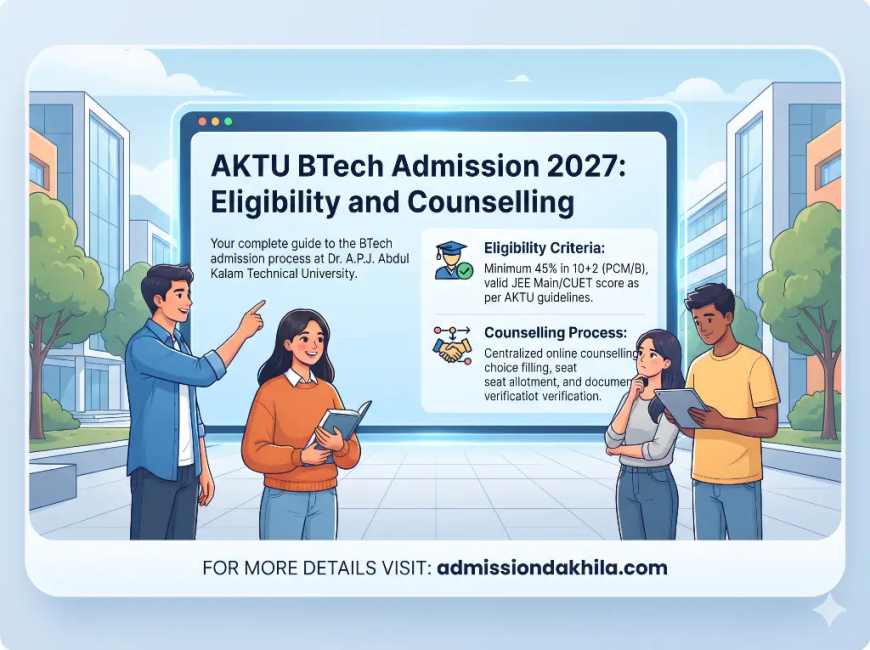
AKTU BTech Admission 2027: Eligibility and Counselling
1. Introduction to AKTU BTech Admission 2027
Engineering remains a popular career choice for students who want to work in software development, artificial intelligence, electronics, mechanical design, civil infrastructure, cybersecurity, data science and other technical fields. Uttar Pradesh offers a broad range of engineering colleges, including government institutions, aided colleges and private institutions affiliated with Dr. A.P.J. Abdul Kalam Technical University.
For students planning to begin an engineering degree in 2027, understanding AKTU BTech Admission 2027 is an important first step. The admission process generally involves checking eligibility, appearing for the applicable entrance examination, registering for counselling, selecting preferred colleges and branches, receiving a seat allotment and completing admission formalities.
UPTAC, or Uttar Pradesh Technical Admission Counselling, is the state-level counselling process associated with admissions to participating technical institutions. The official portal describes AKTU as the university responsible for UPTAC counselling and admissions to degree-level engineering institutions and other professional colleges in Uttar Pradesh.
Students should understand that university affiliation alone does not guarantee admission to a particular college. Eligibility, entrance examination rank, category, seat availability, college preferences and the rules of the applicable counselling round can all affect the final outcome.
This guide from Admission Dakhila explains how students can prepare for the 2027 admission cycle, what documents they may need and how to make informed college choices.
To apply for AKTU BTech Admission 2027, first check the official eligibility requirements and the accepted entrance examination route. Then register for the relevant Uttar Pradesh counselling process, enter your academic and examination details, select your preferred engineering colleges and branches, and follow the seat-allotment and admission instructions. Check the official UPTAC and AKTU announcements for confirmed dates and rules. For help exploring engineering colleges and admission options, visit Admission Dakhila at https://www.admissiondakhila.com.
2. What Is AKTU?
Dr. A.P.J. Abdul Kalam Technical University, commonly known as AKTU, is a state technical university in Uttar Pradesh. Formerly known as Uttar Pradesh Technical University (UPTU), it oversees academic and institutional functions across a large network of affiliated institutions.
AKTU-affiliated colleges offer professional programmes in engineering, management, pharmacy and other disciplines. BTech is one of the major undergraduate pathways for students seeking careers in engineering and technology.
What is UPTAC?
UPTAC stands for Uttar Pradesh Technical Admission Counselling. It coordinates admission counselling for eligible candidates seeking seats in participating institutions and programmes covered by its admission rules.
For BTech applicants, the official UPTAC entrance examination page has listed JEE Main as the principal examination route for regular counselling in recent admission cycles. Other routes, including CUET UG or Class 12 merit, have appeared in certain special-counselling arrangements in previous cycles. These provisions must not be assumed to apply unchanged in 2027.
Students should distinguish between three terms:
-
AKTU: The university responsible for the relevant academic and institutional framework.
-
UPTAC: The counselling and admission process for participating institutions.
-
JEE Main: The national engineering entrance examination whose applicable rank has been used for the main BTech counselling process.
Why consider AKTU-affiliated colleges?
AKTU-affiliated institutions may offer a variety of engineering specialisations, campus environments, fee structures and placement opportunities. However, colleges can differ considerably in teaching quality, laboratories, industry connections, student support and employment outcomes.
Before selecting a college, students should investigate the specific institution rather than relying only on the university name.
3. AKTU BTech Admission 2027: Important Dates
The official 2027 UPTAC counselling schedule and admission bulletin should be treated as the final authority for dates. The following table is a planning guide, not a confirmed timetable.
|
Admission activity |
Expected planning period |
|---|---|
|
JEE Main 2027 examination process |
As announced by NTA |
|
Class 12 examinations and results |
According to the relevant board |
|
UPTAC 2027 notification |
Await official announcement |
|
Counselling registration |
As announced in the schedule |
|
Document verification |
During the notified period |
|
College and branch choice filling |
According to counselling rounds |
|
Seat allotment and acceptance |
As published by UPTAC |
|
Reporting to allotted college |
Within the allotted deadline |
|
Special or vacant-seat rounds |
If officially announced |
The National Testing Agency's JEE Main website is the appropriate place to check examination notices, application updates and results. The UPTAC portal should be checked separately for counselling instructions.
Official links:
-
UPTAC official website
-
AKTU official website
-
JEE Main official website
Admission tip: Do not plan travel, make non-refundable hostel payments or assume a seat is secured based on unofficial dates. Wait for the applicable official notification and keep checking for revised deadlines.
4. AKTU BTech Admission 2027 Eligibility Criteria
Eligibility is one of the most important parts of the admission process. Candidates must satisfy the academic requirements and entrance examination conditions specified for the programme and admission category.
The precise requirements for 2027 must be confirmed through the applicable UPTAC information bulletin. The following explains the requirements used in recent BTech admission cycles.
4.1 Educational qualification
Candidates generally need to have passed Class 12 or an equivalent qualifying examination from a recognised board.
The usual subject combination for conventional BTech programmes includes:
-
Physics as a compulsory subject.
-
Mathematics as a compulsory subject.
-
An additional eligible subject, such as Chemistry, Computer Science, Biotechnology, Biology or an approved technical or vocational subject, as specified in the applicable rules.
The exact acceptable subject combinations can depend on the programme and official eligibility provisions. Candidates should not assume that any three Class 12 subjects automatically qualify them for every BTech branch.
4.2 Minimum qualifying marks
Recent UPTAC BTech admission information has used a minimum of 45% aggregate marks for general-category candidates and 40% for eligible reserved-category candidates in the qualifying examination, subject to the specified subject requirements. Candidates must verify the precise calculation and applicable category provisions in the 2027 bulletin.
These are eligibility thresholds, not guaranteed admission cutoffs. A student who meets the minimum marks requirement may still need a competitive entrance examination rank to obtain a preferred college or branch.
4.3 JEE Main requirement
JEE Main has been the principal entrance examination for regular UPTAC BTech counselling in recent cycles. Students planning for 2027 should register for the applicable JEE Main session, prepare for the examination and retain their application and score details.
The counselling authority determines which examination results, ranks and categories are accepted. A valid JEE Main score alone does not complete the admission process; candidates must also satisfy programme eligibility and counselling requirements.
4.4 Age limit
Do not assume that an age restriction applies simply because one exists for another entrance examination or course. Check the 2027 UPTAC bulletin for any applicable age-related conditions and the rules governing the qualifying examination.
4.5 Eligibility for candidates from outside Uttar Pradesh
Students from other states should review the current domicile, seat-allocation and category provisions before applying.
Eligibility to participate in counselling does not necessarily mean that a candidate will receive the same reservation benefits or access to every seat category as a candidate meeting Uttar Pradesh domicile requirements. Some documents may be required from the candidate or their parents, depending on the rules.
4.6 Eligibility checklist
Before registering, verify that you:
-
Have the required Class 12 qualification.
-
Meet the subject combination and minimum marks requirements.
-
Have the accepted entrance examination result, where required.
-
Can provide authentic academic and identity documents.
-
Have the appropriate category or domicile documents, if applicable.
-
Understand the rules for the specific college and programme you intend to select.
5. Entrance Examinations and Admission Routes
JEE Main 2027
JEE Main is the main examination that engineering aspirants should prioritise when preparing for conventional BTech admission through regular UPTAC counselling.
The examination assesses Physics, Chemistry and Mathematics. Preparation should focus on conceptual understanding, numerical problem-solving, time management, practice papers and revision.
Students should use the official NTA information bulletin to confirm the 2027 syllabus, examination pattern, eligibility rules, application deadlines and result procedures.
Can students get AKTU BTech admission without JEE Main?
This is a common question among students who are preparing for Class 12 examinations or have not obtained their expected JEE Main result.
The answer depends on the admission route officially permitted for the relevant year and counselling round. Previous UPTAC materials have included alternative examination or qualifying-examination merit routes for certain special counselling arrangements. That does not establish a guaranteed direct-admission route for 2027.
Students should therefore:
-
Check the latest UPTAC BTech entrance-examination table.
-
Read the current admission bulletin.
-
Confirm whether an alternative route is officially permitted.
-
Check whether the route applies to their intended college, branch and category.
-
Avoid paying intermediaries who promise a guaranteed seat without following the official process.
Direct admission versus counselling-based admission
The term “direct admission” is sometimes used in advertisements for private colleges. Its meaning may vary: it could refer to institutional assistance, admission to a seat under a permitted category, or an informal claim that a student can bypass normal rules.
Students should ask the college for written confirmation of the admission route, eligibility requirements, total fees and applicable regulatory approvals. Any admission must comply with the rules applicable to that institution and programme.
6. AKTU BTech Admission Process 2027
The admission process can be understood as a sequence of steps. Exact dates, payment amounts, round names and portal instructions will be determined by the official 2027 schedule.
Step 1: Complete the entrance examination process
Register for JEE Main 2027 through the official NTA portal if your intended admission route requires it. Enter your details carefully, check the examination instructions and save your confirmation page.
Step 2: Review your result and eligibility
After the result is published, note your rank and other relevant examination details. Review the UPTAC eligibility conditions and assess which institutions and branches might be realistic options.
Do not confuse percentile, raw marks and rank. Different colleges and counselling rounds may use different ranking information or eligibility rules.
Step 3: Register for UPTAC counselling
When registration opens, visit the official portal announced for the 2027 session. Complete the registration form, enter your academic information and upload documents in the required format.
Pay the prescribed fee through the authorised payment gateway and retain the receipt. Registration does not itself guarantee a seat.
Step 4: Complete document verification
Submit the requested information and documents within the prescribed period. If the portal raises a query, respond promptly and follow the instructions.
Names, dates of birth, marks, category information and other details should match the supporting records. Discrepancies may delay verification.
Step 5: Fill college and branch choices
Review participating colleges and their available BTech branches. Prepare a ranked list based on your genuine preferences, budget, location, academic interests and likely admission prospects.
Where required, lock your choices before the deadline.
Step 6: Check seat allotment
After a counselling round, log in to the official portal to check whether a seat has been allotted. Read the instructions for accepting, freezing, floating, upgrading or withdrawing, depending on the options offered in that round.
Step 7: Pay the required fee and complete reporting
If you accept an allotment, complete the required payment and verification steps within the deadline. Follow the official instructions for online or physical reporting to the allotted institution.
Step 8: Confirm final admission
Ask the college for a fee receipt and confirmation of your admission status. Check reporting instructions, original-document requirements, hostel availability and the academic calendar.
Do not consider admission complete merely because a college appears in a provisional allotment result.
7. UPTAC Counselling 2027 Explained
UPTAC counselling is the process through which eligible applicants compete for available seats at participating institutions under the applicable admission rules. Understanding the process before registration helps students avoid last-minute errors.
The current official UPTAC website provides admission information, examination-route details, information bulletins and counselling procedures from previous cycles. Candidates should use the 2027 documents when they become available rather than treating an older brochure as the final authority.
7.1 Online registration
During the notified registration window, candidates create or access their counselling account, provide the required details and complete payment.
Students should use their own valid contact details and maintain access to the registered mobile number and email address. Save login information securely and do not share passwords or one-time passwords with agents.
7.2 Document upload and verification
Depending on the portal instructions, students may need to upload scanned documents, enter marks or respond to verification queries.
Before submission, check that:
-
The uploaded files are readable.
-
All pages are included.
-
Names and dates match the original records.
-
Category certificates meet the required format and validity rules.
-
Any correction requested by the authority is completed before the deadline.
7.3 Choice filling and locking
Candidates select eligible colleges and branches from the available list. They should rank their choices in genuine preference order rather than simply copying another student's list.
If the system requires choice locking, complete it before the deadline. An unsubmitted or unlocked choice list may not be considered in the intended way.
7.4 Seat allotment
Seat allotment depends on the rules applicable to the round, including factors such as rank, category, seat availability, reservation provisions and candidate preferences.
A college's previous-year closing rank is useful for planning, but it is not a promise of the same result in 2027.
7.5 Seat acceptance and subsequent rounds
The counselling authority may offer options such as freezing an allotted seat or participating in further rounds for possible upgradation. The names, availability and consequences of these options must be checked in the current instructions.
Candidates should understand the fee, withdrawal, refund and reporting rules before accepting or surrendering a seat.
7.6 Special counselling rounds
Vacant seats may be addressed through additional or special rounds if announced by the authority. Eligibility and registration arrangements can differ from the main counselling rounds.
Do not assume that students who missed the regular registration deadline will automatically be eligible for a special round. Check the published notice for the exact conditions.
8. How to Register for AKTU BTech Counselling 2027
The following practical walkthrough can help candidates prepare for registration.
Before opening the application form
Keep the following information accessible:
-
Class 10 and Class 12 academic records.
-
JEE Main application and result details, where applicable.
-
A valid mobile number and email address.
-
A recent photograph and signature, if requested.
-
Category, domicile or other supporting certificates, where applicable.
-
An accepted payment method.
During registration
Open the official counselling portal linked from the current UPTAC website. Check that the page relates to the correct academic session.
Enter your personal details exactly as requested. Review each field before proceeding, especially examination numbers, marks, category and domicile details.
Upload documents according to the specified file type and size limits. Complete payment only through the official portal and download the acknowledgement.
After registration
Save your application number and payment receipt. Check the portal regularly for verification queries, choice-filling announcements, revised schedules and allotment results.
If the application contains a mistake, follow the official correction procedure. Do not create multiple registrations unless the authority specifically instructs you to do so.
Official reference: UPTAC portal
9. Choice Filling: How to Select Colleges and Branches
Choice filling is one of the most important decisions in the counselling process. A candidate can have a reasonable entrance examination rank but still miss a suitable option by entering too few choices or ranking them poorly.
9.1 Identify your preferred engineering branch
Start by identifying the subjects and work environments that interest you.
|
BTech branch |
Areas of study and potential career paths |
|---|---|
|
Computer Science and Engineering |
Software, systems, programming and computing |
|
Artificial Intelligence and Machine Learning |
Intelligent systems, model development and applied AI |
|
Information Technology |
Applications, networks, databases and enterprise technology |
|
Electronics and Communication Engineering |
Circuits, communication systems and embedded technology |
|
Electrical Engineering |
Power systems, electrical machines and automation |
|
Mechanical Engineering |
Manufacturing, design, materials and mechanical systems |
|
Civil Engineering |
Construction, transportation and infrastructure |
|
Chemical Engineering |
Industrial processes, materials and chemical production |
Branch names, specialisations and seat availability vary by institution. Review the actual curriculum rather than selecting a programme based only on a fashionable title.
9.2 Research individual colleges
Before adding a college to your preference list, investigate:
-
Accreditation and applicable approvals.
-
University affiliation and programme recognition.
-
Faculty qualifications and teaching arrangements.
-
Laboratories, workshops and computing facilities.
-
Internship support and industry connections.
-
Recent placement reports and their methodology.
-
Annual tuition, hostel charges and other compulsory expenses.
-
Distance from home and transport options.
-
Student support, safety and campus facilities.
An institution's marketing material can provide an introduction, but students should cross-check important claims and seek written details.
9.3 Use a balanced preference strategy
A sensible preference list can contain three groups:
Ambitious options: Colleges or branches that may be difficult to secure at your rank but remain worth considering.
Realistic options: Institutions where your rank appears reasonably competitive based on available historical information.
Backup options: Acceptable colleges and branches that provide an alternative if your preferred choices remain unavailable.
These groups are planning tools, not official categories. Admission outcomes can change because of seat availability, applicant preferences and counselling rules.
9.4 Rank choices honestly
If you prefer College A over College B, normally place A higher, provided you are willing and eligible to accept the seat. Do not place a less-preferred option above your actual favourite simply because someone predicts a better chance of allotment.
Read the current choice-filling rules carefully to understand how preferences are processed and how any upgrade options work.
10. AKTU BTech Seat Allotment, Acceptance and Upgradation
Seat allotment matches eligible candidates with available seats according to the applicable counselling algorithm and rules.
How is a seat allotted?
The process generally considers the candidate's relevant rank, applicable category and reservation provisions, available seats, eligibility and ordered preferences. The precise priority rules are defined by the official counselling authority.
For example, two candidates may prefer the same computer science branch at the same college. Their outcomes may differ because of their relative ranks, category, seat pool and other applicable rules.
What should you do after allotment?
First, read the allotment result carefully. Confirm the college name, programme, reporting deadline and any required payment.
Then decide among the options permitted by the current round. Understand the implications of freezing a seat, requesting an upgrade or withdrawing, where these options are available.
Can you change your college after allotment?
A candidate may have an opportunity to seek an upgrade or participate in a later round, depending on the official rules and the candidate's status. Such an opportunity is not guaranteed.
Before taking action, check whether the allotted seat will be retained, whether the next round changes your commitment, and whether any fee is refundable.
What if you do not get your preferred college?
Review the remaining counselling opportunities and any officially announced vacant-seat process. Reassess your college and branch preferences without compromising on essential requirements such as recognition, affordability and academic suitability.
If you consider admission outside the central counselling route, verify that the college's proposed procedure is permitted and that your admission will be properly documented.
11. Documents Required for AKTU BTech Admission 2027
The final document list will be specified by the official counselling bulletin and the allotted institution. Candidates should prepare common documents early to avoid delays.
|
Document |
Why it may be required |
|---|---|
|
Class 10 marksheet or certificate |
Date of birth and academic record |
|
Class 12 marksheet |
Qualifying examination and subject details |
|
Class 12 passing certificate |
Evidence of qualification, where requested |
|
JEE Main scorecard or rank details |
Entrance examination verification |
|
JEE Main admit card |
Supporting examination record, if requested |
|
Counselling registration and allotment documents |
Proof of application and seat allocation |
|
Government-issued photo ID |
Identity verification |
|
Recent passport-size photographs |
Admission and institutional records |
|
Category certificate |
Reservation claim, if applicable |
|
EWS certificate |
EWS claim, if applicable |
|
Domicile or residence documents |
Applicable state or regional eligibility |
|
PwD certificate |
Disability-related provisions, if applicable |
|
Migration or transfer certificate |
As required by the institution |
|
Character certificate |
As required by the institution |
|
Payment receipts |
Evidence of completed payments |
Important document precautions
A certificate issued in an incorrect format, an expired document or a mismatch in personal details can create verification problems.
Candidates claiming a reserved category should check the relevant issuing authority, certificate format and validity conditions. Do not assume that every certificate accepted by another examination authority will automatically be accepted for UPTAC.
Students whose qualifying examination was completed outside Uttar Pradesh should carefully review the domicile and documentation provisions applicable to their circumstances.
Keep both digital copies and original documents ready. Never submit false marksheets, altered certificates or misleading category information.
12. Reservation and Category-Based Considerations
Reservation provisions can affect eligibility, seat allocation and the documents required for counselling. The applicable rules depend on the current admission bulletin, institution type, seat category and relevant state or national provisions.
Candidates may encounter categories such as SC, ST, OBC, EWS and PwD, depending on the applicable rules.
Who should claim reservation benefits?
Candidates should claim a category only when they meet the applicable conditions and can provide the required evidence. Check whether a certificate must follow a state-specific format or meet a particular issue-date requirement.
Are all reservation benefits available to students from other states?
Not necessarily. State domicile, category recognition and seat-allocation rules can affect which benefits apply. Students from outside Uttar Pradesh should not assume that a certificate issued by their home state automatically qualifies them for every Uttar Pradesh state-reserved seat.
Can a reservation certificate be corrected later?
Correction opportunities depend on the applicable process and deadlines. Candidates should not rely on a future correction window to repair missing or invalid documents.
For accurate guidance, consult the official information bulletin and, where necessary, contact the counselling helpdesk.
13. AKTU BTech Fees and Scholarships
The cost of a BTech degree can vary substantially between institutions. Government, aided and private colleges may have different fee structures, while hostel accommodation and personal expenses can increase the total cost.
There is no single tuition figure that accurately represents every AKTU-affiliated BTech college.
What expenses should students consider?
A realistic budget should include:
-
Tuition and academic fees.
-
Registration or admission-related charges.
-
Examination and university-related fees.
-
Laboratory or other compulsory charges, where applicable.
-
Hostel accommodation and mess expenses.
-
Books, equipment, software and stationery.
-
Transport and daily living costs.
-
Internship, project or other programme-related expenses.
Ask each college for a written breakdown of compulsory charges and clarify whether any listed fees are refundable.
Scholarships and financial assistance
Eligible students may be able to apply for scholarships or fee assistance offered by government departments, institutions or other authorised bodies. Availability depends on the scheme's eligibility conditions, family income criteria, academic requirements, category provisions and application deadlines.
Students should check official Uttar Pradesh scholarship information and ask their institution which schemes apply to their programme.
Do not assume that meeting the academic eligibility criteria automatically guarantees a scholarship. Some schemes require a separate application, document verification and approval.
How to compare colleges by cost
Compare the full expected cost of completing the degree rather than just the first-year tuition. A college with lower tuition may involve higher accommodation or commuting expenses. Another institution may offer financial assistance, but eligibility and renewal conditions must be confirmed.
Admission Dakhila can be used as a starting point for exploring engineering college options. Final fee decisions should be based on current, written information from the college and relevant official authorities.
14. How to Choose the Best AKTU-Affiliated BTech College
The best college for one student may not be the best choice for another. The right decision balances academic quality, career objectives, affordability, location and personal preferences.
Academic quality
Investigate the curriculum, laboratory access, faculty availability and frequency of practical projects. Engineering requires more than completing written examinations; students need opportunities to develop technical and problem-solving skills.
Placement transparency
Review the latest placement report available from the institution. Look for the number of eligible students, the number placed, median compensation where published, the definition of the highest package and the range of recruiting companies.
A headline placement package does not describe the experience of every graduate. Ask whether the published figures cover all branches or only selected programmes.
Infrastructure and learning environment
Check whether students have access to functioning laboratories, libraries, internet facilities, project spaces and relevant technical equipment.
For specialised branches such as electronics, mechanical engineering or civil engineering, the quality and availability of practical facilities can be especially important.
Location and accessibility
Consider transport, accommodation, safety, healthcare access and proximity to internships or industrial areas. Living expenses can affect the total cost of studying.
Institutional recognition
Verify the institution's current affiliation and the applicable programme approvals through reliable official records. Do not rely solely on an advertisement or an old brochure.
Student feedback
Speak with current students and recent graduates when possible. Ask about teaching consistency, attendance rules, internship support, campus recruitment, examination arrangements and grievance handling.
15. Common Mistakes to Avoid During UPTAC Counselling
Many avoidable errors occur because students wait until the last moment or depend on unverified information.
Mistake 1: Ignoring official notifications
Old counselling dates and previous-year eligibility criteria can become outdated. Always check the current session's bulletin.
Mistake 2: Registering too late
A missed deadline may prevent participation in a regular round. Set reminders for registration, verification, choice locking, payments and reporting.
Mistake 3: Filling too few choices
A very short preference list can reduce the number of acceptable outcomes available to you. Consider a broader selection of eligible colleges and branches that you would genuinely attend.
Mistake 4: Selecting a branch without research
Do not select a programme solely because it is associated with a popular technology trend. Read the syllabus and consider whether the subject aligns with your interests and abilities.
Mistake 5: Assuming last year's cutoff will repeat
Previous-year closing ranks provide context, not a guarantee. Demand, seat capacity, applicant preferences and category-wise competition may change.
Mistake 6: Uploading incorrect documents
Check certificate formats, file readability and personal details before submission. Respond to verification queries within the specified period.
Mistake 7: Paying an unauthorised agent
Use official portals for registration and counselling payments. Do not share passwords or OTPs, and demand written documentation for any payment made directly to a college.
Mistake 8: Misunderstanding the upgrade process
Before freezing, floating or withdrawing, understand the consequences under the current rules. Never assume that a better seat is guaranteed in a subsequent round.
Mistake 9: Ignoring the total cost
Include hostel, food, travel, examination and other compulsory expenses in your financial plan.
Mistake 10: Missing physical reporting
If the allotment instructions require reporting to a college, complete it within the specified deadline and carry the required original documents.
16. Career Opportunities After BTech
BTech graduates can pursue employment, postgraduate study, research, entrepreneurship and government-sector opportunities, depending on their qualifications and interests.
Computer Science and Information Technology
Potential roles include software developer, systems engineer, cybersecurity analyst, cloud engineer, data analyst and IT support specialist. Relevant programming skills, practical projects and internships can strengthen a graduate's profile.
Artificial Intelligence and Data Science
Students may pursue roles involving data preparation, model development, machine learning applications, analytics and intelligent systems. Employers often look for sound mathematical understanding, programming skills and evidence of practical work.
Electronics and Electrical Engineering
Possible paths include electronics design, embedded systems, power systems, industrial automation, testing and telecommunications. Relevant laboratories, internships and technical certifications can support career development.
Mechanical and Civil Engineering
Mechanical graduates may work in design, manufacturing, quality assurance, maintenance or production. Civil engineering graduates may pursue construction, structural design, infrastructure, transportation and project-management roles, subject to job requirements.
Higher education
Graduates can consider MTech, specialised postgraduate programmes, management education, research or other relevant qualifications. Entrance examinations and admission criteria depend on the programme and institution.
Government examinations
Engineering graduates may explore eligible technical recruitment examinations, public-sector opportunities and other government recruitment processes. Eligibility differs by post, discipline, age and examination rules.
Career advice: A degree provides the foundation, but practical skills, communication, internships, projects and continuous learning influence professional opportunities. Choose a college that helps you build these capabilities.
17. How Admission Dakhila Can Help Students
Admission Dakhila is an education information platform that students can use to explore colleges, admission processes and academic opportunities.
For students preparing for AKTU BTech Admission 2027, a structured research approach can make it easier to compare institutions and organise application tasks.
Students can use Admission Dakhila to explore relevant admission information and investigate engineering college options.
How to use Admission Dakhila effectively
-
Identify your preferred engineering branches.
-
Explore colleges that offer the programmes you want.
-
Compare location, published fees, facilities and available placement information.
-
Shortlist institutions that fit your academic goals and budget.
-
Verify admission requirements and fee details with official sources before making a decision.
-
Keep track of application and counselling deadlines using the official notifications.
Admission Dakhila should complement—not replace—the official counselling authority. The final eligibility decision, seat allotment, payment instructions and admission deadlines must be confirmed through the relevant official portal.
Why early planning matters
Students who begin research early can compare more colleges, prepare documents, discuss finances with their families and avoid rushed choices. They can also identify alternative branches and institutions before the counselling window opens.
The objective is not simply to obtain any seat. It is to find an eligible, affordable and suitable engineering programme that supports the student's long-term goals.
18. Frequently Asked Questions (FAQs)
The following FAQs are written to answer common search queries directly. They can also support the article's FAQ section and help readers find specific information quickly.
1. What is AKTU BTech Admission 2027?
AKTU BTech Admission 2027 refers to the process through which eligible students seek admission to participating BTech programmes associated with AKTU and the relevant Uttar Pradesh counselling process. Candidates must follow the applicable entrance examination, eligibility, registration and seat-allotment rules.
2. What is the eligibility for AKTU BTech Admission 2027?
Candidates generally need to pass Class 12 with Physics and Mathematics as compulsory subjects and satisfy the additional subject and minimum-mark requirements specified in the official bulletin. Recent cycles have used 45% aggregate marks for general-category candidates and 40% for eligible reserved-category candidates, but the 2027 rules must be verified.
3. Is JEE Main compulsory for AKTU BTech admission?
JEE Main has been the principal route for regular UPTAC BTech counselling in recent cycles. Whether any alternative route is available depends on the official rules for the 2027 admission session and the relevant counselling round.
4. How can I apply for UPTAC counselling 2027?
Candidates should visit the official UPTAC website, open the portal designated for the 2027 session, register during the notified window, provide the required information, complete document verification and follow the choice-filling and seat-allotment instructions.
5. When will AKTU BTech counselling 2027 begin?
The confirmed dates should be taken from the official 2027 UPTAC counselling schedule. Students should monitor the official website rather than rely on projected dates published without an official notice.
6. Can students from outside Uttar Pradesh apply for AKTU BTech admission?
Students from outside Uttar Pradesh may be eligible under the applicable admission rules, but domicile, reservation and seat-category provisions can differ. Applicants should check the current bulletin and prepare any required parent-domicile or other supporting documents.
7. What documents are required for AKTU BTech counselling?
Common documents include Class 10 and Class 12 records, JEE Main details where applicable, identity proof, counselling registration documents, photographs and relevant category or domicile certificates. The final list depends on the official bulletin and the candidate's circumstances.
8. How are seats allotted in UPTAC counselling?
Seats are allotted according to the applicable counselling rules, relevant rank, candidate preferences, category and reservation provisions, eligibility and seat availability. The precise process and any changes must be checked in the current year's official instructions.
9. What should I do if I do not get my preferred BTech college?
Review subsequent counselling rounds and officially announced vacant-seat opportunities, if eligible. You can also reassess your college and branch preferences, compare the available options and verify that any alternative admission route is authorised.
10. Where can I find information about AKTU BTech colleges and admission?
Students should consult the official UPTAC website for counselling information and the AKTU website for university information. They can also explore college and admission information through Admission Dakhila, while verifying final decisions and fees with the relevant official authorities.
19. Conclusion: Prepare for AKTU BTech Admission 2027 with the Right Strategy
AKTU BTech Admission 2027 is an important opportunity for students who want to pursue engineering in Uttar Pradesh. A successful admission journey requires more than meeting the minimum eligibility criteria. Students should understand the entrance examination requirements, prepare their documents, register for counselling on time, compare colleges carefully and make informed decisions during choice filling and seat allotment.
The most important step is to rely on official information. Confirm the eligibility requirements, accepted examination routes, registration dates, reservation provisions, counselling fees and seat-acceptance rules through the relevant 2027 notifications. Do not assume that previous-year policies or unofficial admission promises will apply to the next session.
Students should also consider the long-term value of their engineering education. Compare academic quality, practical facilities, internship opportunities, placement transparency, total fees and location before finalising a college.
Admission Dakhila can help students explore engineering colleges, research admission options and organise their college shortlists. Visit https://www.admissiondakhila.com to begin researching your options for the 2027 admission session.
Start early, keep your documents ready, monitor official announcements and choose a college that aligns with your academic interests, career goals and budget. A well-planned approach can help you navigate the counselling process with greater confidence.