BBA Entrance Exams in India for 2027: Complete Guide to Exams, Eligibility, Dates, Syllabus, Fees and Admission
The major entrance examinations for Bachelor of Business Administration (BBA) and related undergraduate management programmes in India include CUET-UG, IPMAT, SET, NPAT, Christ University entrance or selection assessments, and other university-specific admission tests. The appropriate examination depends on the university, programme and admission route selected by the student.
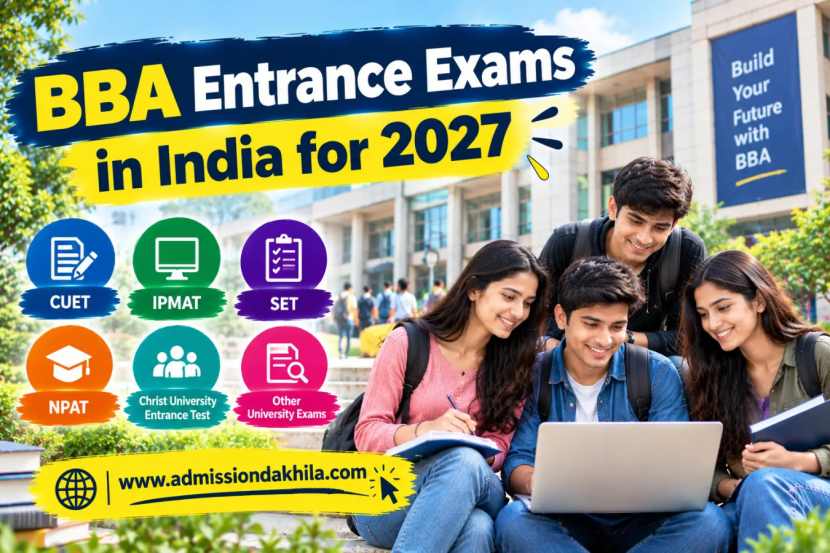
Students who have completed or are appearing for Class 12 can explore these options, subject to each institution's eligibility requirements. Most entrance tests assess some combination of quantitative aptitude, logical reasoning, English language skills and general awareness. Integrated management entrance exams may also include verbal ability and higher-level mathematics.
For BBA admission in 2027, students should shortlist colleges, verify official eligibility criteria, check application deadlines and prepare for the relevant examination. Admission Dakhila can help students explore BBA colleges, compare admission options and understand the application process.
If you are planning to pursue a BBA in India in 2027, consider CUET-UG for participating universities, SET for eligible programmes at Symbiosis institutes, NPAT for relevant NMIMS programmes, and IPMAT if you are interested in an integrated management programme at IIMs or other participating institutions. Christ University and several other universities also have their own selection procedures.
First, identify your preferred colleges and then check which entrance examination each college accepts. You can visit **Admission Dakhila at https://www.admissiondakhila.com** to explore BBA admission information and compare suitable options.
BBA Entrance Exams in India for 2027
1. Introduction to BBA Entrance Exams in India for 2027
Choosing the right undergraduate course after Class 12 is an important decision for students who want to build a career in business, management, marketing, finance, entrepreneurship or corporate leadership. The Bachelor of Business Administration (BBA) is one of the popular undergraduate options for students interested in developing business knowledge and managerial skills.
BBA programmes introduce students to essential business concepts, including accounting, economics, organisational behaviour, marketing, human resource management, business communication and financial management. Depending on the university, students may also explore emerging specialisations such as digital marketing, business analytics, international business, logistics and entrepreneurship.
For admission in the 2027 academic session, students can explore several entrance examinations conducted by national testing agencies, universities, private institutions and management schools. Some universities accept a common entrance test score, while others conduct their own tests or select applicants through a combination of academic marks, aptitude assessments, interviews and other criteria.
The most suitable exam depends on your preferred college and programme. For example, CUET-UG may be relevant for participating universities, SET for selected Symbiosis programmes, NPAT for eligible NMIMS programmes, and IPMAT for certain five-year integrated management courses. These examinations are not interchangeable, and eligibility must be checked separately for every programme.
Students preparing for the 2027 intake should begin by researching colleges, understanding the examination pattern, preparing a realistic study schedule and tracking official application announcements.
Admission Dakhila can support this research process by helping students discover BBA colleges, understand admission routes and compare institutions according to their academic preferences, location, budget and career goals.
Why should students prepare for BBA entrance exams early?
Early preparation offers several advantages:
-
More time to strengthen quantitative aptitude and English.
-
Opportunities to practise reasoning and data interpretation.
-
Time to compare multiple universities and examination requirements.
-
Better preparation for interviews and selection rounds.
-
Fewer missed deadlines and application mistakes.
-
More time to evaluate tuition fees, accommodation and other costs.
A good entrance examination score can improve admission opportunities at participating institutions, but it does not automatically guarantee admission. Final selection may depend on eligibility, seat availability, category rules, interviews, merit lists and university-specific criteria.
2. What Is a BBA Entrance Exam?
A BBA entrance exam is an assessment used by a university or institution to evaluate applicants seeking admission to a Bachelor of Business Administration or a related undergraduate management programme.
These examinations commonly assess numerical ability, logical thinking, English language proficiency and analytical skills. Depending on the test, questions may also cover general awareness, data interpretation, reading comprehension and business-related aptitude.
The purpose is to evaluate whether applicants have the academic foundation and problem-solving ability required for undergraduate management studies.
Types of BBA entrance examinations
National-level examinations: These are conducted for admission to participating institutions across different states. CUET-UG is a major example.
University-level examinations: Individual universities or university groups conduct tests for their own programmes. Examples include SET and NPAT for relevant programmes.
Integrated management entrance examinations: These tests are intended for five-year or other integrated management programmes that combine undergraduate study with advanced management education. Examples include IPMAT and JIPMAT.
State-level examinations: Some states conduct common entrance examinations for participating colleges. Maharashtra's BBA/BMS-related CET process is an example, subject to the applicable admission notification.
Institute-specific assessments: Certain institutions use their own entrance tests, interviews, aptitude assessments or a combination of selection methods.
BBA versus integrated management programmes
Students should distinguish between a standard BBA and a five-year integrated management programme.
A conventional BBA generally lasts three or four years, depending on the university's structure and applicable curriculum framework. It provides an undergraduate business education and may offer honours, research or specialisation options.
An integrated management programme usually combines undergraduate-level studies with postgraduate management education. It may award qualifications at different stages according to the institution's rules and the programme structure.
For students interested in an IIM-style management pathway directly after Class 12, IPMAT and JIPMAT can be particularly relevant. However, these exams are not admission tests for every BBA college.
3. List of Top BBA Entrance Exams in India for 2027
The following examinations and selection routes are worth researching for the 2027 admission cycle. The programmes available through each test may change, so students must confirm the current participating institutions and course-specific requirements.
3.1 CUET-UG 2027
The Common University Entrance Test for Undergraduate Programmes, commonly called CUET-UG, is conducted by the National Testing Agency (NTA).
It provides an admission route for participating central universities and other participating institutions that use CUET-UG scores for undergraduate selection. Some universities offer BBA or related management programmes through this route.
Who should consider CUET-UG?
Students who want to apply to several participating universities should investigate CUET-UG before choosing their examination subjects.
Important points:
-
Check whether your target university offers BBA through CUET-UG.
-
Verify the required language and domain subjects.
-
Review the university's course-specific eligibility requirements.
-
Check how the institution calculates merit and whether additional criteria apply.
-
Apply separately to participating universities when their admission process requires it.
The NTA's official CUET portal publishes information bulletins, registration notices, examination updates and related documents. Students should use the official portal rather than relying exclusively on third-party date predictions.
3.2 IPMAT Indore 2027
The Integrated Programme in Management Aptitude Test conducted by the Indian Institute of Management Indore is designed for admission to its five-year Integrated Programme in Management, subject to the applicable admission rules.
The programme is intended for students who want to enter an integrated management pathway after school.
The examination has historically assessed quantitative ability and verbal ability, with multiple-choice and short-answer components in its quantitative sections. Candidates should consult the 2027 admission procedure for the final pattern and eligibility requirements.
Why consider IPMAT Indore?
-
It provides a route into an integrated management programme at IIM Indore.
-
It suits students who want to begin management education after Class 12.
-
It tests both mathematical and verbal aptitude.
-
Admission involves meeting the published eligibility criteria and selection requirements.
The 2026 admission procedure illustrates why applicants must check details such as qualifying examination requirements, age conditions and application deadlines instead of assuming they remain identical in 2027.
3.3 IPMAT Rohtak 2027
IPMAT Rohtak is associated with admission to the five-year Integrated Programme in Management at IIM Rohtak.
Students interested in this route should review the institute's current notification to confirm the accepted qualifying qualifications, age conditions, examination format and selection procedure.
Preparation may involve:
-
Quantitative aptitude.
-
Logical reasoning.
-
English language skills.
-
Time management.
-
Interview preparation, if included in the applicable selection process.
Do not assume the IPMAT Indore and IPMAT Rohtak formats are identical. Candidates should prepare according to the specific examination they intend to take.
3.4 JIPMAT 2027
The Joint Integrated Programme in Management Admission Test, or JIPMAT, is associated with admission to the integrated management programmes at participating institutions, including IIM Jammu and IIM Bodh Gaya, subject to their current admission policies.
JIPMAT is relevant for students interested in management education directly after Class 12.
Applicants should review:
-
The official eligibility criteria.
-
The prescribed examination syllabus.
-
The marking scheme and test duration.
-
The participating institutions for the relevant admission year.
-
The admission and counselling process after the results.
3.5 Symbiosis Entrance Test (SET) 2027
The Symbiosis Entrance Test, commonly known as SET, is used for admission to eligible undergraduate programmes offered by participating Symbiosis institutes.
Students interested in BBA programmes at institutions such as Symbiosis Centre for Management Studies should confirm which test and selection rounds apply to their chosen campus and programme.
SET preparation commonly includes English, quantitative aptitude, logical reasoning and general awareness, although the exact pattern should be checked against the applicable year's official bulletin.
Why consider SET?
-
It provides an entrance route for relevant Symbiosis undergraduate programmes.
-
It can suit students who want a private university management education.
-
It encourages preparation across several aptitude areas.
-
Some programmes may include additional selection requirements beyond the entrance score.
3.6 NMIMS NPAT 2027
The National Test for Programmes After Twelfth, known as NPAT, is associated with admission to eligible undergraduate programmes at NMIMS.
Depending on the current programme list, NPAT may be relevant to BBA and related business or management degrees. Students should verify campus-wise availability because the programmes offered and their admission requirements may differ.
Key points to consider:
-
Check the exact programme name and campus.
-
Review the eligibility criteria for your qualifying examination.
-
Confirm registration, examination windows and attempt rules.
-
Read the official instructions regarding score validity and selection.
-
Compare programme fees and other expenses before applying.
3.7 Christ University Entrance and Selection Process 2027
Christ University offers undergraduate programmes through its published admissions and selection procedures. The applicable assessment may include an entrance test, skill assessment, micro presentation, personal interview or other components, depending on the programme and admission cycle.
Students should not assume every Christ undergraduate course uses an identical selection process.
Before applying, check the exact BBA specialisation, campus, application round, qualifying requirements and components of the selection process.
Preparation suggestions:
-
Practise English comprehension and communication.
-
Revise basic mathematics and reasoning.
-
Develop confidence in interviews.
-
Learn to explain why you want to study business management.
-
Read about current business and economic developments.
3.8 AIMA UGAT 2027
The Under Graduate Aptitude Test, commonly called UGAT, is conducted by the All India Management Association for eligible undergraduate programmes at participating institutions.
Depending on the participating institute and current admission rules, UGAT scores may be accepted for BBA and other undergraduate programmes.
Students should confirm whether their target college accepts the score in 2027 and whether a separate institutional application is necessary.
Useful preparation areas can include English, numerical and data-related aptitude, reasoning and general awareness, according to the applicable test pattern.
3.9 MAH BBA/BMS CET 2027
Students targeting participating management colleges in Maharashtra should investigate the state's applicable common entrance test and admission process for undergraduate management programmes.
The exact examination name, participating courses, eligibility and centralised admission procedure should be confirmed in the official 2027 notification.
This route may be particularly relevant to students considering colleges in Mumbai, Pune and other parts of Maharashtra.
Applicants should review domicile or candidature rules where applicable, as well as reservation requirements, registration steps and counselling instructions.
3.10 IPU CET and GGSIPU Admission Routes
Guru Gobind Singh Indraprastha University and its affiliated institutions offer undergraduate programmes through the admission routes specified for each course.
Depending on the programme and the applicable admission-year rules, selection may use a university entrance test, a national examination score or another recognised route.
Students looking at BBA colleges in Delhi NCR should verify:
-
The exact admission route for BBA in 2027.
-
The list of participating or affiliated institutions.
-
The programme-specific eligibility requirements.
-
The counselling and seat-allocation procedure.
-
Whether a separate application or registration is required.
3.11 UPESMET-UG 2027
UPES publishes an undergraduate management entrance route known as UPESMET-UG for eligible BBA and integrated BBA-MBA programmes.
Its published 2027 admission information identifies UPESMET-UG and lists other possible selection routes, including UGAT, CUET-UG and board marks, subject to the programme's eligibility and selection criteria. The institution also provides information about the online examination process.
Students considering UPES should confirm which routes are available for their chosen programme, what minimum marks are required, and whether a particular entrance test can be waived.
3.12 Other University-Specific BBA Tests
Several universities and private institutions use their own admission assessments or selection procedures. Depending on the programme and current rules, students may also research institutions such as Bennett University, MIT-WPU, Ashoka University and other universities offering business-related undergraduate degrees.
A university may use an aptitude test, academic merit, an interview or a combination of criteria. Some programmes accept national test scores, while others require a separate application.
Always confirm that the programme leads to the qualification you want and that the institution is appropriately recognised or authorised to award it.
4. Comparison of Major BBA Entrance Exams
The table below is a practical starting point for building your examination shortlist. It describes broad admission routes rather than guaranteeing admission to any particular college.
|
Entrance exam |
Main admission route |
Best suited for |
|---|---|---|
|
CUET-UG |
Participating universities |
Students applying to multiple CUET-accepting universities |
|
IPMAT Indore |
IIM Indore integrated management programme |
Students targeting a five-year management pathway |
|
IPMAT Rohtak |
IIM Rohtak integrated management programme |
Students interested in IIM Rohtak's programme |
|
JIPMAT |
Participating integrated management programmes |
Students targeting relevant programmes at IIM Jammu or IIM Bodh Gaya |
|
SET |
Eligible Symbiosis programmes |
Students interested in participating Symbiosis institutes |
|
NPAT |
Eligible NMIMS undergraduate programmes |
Students considering NMIMS business-related degrees |
|
AIMA UGAT |
Participating institutions |
Students looking for colleges accepting UGAT scores |
|
MAH BBA/BMS CET |
Participating Maharashtra institutions |
Students targeting eligible management programmes in Maharashtra |
|
GGSIPU admission routes |
Eligible university and affiliated programmes |
Students targeting Delhi NCR institutions |
|
UPESMET-UG |
Eligible UPES programmes |
Students considering UPES BBA or integrated programmes |
|
Christ University selection |
Eligible Christ programmes |
Students interested in Christ University |
Which BBA entrance exam is best?
There is no single best BBA entrance exam for every student.
-
For participating central universities: Start by checking CUET-UG.
-
For an IIM integrated management programme: Investigate IPMAT and JIPMAT.
-
For Symbiosis: Check SET and the relevant institute's selection process.
-
For NMIMS: Check NPAT for your intended programme.
-
For Maharashtra colleges: Review the applicable state CET and admission rules.
-
For private universities: Compare their institutional tests and accepted alternative scores.
The best examination is the one that aligns with your target colleges, academic eligibility, preparation strengths, budget and career plans.
5. Eligibility Criteria for BBA Entrance Exams in India
Eligibility varies by examination and university. Although many BBA programmes accept students from different Class 12 streams, students must review the current programme-specific rules before applying.
5.1 Educational qualification
Most undergraduate BBA programmes require applicants to have passed Class 12 or an equivalent recognised qualification.
Depending on the institution, students who are appearing for their final school examinations may also be allowed to apply provisionally.
Some programmes require a minimum percentage of marks. Others may set different criteria for particular categories or qualifying boards.
5.2 Minimum marks in Class 12
The required marks are not uniform across India.
A programme may require a specified aggregate percentage, while another may consider particular subjects or use a different eligibility formula. Integrated management programmes can also have additional academic requirements.
Students should therefore avoid relying on a single percentage as a universal BBA admission rule.
5.3 Is mathematics compulsory for BBA?
Mathematics is not compulsory for every BBA programme. Many universities accept students from commerce, science and arts backgrounds, subject to their course-specific criteria.
However, certain institutions, programmes or examination routes may require mathematics, a particular subject combination or a specified level of quantitative preparation.
Even where mathematics is not compulsory for admission, basic numerical aptitude can be useful for entrance tests and later business subjects such as accounting, economics and statistics.
5.4 Age requirements
Many standard BBA programmes do not apply the same age conditions as certain integrated management programmes. However, age criteria can differ between examinations and institutions.
For example, integrated management admission procedures may specify a date-of-birth condition. Students must read the official 2027 rules rather than assume they are eligible based on Class 12 marks alone.
5.5 Can students from any stream apply?
In many cases, yes. Commerce, science and humanities students can apply to BBA programmes that accept all recognised Class 12 streams.
The final decision depends on the institution's eligibility criteria. Students should confirm the subject requirements and minimum marks before paying application fees.
6. BBA Entrance Exam Syllabus and Exam Pattern
The syllabus differs by examination. However, several topics commonly appear across undergraduate aptitude tests.
6.1 Quantitative aptitude
Quantitative aptitude evaluates a student's ability to solve numerical problems accurately and efficiently.
Common preparation topics include:
-
Percentages.
-
Ratio and proportion.
-
Averages.
-
Profit, loss and discount.
-
Simple and compound interest.
-
Time and work.
-
Time, speed and distance.
-
Number systems.
-
Basic algebra.
-
Geometry and mensuration.
-
Probability and elementary statistics.
-
Data interpretation.
Students should practise according to the level of mathematics required by their selected examination. A test for a competitive integrated management programme may demand more advanced quantitative preparation than another undergraduate selection test.
6.2 Logical reasoning
Logical reasoning measures the ability to identify patterns, evaluate relationships and solve structured problems.
Topics may include:
-
Number and letter series.
-
Coding and decoding.
-
Blood relations.
-
Directions.
-
Seating arrangements.
-
Syllogisms.
-
Analogies.
-
Classification.
-
Statements and conclusions.
-
Puzzles.
-
Basic analytical reasoning.
Practising a variety of questions is more useful than memorising only a small set of repeated patterns.
6.3 English language and verbal ability
English is an important component of many management entrance examinations.
Common topics include:
-
Reading comprehension.
-
Vocabulary.
-
Synonyms and antonyms.
-
Grammar.
-
Sentence correction.
-
Para jumbles.
-
Fill-in-the-blanks.
-
Sentence completion.
-
Verbal reasoning.
Read quality editorial material regularly, practise comprehension passages and maintain a vocabulary notebook. Reviewing errors in grammar questions can help you recognise recurring weaknesses.
6.4 General awareness
Some examinations assess general awareness, while others place greater emphasis on mathematics, reasoning or verbal ability.
Potential topics include:
-
National and international current affairs.
-
Indian economy.
-
Business and industry developments.
-
Government initiatives.
-
Important organisations.
-
Sports and awards.
-
Basic financial awareness.
-
Major national and international events.
Follow reliable news sources and revise important developments periodically. Do not assume every BBA entrance examination contains a general awareness section.
6.5 Data interpretation
Data interpretation requires candidates to understand information presented in tables, charts, graphs and numerical summaries.
Students should practise:
-
Bar graphs.
-
Pie charts.
-
Line graphs.
-
Tables.
-
Percentage comparisons.
-
Ratio-based analysis.
-
Data sufficiency, where applicable.
The most effective approach is to improve both calculation speed and the ability to identify what the question is asking.
6.6 How to understand the exam pattern
Before starting preparation, record the following for every target examination:
-
Number of sections.
-
Number and type of questions.
-
Total duration.
-
Marking scheme.
-
Negative marking, if any.
-
Question distribution.
-
Computer-based or other examination mode.
-
Selection stages after the test.
These details can vary between examinations and admission years. Use the latest official information bulletin to prepare a reliable study plan.
7. Tentative BBA Entrance Exam Dates for 2027
Students should start monitoring applications well before their preferred examination dates. Many entrance examinations operate on different schedules, and some universities use multiple application windows or test sessions.
The following table provides a planning calendar, not a confirmed examination timetable.
|
Exam |
Likely planning period for 2027 |
What to monitor |
|---|---|---|
|
CUET-UG |
Early-year registration; examination period to be announced |
NTA notification and information bulletin |
|
IPMAT Indore |
Registration and examination dates to be announced |
IIM Indore admission page |
|
IPMAT Rohtak |
Dates to be announced |
IIM Rohtak admission notification |
|
JIPMAT |
Dates to be announced |
NTA/JIPMAT official portal |
|
SET |
Application and examination schedule to be announced |
Official SET website |
|
NPAT |
Registration and test windows to be announced |
NMIMS admission portal |
|
AIMA UGAT |
Schedule to be announced |
AIMA official website |
|
MAH BBA/BMS CET |
Schedule to be announced |
Maharashtra CET Cell |
|
GGSIPU admission routes |
Schedule to be announced |
GGSIPU admission notices |
|
UPESMET-UG |
Refer to the published 2027 admission information and updates |
UPES admission portal |
|
Christ University selection |
Programme-specific application rounds |
Christ University admissions |
Some 2027 admission information is already appearing online, but projected dates published by third parties should not be treated as final. Check the conducting institution's notification for the actual opening date, deadline, examination date and any changes.
How to track BBA entrance exam dates
Create a calendar with separate entries for registration, payment, correction windows, admit cards, examination dates, results and counselling.
Check official websites at least weekly during active application periods. Increase the frequency when a deadline is approaching.
Keep a spreadsheet with these columns:
-
Examination name.
-
Official application link.
-
Registration opening date.
-
Last date to apply.
-
Application fee.
-
Examination date.
-
Admit card date.
-
Result date.
-
College application or counselling deadline.
-
Application status.
This simple system can prevent missed opportunities, especially if you apply to several universities.
8. How to Apply for BBA Entrance Exams in India
Most applications are completed online, although the exact process varies by institution.
Step 1: Select your target colleges
Begin by identifying colleges that offer the type of BBA or integrated management programme you want.
Consider location, total fees, curriculum, accreditation or recognition, internship opportunities, placements, hostel availability and career outcomes.
Do not select an examination solely because it is popular. Choose it because it provides access to programmes that match your goals.
Step 2: Check the admission route
Visit the official website of each shortlisted college and check its admission notice for 2027.
Determine whether the programme accepts CUET-UG, SET, NPAT, IPMAT, another entrance test or a merit-based selection route.
Some institutions require both an entrance examination application and a separate university application.
Step 3: Review eligibility
Check Class 12 qualification requirements, minimum marks, subject combinations, age limits and category-specific rules.
If you are awaiting board results, confirm whether provisional applications are permitted and when final documents must be submitted.
Step 4: Complete registration
Register on the official examination website using accurate personal and academic details.
Use an active email address and mobile number that you can access throughout the admission process.
Step 5: Upload the required documents
Depending on the application, you may need a photograph, signature, identification information and academic details. Follow the official file-format and size requirements.
Step 6: Pay the application fee
Check the applicable fee and payment deadline before submitting the form. Application fees vary, and payment rules differ across examination authorities.
Save the payment receipt and confirmation page.
Step 7: Download the admit card
When released, download your admit card and check the candidate details, examination centre or online test instructions, reporting time and permitted items.
Step 8: Appear for the examination
Follow the official instructions. Carry the required identification documents if the examination is conducted at a test centre.
Step 9: Complete college applications and counselling
After the examination, review your score and the participating institutions' admission procedures.
Some colleges require a separate application, preference selection, counselling registration, interview or document verification. Meeting an entrance cutoff does not necessarily mean you have secured a seat.
Step 10: Confirm admission
Before paying the final admission amount, verify the offer letter, programme name, fee schedule, refund rules, academic conditions and reporting requirements.
Keep copies of all admission-related documents.
9. Best Colleges and Universities to Explore Through BBA Entrance Exams
The best institution for a student depends on the programme, budget, academic profile, preferred location and career objectives. Rather than choosing a college based only on its brand name, compare the actual course and admission requirements.
The following institutions and institution groups are useful starting points for research.
9.1 IIM Indore
IIM Indore is known for its five-year Integrated Programme in Management. Students who wish to pursue management education directly after school should review its admission procedure, curriculum, fees and selection criteria.
The programme is different from a conventional standalone BBA.
9.2 IIM Rohtak
IIM Rohtak offers an integrated management route for eligible students after Class 12. Applicants should review its current examination requirements and selection process before preparing for its entrance test.
9.3 IIM Jammu and IIM Bodh Gaya
Students interested in integrated management education can investigate the programmes associated with JIPMAT and verify the participating institutions and admission rules for 2027.
9.4 University of Delhi and participating colleges
Students interested in undergraduate management education at Delhi University should identify the exact programme and college and check the applicable CUET-UG subject requirements and university admission process.
Do not assume that every Delhi University college offers a BBA under the same course name. Some offer related undergraduate management or business programmes.
9.5 Symbiosis institutes
Students considering Symbiosis should compare individual campuses, course structures, entrance requirements, fees and selection rounds. SET may be relevant for selected undergraduate programmes.
9.6 NMIMS
NMIMS offers a range of undergraduate programmes, including business-related courses. Check the precise programme and campus before applying through NPAT or another published admission route.
9.7 Christ University
Students can research Christ University's undergraduate business programmes by campus, specialisation and selection procedure. Confirm the relevant admission round and required assessments.
9.8 UPES
UPES is an option for students researching BBA and integrated BBA-MBA programmes. Its published admission information describes multiple possible selection routes, subject to course-specific requirements.
9.9 Other private universities
Private universities may offer BBA programmes in marketing, finance, international business, entrepreneurship, business analytics and other areas.
Before making a final choice, compare:
-
Total tuition fees over the entire programme.
-
Hostel and transport costs.
-
Internship and industry-project opportunities.
-
Faculty qualifications and teaching methods.
-
Placement reports and their methodology.
-
Curriculum flexibility and specialisations.
-
Recognition and applicable regulatory requirements.
-
Student support and campus facilities.
How to compare BBA colleges effectively
A useful approach is to divide your shortlist into three groups:
Ambitious choices: Institutions where admission is competitive and your profile may be less certain.
Target choices: Institutions where your academic profile and entrance preparation appear reasonably aligned with published requirements.
Alternative choices: Institutions that offer an acceptable programme and a realistic admission route within your budget.
This is a planning method, not a prediction of admission. Cutoffs, competition and seat availability can change every year.
10. BBA Admission Without an Entrance Exam in 2027
Not every BBA programme requires a separate entrance examination.
Some colleges consider Class 12 marks, while some private universities offer direct application or merit-based selection routes. Others accept national examination scores in place of their own tests when their admission policies permit it.
Who should consider admission without an entrance exam?
This route may suit students who:
-
Prefer institutions that select applicants through board marks.
-
Have not registered for major entrance examinations.
-
Want additional college options.
-
Meet the published academic requirements of merit-based programmes.
-
Prefer a university with a different selection procedure.
However, direct admission does not mean guaranteed admission to every college. Eligibility, available seats, document verification and institutional selection rules still apply.
How to find legitimate admission options
-
Visit the university's official admission website.
-
Check whether the programme accepts board marks or other recognised scores.
-
Verify the eligibility and selection criteria.
-
Confirm the total fees and refund policy.
-
Check the institution's recognition and authority to award the qualification.
-
Obtain written confirmation of the admission process before paying any agent or intermediary.
Be cautious of claims promising guaranteed admission to a highly competitive programme without following its official selection rules.
Admission Dakhila can be used as a starting point for exploring college options and understanding the differences between entrance-based and merit-based admission routes.
11. Preparation Strategy for BBA Entrance Exams in 2027
A structured preparation plan helps students manage school examinations and entrance preparation together.
The right timetable depends on your starting level, target examination and available study time. A student preparing for IPMAT may need a different quantitative strategy from a student applying primarily through CUET-UG or a university-specific test.
11.1 Start with a diagnostic test
Take one practice test or a set of sample questions before starting full preparation.
Identify your strengths and weaknesses in mathematics, English, reasoning and general awareness.
Record your accuracy, time spent and topics where you made mistakes.
11.2 Build a realistic weekly schedule
A balanced weekly routine could include:
-
Quantitative aptitude practice on several days.
-
English reading and vocabulary throughout the week.
-
Logical reasoning practice on alternate days.
-
Regular revision of formulas and error notes.
-
General awareness review where relevant.
-
One or more timed practice sessions as your preparation progresses.
Adjust the schedule around school examinations and other responsibilities. Consistency matters more than an unrealistic daily target.
11.3 Strengthen the fundamentals
Before attempting difficult questions, make sure you understand the basics.
For mathematics, revise percentages, ratios, averages, algebra and other syllabus topics. For English, improve grammar and comprehension. For reasoning, learn the logic behind each question type instead of memorising isolated answers.
11.4 Practise timed questions
Entrance examinations test both knowledge and time management.
Practise solving questions within a fixed time limit. Learn when to skip a difficult problem and return to it later.
Do not sacrifice accuracy merely to increase the number of attempted questions.
11.5 Analyse every mock test
After a mock test, categorise mistakes into:
-
Conceptual errors.
-
Calculation errors.
-
Misreading the question.
-
Time-management problems.
-
Guesswork.
-
Questions that should have been skipped.
Reviewing these categories helps you identify the changes most likely to improve your performance.
11.6 Revise regularly
Set aside time each week to revisit formulas, vocabulary, reasoning methods and difficult questions.
Maintain a concise revision notebook. Reviewing your own mistakes is often more productive than repeatedly completing questions you already solve correctly.
11.7 Prepare for interviews
Some management programmes include personal interviews or other selection activities.
Prepare to answer questions such as:
-
Why do you want to study BBA?
-
What interests you about business management?
-
Which business leader or company do you admire, and why?
-
What are your strengths and areas for improvement?
-
What do you hope to learn during the programme?
-
How do you handle teamwork and disagreements?
Use genuine examples from school projects, activities, volunteering or other experiences. Avoid memorised answers that do not reflect your interests.
12. Recommended Study Materials and Mock Tests
The most important resource is the official syllabus and examination information bulletin for your chosen test.
Use the following resource categories:
Official sample papers and previous papers: These help you understand the question style, subject distribution and expected difficulty, where such resources are available.
Quantitative aptitude books: Choose a resource that covers the mathematics topics required for your examination and includes graded practice questions.
English and reading comprehension material: Use grammar exercises, vocabulary revision and regular comprehension practice.
Logical reasoning workbooks: Practise common reasoning formats and timed sets.
Mock-test platforms: Choose tests that match the latest exam structure. Check the quality of explanations and whether the practice tests are updated.
Current affairs resources: For examinations that include general awareness, follow a reliable news source and revise major developments.
Avoid buying multiple resources that repeat the same material. One suitable book for each weak area, the official syllabus and a structured mock-test plan may be sufficient for many students.
13. Documents Required for BBA Admission
The required documents vary by university and examination. Students should prepare a digital folder and a physical folder with commonly requested records.
Typical documents may include:
-
Class 10 marksheet or certificate.
-
Class 12 marksheet or provisional result, when available.
-
School leaving or transfer certificate, where required.
-
Migration certificate, where applicable.
-
Entrance exam admit card.
-
Entrance exam scorecard or result.
-
Government-approved identity document, as specified.
-
Recent photographs.
-
Signature image, where required for online applications.
-
Category certificate, if claiming an applicable reservation benefit.
-
EWS or other supporting certificate, if required.
-
Disability certificate, where applicable.
-
Domicile or residence certificate, if required.
-
Passport or equivalent documentation for international applicants, where applicable.
-
Fee payment receipts and admission offer letter.
Not every college requires every document. Follow the official checklist and make sure names, dates of birth and other details match across your records.
14. BBA Course Fees and Career Opportunities
The total cost of a BBA programme can vary significantly by institution, location, duration, curriculum and facilities.
Students should not compare colleges using tuition fees alone. Hostel accommodation, meals, transport, examination fees, deposits, books and other charges may affect the total cost.
14.1 What affects BBA fees?
Factors include:
-
Public or private institution status.
-
Campus location.
-
Programme duration.
-
Specialisation and curriculum.
-
Residential facilities.
-
International or exchange opportunities.
-
Additional certification or activity fees.
Ask each institution for a current, written fee schedule covering the entire programme.
14.2 BBA specialisations
Depending on the university, students may find options such as:
BBA in Marketing: Focuses on customer behaviour, branding, sales and marketing strategy.
BBA in Finance: Introduces financial management, investment concepts, budgeting and business finance.
BBA in Human Resource Management: Covers recruitment, employee development, organisational behaviour and workplace policies.
BBA in Business Analytics: Introduces data-driven decision-making, analytical methods and business problem-solving.
BBA in International Business: Focuses on global trade, international markets and cross-border business operations.
BBA in Digital Marketing: Explores digital campaigns, content strategy, online customer acquisition and marketing analytics.
BBA in Entrepreneurship: Helps students understand business planning, innovation, start-up development and venture management.
BBA in Logistics and Supply Chain Management: Covers inventory, procurement, transport, distribution and supply chain operations.
Specialisations are not available at every institution. Check the actual curriculum rather than relying only on the course title.
14.3 Career options after BBA
A BBA can provide a foundation for entry-level opportunities in several areas, depending on a student's skills, internships, experience and the employer's requirements.
Potential career paths include:
-
Business development executive.
-
Marketing executive.
-
Sales associate or sales executive.
-
Human resources coordinator.
-
Operations executive.
-
Customer relationship executive.
-
Junior financial or business analyst, where qualified.
-
Digital marketing associate.
-
Entrepreneur or family-business manager.
-
Administrative or management trainee.
Some analytical, finance and specialist roles require additional technical skills, qualifications or experience. A BBA degree alone does not guarantee a particular job title or salary.
14.4 Is BBA useful for an MBA?
Yes. BBA can provide a foundation for postgraduate management study, including an MBA, subject to the admission requirements of the institution offering the postgraduate programme.
Students can also consider professional qualifications, internships, work experience or specialist courses based on their interests.
14.5 How to evaluate placement claims
When comparing BBA colleges, ask for programme-specific placement information rather than relying on university-wide headlines.
Check:
-
The number of eligible students.
-
The number of students placed.
-
The median and average salary, where disclosed.
-
The roles and employers represented.
-
Internship opportunities.
-
Whether the data refers to BBA students or all university programmes.
-
The reporting period and methodology.
A college with a strong general reputation may not have identical outcomes across every undergraduate programme.
15. Common Mistakes to Avoid During BBA Entrance Preparation
Even capable students can lose opportunities by overlooking important details.
Mistake 1: Applying without checking eligibility
Always verify academic requirements, subject combinations and other conditions before paying the application fee.
Mistake 2: Assuming one entrance score is accepted everywhere
Universities may accept different tests for different programmes. Check the precise programme and campus.
Mistake 3: Relying on unconfirmed dates
Third-party calendars can be useful for planning, but the official examination authority should be your final source for deadlines.
Mistake 4: Ignoring negative marking
If your exam penalises incorrect answers, random guessing may reduce your score. Learn the actual marking scheme and practise an appropriate attempt strategy.
Mistake 5: Preparing only for mathematics
Many examinations also assess English, reasoning, data interpretation or general awareness. Give attention to every section required by your target test.
Mistake 6: Taking mock tests without reviewing mistakes
Mock tests are useful only when you learn from them. Analyse the reasons behind incorrect answers and track progress.
Mistake 7: Ignoring the total cost of college
Compare the full programme cost, including accommodation and other compulsory charges.
Mistake 8: Focusing only on placements
Consider curriculum, teaching quality, internships, student support, location and opportunities for further study alongside employment outcomes.
Mistake 9: Missing separate college applications
A national examination registration may not automatically complete the application process for every participating university. Check whether separate registration is needed.
Mistake 10: Trusting guaranteed-admission claims without verification
Confirm admission offers through official university channels and keep receipts and written communications.
16. How Admission Dakhila Can Help Students Planning BBA Admission in 2027
Finding the right BBA programme requires more than preparing for an entrance examination. Students also need to compare institutions, understand admission requirements and consider the practical cost of studying at different campuses.
Admission Dakhila can serve as a starting point for students researching undergraduate management options.
Visit Admission Dakhila to explore education and admission information.
Students can use the research process to:
-
Shortlist BBA colleges by location.
-
Explore programme options and specialisations.
-
Compare admission routes.
-
Understand entrance-based and merit-based selection.
-
Research fees and campus facilities.
-
Identify questions to ask college admission offices.
-
Plan their applications before deadlines.
Before finalising a college, independently verify its current admission notice, programme recognition, fee schedule, selection process and placement information.
A well-planned application strategy should include multiple suitable institutions rather than depending on a single examination or college.
17. Conclusion: Plan Your BBA Admission in India for 2027
BBA entrance exams in India for 2027 offer students multiple routes into undergraduate business education and integrated management programmes. The right option depends on the university, course structure, academic eligibility, entrance examination requirements and long-term career goals.
CUET-UG is worth exploring for participating universities, while IPMAT and JIPMAT are relevant to selected integrated management programmes. SET, NPAT, AIMA UGAT, state-level examinations and university-specific selection processes provide additional possibilities, depending on the institutions students wish to join.
The most effective admission strategy is to begin early, prepare according to the official syllabus, track application dates, practise mock tests and compare colleges on more than reputation alone. Students should evaluate total fees, course content, internships, placement reporting, campus facilities and further-study opportunities before making a decision.
Start your BBA admission research with Admission Dakhila. Visit https://www.admissiondakhila.com to explore college options and build a shortlist that suits your academic profile, preferred location and budget.
Your next step is simple: identify your preferred colleges, confirm their accepted entrance exams and create a preparation and application calendar for the 2027 admission cycle.
18. Frequently Asked Questions (FAQs)
The following FAQs are written to address common student questions and support search-friendly, concise answers.
FAQ 1. Which are the top BBA entrance exams in India for 2027?
Major examinations to research include CUET-UG, IPMAT Indore, IPMAT Rohtak, JIPMAT, SET, NPAT, AIMA UGAT and applicable state-level or university-specific entrance tests. The best option depends on the college and programme you want to pursue.
FAQ 2. When will BBA entrance exam registrations start for 2027?
Registration schedules vary by examination. Some institutions begin their application processes several months before the academic session starts. The official 2027 dates should be checked on the relevant examination or university website.
FAQ 3. Is CUET-UG compulsory for BBA admission?
No. CUET-UG is required only where the relevant institution or programme uses it as an admission route. Other universities may accept different entrance tests, academic merit or their own selection procedures.
FAQ 4. Can I pursue BBA without mathematics in Class 12?
Yes, many BBA programmes accept students who did not study mathematics in Class 12. However, requirements differ by university and programme, so check the official eligibility criteria before applying.
FAQ 5. Can students from the science or arts stream apply for BBA?
Yes. Many BBA programmes accept students from commerce, science and humanities backgrounds. Applicants must still meet the specific academic and subject requirements of their chosen institution.
FAQ 6. Is IPMAT an entrance exam for a regular three-year BBA?
IPMAT is associated with admission to specific integrated management programmes, not every conventional three-year BBA. Students should distinguish integrated programmes from standalone undergraduate degrees before applying.
FAQ 7. What is the syllabus for BBA entrance exams?
Depending on the examination, the syllabus may include quantitative aptitude, logical reasoning, English language, reading comprehension, data interpretation and general awareness. Always check the official syllabus for your particular examination.
FAQ 8. Can I get BBA admission without an entrance exam in 2027?
Yes, some colleges offer merit-based admission or other routes that do not require a separate entrance examination. Eligibility, available seats and institutional admission rules still apply.
FAQ 9. How should I prepare for BBA entrance exams after Class 12?
Begin by reviewing the official syllabus and taking a diagnostic test. Strengthen weak areas, practise timed questions, take mock tests and analyse your mistakes. Keep track of application deadlines alongside your preparation.
FAQ 10. Where can I find BBA colleges and admission information for 2027?
You can research college options, programme requirements and admission routes through official university websites and education resources such as Admission Dakhila, available at https://www.admissiondakhila.com. Always verify final admission details with the institution.