BCA vs BSc IT: Fees, Subjects and Career Scope — Complete Guide for 2027 Admission
BCA is generally a good choice for students interested in software development, programming, web applications, and computer applications. BSc IT is suitable for students interested in information technology systems, networking, databases, cybersecurity, and IT infrastructure. Both courses commonly take three years, although some universities offer four-year honours pathways. Fees depend on the institution, curriculum, and study mode. Students should compare subjects, practical training, internships, placement records, and higher-study options before choosing. Admission Dakhila can help students explore course options and make an informed admission decision.
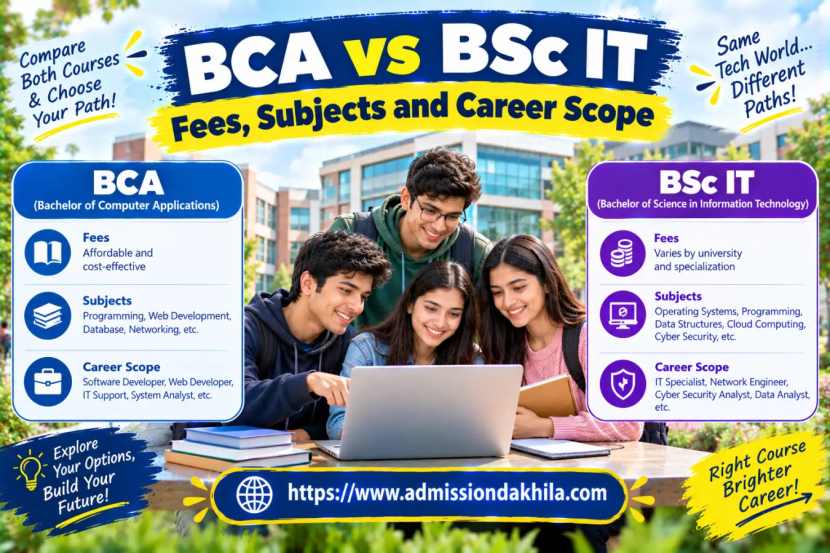
BCA vs BSc IT: Fees, Subjects and Career Scope
Introduction
Choosing the right undergraduate course after Class 12 is an important decision for students who want to build a career in the information technology industry. With opportunities in software development, web design, data analytics, cybersecurity, cloud computing, and IT support, technology-related degrees have become popular among students from different academic backgrounds.
Two courses frequently compared by students are the Bachelor of Computer Applications (BCA) and the Bachelor of Science in Information Technology (BSc IT). Both degrees introduce students to computing, programming, databases, and digital systems. However, their academic approaches, elective subjects, eligibility conditions, and emphasis can differ from one university to another.
Students often ask whether BCA is better than BSc IT, which course has lower fees, whether Mathematics is compulsory, which degree offers better placements, and which qualification is more useful for software jobs.
The answer is not the same for every student. A BCA programme with strong programming laboratories and industry projects may be more useful for a software developer than a BSc IT programme with limited practical training. Conversely, a well-designed BSc IT programme with strong networking, cloud, and cybersecurity modules may suit a student who wants to specialise in IT infrastructure.
This guide from Admission Dakhila compares both courses across fees, subjects, eligibility, admission procedures, career opportunities, salary expectations, placements, and higher education so that students can make a practical decision for the 2027 admission cycle.
BCA may be better for students who want to focus on software programming and application development, while BSc IT may suit students interested in networking, information systems, cloud technologies, and cybersecurity. However, both degrees can lead to software and IT careers. The better choice depends on the syllabus, college quality, practical projects, fees, and the skills you develop. For course comparisons and admission guidance, visit Admission Dakhila at https://www.admissiondakhila.com.
1. What Is BCA?
The Bachelor of Computer Applications is an undergraduate degree focused on computer applications, programming, software development, and the practical use of computing technologies.
BCA is designed for students who want to understand how software applications are created, tested, maintained, and used in businesses and other organisations. The course typically combines classroom teaching with computer laboratories, assignments, programming exercises, and projects.
Many universities offer BCA as a three-year programme divided into six semesters. Some institutions also offer four-year honours programmes or other structures under their applicable academic framework. Students should verify the exact duration of their chosen programme before applying. IGNOU, for example, lists its BCA programme with a minimum duration of 36 months and a maximum completion period of 72 months.
IGNOU+1
What Do Students Learn in BCA?
Depending on the university, BCA students may study:
-
Programming languages such as C, C++, Java, and Python.
-
Data structures and algorithms.
-
Database management systems.
-
Operating systems.
-
Computer networks.
-
Web development.
-
Software engineering.
-
Object-oriented programming.
-
Mobile application development.
-
Artificial intelligence and data analytics electives.
-
Software testing and project development.
The main advantage of BCA is its emphasis on applying computing concepts to develop useful applications. Students may build websites, database-driven systems, mobile applications, and small software projects as part of their coursework.
Who Should Choose BCA?
BCA can be a suitable choice for students who:
-
Enjoy coding and logical problem-solving.
-
Want to pursue software development or web development.
-
Are interested in application programming.
-
Want to build a foundation for MCA or related postgraduate study.
-
Prefer a computing-focused undergraduate programme.
Students do not necessarily need advanced programming knowledge before entering BCA. However, they should be willing to practise regularly, learn technical concepts, and improve their problem-solving skills.
2. What Is BSc IT?
The Bachelor of Science in Information Technology is an undergraduate degree that focuses on the technologies and systems used to store, process, manage, secure, and communicate information.
BSc IT programmes commonly cover programming and databases alongside areas such as computer networks, operating systems, IT infrastructure, information security, and systems administration. The precise balance varies by university.
For example, Babasaheb Bhimrao Ambedkar University lists BSc Information Technology as a three-year programme, with its own science-stream eligibility requirements and semester tuition fee. This illustrates why students should consult the specific university's course page rather than assuming every BSc IT programme has identical conditions.
Computer Science & Information Technology
What Do Students Learn in BSc IT?
Common subjects may include:
-
Fundamentals of information technology.
-
Programming and problem-solving.
-
Database management.
-
Computer architecture.
-
Operating systems.
-
Computer networks.
-
Information security.
-
Software engineering.
-
Web technologies.
-
Cloud computing electives.
-
Data management.
-
IT service and systems administration.
Some institutions offer specialisations or elective modules in cybersecurity, data analytics, cloud infrastructure, or enterprise technology. Others follow a broader science-based curriculum.
Who Should Choose BSc IT?
BSc IT may be suitable for students who:
-
Want a broad understanding of information technology systems.
-
Are interested in networking and infrastructure.
-
Want to explore cybersecurity or cloud computing.
-
Enjoy studying both theoretical concepts and practical systems.
-
Want to pursue MSc IT, MCA where eligible, or another relevant postgraduate programme.
BSc IT is not limited to IT support jobs. With the right subjects, programming skills, projects, and additional training, graduates can also pursue software development and other technical careers.
3. BCA vs BSc IT: Key Differences
The most important distinction is the course structure and learning emphasis, not the name of the degree alone.
|
Comparison factor |
BCA |
BSc IT |
|---|---|---|
|
Full form |
Bachelor of Computer Applications |
Bachelor of Science in Information Technology |
|
Degree type |
Computer applications-focused undergraduate degree |
Science degree focused on information technology |
|
Typical duration |
3 years; some four-year options |
3 years; some four-year options |
|
Main emphasis |
Programming, software applications, application development |
IT systems, networks, databases, security, and computing |
|
Programming |
Usually a central component |
Commonly included; depth varies |
|
Networking |
Usually included |
May receive greater emphasis |
|
Software development |
Strong potential focus |
Included in many curricula |
|
Cybersecurity |
Available through subjects or electives |
Available through subjects or electives |
|
Practical learning |
Labs, assignments, and projects |
Labs, assignments, and projects |
|
Eligibility |
Depends on university; some accept any stream |
Depends on university; some require Science or Mathematics |
|
Higher studies |
MCA and other eligible postgraduate programmes |
MSc IT, MCA where eligible, and related postgraduate programmes |
|
Best fit |
Students interested in building software and applications |
Students interested in broader IT systems and infrastructure |
This is a general comparison, not a universal syllabus rule. Some BSc IT programmes offer extensive software development training, while some BCA programmes have strong networking and cybersecurity components.
Which Course Is More Practical?
Neither degree is automatically more practical. The answer depends on the college's laboratories, curriculum, faculty, projects, internships, and industry exposure.
Before applying, check whether students complete substantial projects, use current programming tools, receive regular lab access, and have opportunities to undertake internships.
A course that teaches fewer technologies thoroughly through practical work may be more valuable than one that lists many technologies but offers little hands-on experience.
4. BCA vs BSc IT Fees in India
Fees are an important factor for students and families planning undergraduate education. The total cost can vary considerably depending on whether the college is a government institution, private university, affiliated college, or open and distance-learning institution.
BCA Course Fees
As a broad planning estimate, students may encounter the following annual tuition ranges:
|
Type of institution |
Illustrative annual tuition |
|---|---|
|
Government or public institution |
₹5,000–₹50,000 |
|
Private affiliated college |
₹30,000–₹1,20,000 |
|
Private university |
₹60,000–₹2,00,000 or more |
|
Online or distance programme |
Varies substantially by university |
These are indicative budgeting ranges, not verified prices for every college or an official national average. Fees may fall outside these ranges.
For a concrete example, IGNOU lists a total programme fee of ₹49,800 for its cited BCA programme, excluding examination fees. The programme's official page should be checked for the current admission session and applicable charges.
IGNOU
BSc IT Course Fees
BSc IT fees also vary by institution and study mode.
|
Type of institution |
Illustrative annual tuition |
|---|---|
|
Government or public institution |
₹5,000–₹60,000 |
|
Private affiliated college |
₹25,000–₹1,20,000 |
|
Private university |
₹50,000–₹2,00,000 or more |
|
Online or distance programme |
Depends on the university |
These figures are general estimates for budgeting. Students must verify the actual fee schedule published for their chosen course and admission year.
A public university may offer BSc IT at a lower tuition cost than a private BCA programme, but this does not mean BSc IT is always cheaper. A private university's BSc IT course may cost more than a BCA course at another institution.
Additional Expenses to Consider
Tuition is only one part of the total cost of a degree. Students should also budget for:
-
Registration and admission charges.
-
Examination fees.
-
Laboratory or technology fees.
-
Books and learning resources.
-
Laptop and internet expenses.
-
Hostel and accommodation costs.
-
Food and transport.
-
Internship travel or certification expenses.
-
Project materials and other academic charges.
For students living away from home, accommodation and food can significantly increase the overall cost.
How to Calculate the Total Course Cost
Use this simple formula:
Total education cost = Total tuition + compulsory fees + accommodation + food + transport + study expenses.
For example, a course with annual tuition of ₹60,000 has a basic three-year tuition cost of ₹1,80,000 if the fee remains unchanged. Hostel charges, examination fees, and other expenses would be additional.
Before paying an admission fee, request a written fee breakdown. Also ask whether fees can increase in subsequent years and whether any refundable security deposit is required.
Which Course Is Cheaper: BCA or BSc IT?
There is no universal winner. The lowest-cost option is the specific recognised and suitable programme whose complete fee structure fits your budget.
Students comparing colleges through Admission Dakhila should consider total cost alongside curriculum, location, internships, faculty, and placement support rather than choosing solely on the advertised first-year tuition.
5. BCA Subjects and Syllabus
BCA subjects are designed to help students develop computing fundamentals and progress towards programming and application development.
The exact syllabus differs across universities, and students should consult the current official curriculum before applying.
First-Year BCA Subjects
The first year generally introduces students to the basics of computers and programming.
Typical subjects include:
-
Computer fundamentals.
-
Programming in C or another introductory language.
-
Mathematics or discrete mathematics.
-
Digital logic.
-
Communication skills.
-
Basic database concepts.
-
Problem-solving techniques.
Students learn how computers process information, how programs are structured, and how basic algorithms solve problems.
Programming laboratory work is especially important. Writing code, identifying errors, and improving a program help students build a strong foundation for advanced subjects.
Second-Year BCA Subjects
The second year often moves towards more advanced programming and software concepts.
Students may study:
-
Data structures.
-
Object-oriented programming.
-
Database management systems.
-
Operating systems.
-
Computer networks.
-
Web development.
-
Software engineering.
-
Java, Python, or another language.
-
System analysis and design.
Database projects, web applications, and programming assignments help students connect theory with practical applications.
Third-Year BCA Subjects
The final year may include advanced technical subjects, electives, and project work.
Depending on the university, subjects may include:
-
Mobile application development.
-
Advanced web technologies.
-
Software testing.
-
Cloud computing.
-
Data analytics.
-
Artificial intelligence fundamentals.
-
Information security.
-
Project management.
-
Major project or internship.
Students should use the final year to develop a portfolio. A well-documented project that demonstrates problem-solving and coding ability can help during internships and entry-level job applications.
Practical Skills BCA Students Should Develop
Alongside university subjects, students can practise:
-
One programming language in depth.
-
Data structures and basic algorithms.
-
SQL and database design.
-
HTML, CSS, JavaScript, or another relevant web stack.
-
Git and version control.
-
Debugging and software testing.
-
Technical documentation.
-
Communication and teamwork.
Students do not need to master every technology during their degree. They should first build a strong foundation and then specialise according to their career interests.
6. BSc IT Subjects and Syllabus
BSc IT typically combines programming with the study of information systems, computing infrastructure, and data management.
The syllabus varies by institution, so the following subjects are representative rather than compulsory in every programme.
First-Year BSc IT Subjects
The first year may include:
-
Fundamentals of information technology.
-
Programming fundamentals.
-
Mathematics or statistics.
-
Computer organisation.
-
Digital systems.
-
Communication skills.
-
Introduction to databases.
-
Basic computer applications.
Students learn the basic principles behind computer systems and information processing. Depending on the programme, practical sessions may cover programming, computer hardware, or operating systems.
Second-Year BSc IT Subjects
The second year may include:
-
Data structures.
-
Database management.
-
Computer networks.
-
Operating systems.
-
Object-oriented programming.
-
Web programming.
-
Software engineering.
-
Information systems.
Networking and systems subjects help students understand how computers communicate, how data moves between systems, and how organisations manage their technology environments.
Third-Year BSc IT Subjects
The final year may offer more advanced topics such as:
-
Information security.
-
Cloud computing.
-
Network administration.
-
Advanced database concepts.
-
Data analytics.
-
Distributed systems.
-
Enterprise IT.
-
Web application development.
-
Project work or internship.
Some institutions allow students to choose electives in areas such as cybersecurity or data analytics. Others emphasise broader information technology concepts.
Practical Skills BSc IT Students Should Develop
To improve employability, BSc IT students should consider developing:
-
Programming and scripting skills.
-
Networking fundamentals.
-
Database querying.
-
Linux or another relevant operating system.
-
Basic cloud platform knowledge.
-
Security awareness.
-
Troubleshooting skills.
-
Documentation and communication.
-
Practical projects and internship experience.
Students targeting software development should practise coding even if their curriculum emphasises systems and infrastructure. Students interested in networking should gain hands-on experience with network configuration and troubleshooting.
7. BCA vs BSc IT Eligibility Criteria After Class 12
Eligibility is one of the most important differences to investigate before choosing a course.
BCA Eligibility
Many universities accept students who have completed Class 12 from a recognised board. Some accept candidates from any stream, while others require Mathematics, Computer Science, a minimum percentage, or particular subjects.
For example, IGNOU's cited BCA programme accepts candidates who have passed Class 12 or an equivalent qualification, subject to its published rules. Other institutions may apply different criteria.
IGNOU
Typical requirements may include:
-
Completion of Class 12 or an equivalent examination.
-
A minimum aggregate percentage prescribed by the institution.
-
Required subjects, if specified.
-
Entrance examination or merit-based selection, where applicable.
Students from Commerce or Arts backgrounds should not assume they are ineligible for BCA. They should check the admission brochure of each university.
BSc IT Eligibility
BSc IT eligibility can be more dependent on the institution's academic requirements.
Some universities require a Science background, while others accept students from other streams if they have studied Mathematics, Statistics, or another specified subject.
For instance, the BSc IT programme listed by Babasaheb Bhimrao Ambedkar University specifies an Intermediate qualification with Science and a minimum marks requirement under its published criteria. These requirements should not be applied to every BSc IT college.
Computer Science & Information Technology
Typical conditions may include:
-
Completion of Class 12 from a recognised board.
-
Science stream, where required.
-
Mathematics or another specified subject, where required.
-
Minimum marks according to the institution's rules.
-
Entrance test or merit-based admission, where applicable.
Can Students Without Mathematics Choose BCA or BSc IT?
Possibly, but eligibility depends on the university and programme.
Some BCA programmes accept students without Mathematics in Class 12. Others require Mathematics or allow specified alternative subjects. BSc IT programmes may have similar or stricter subject requirements, depending on the institution.
Before applying, check:
-
Whether Mathematics is compulsory in Class 12.
-
Whether Mathematics studied in Class 10 is accepted.
-
Whether Computer Science or another subject can substitute.
-
Whether a bridge course is required.
-
Whether the minimum percentage differs by category.
Important: Do not select a college based only on a third-party listing. Confirm the current eligibility requirements on the official admission page.
8. Admission Process for 2027
The admission process for BCA and BSc IT varies by university. Some institutions admit students on the basis of Class 12 marks, while others conduct entrance tests or use an applicable centralised admission process.
Step 1: Shortlist Colleges
Identify institutions that offer your preferred course and fit your budget, location, and career goals.
Compare the official syllabus, programme duration, laboratory facilities, internships, and placement support.
Step 2: Verify Eligibility
Read the current admission brochure and confirm that your Class 12 subjects and marks satisfy the programme requirements.
Do this before paying a non-refundable application fee.
Step 3: Check the Admission Route
Determine whether the institution uses merit-based admission, an entrance examination, counselling, or another selection procedure.
Do not assume that every college requires the same examination.
Step 4: Complete the Application
Fill in the application form carefully and upload the requested documents. Commonly requested documents include:
-
Class 10 marksheet or certificate.
-
Class 12 marksheet or provisional result.
-
Identity proof, where required.
-
Recent photograph and signature.
-
Transfer or migration certificate, where applicable.
-
Category certificate, if applying under a relevant category.
-
Other documents specified by the institution.
Step 5: Attend Counselling or Selection
Follow the university's instructions for merit lists, entrance results, interviews, counselling, or document verification.
Step 6: Confirm the Fee and Seat
Read the fee schedule, refund policy, scholarship conditions, and hostel terms before accepting an offer.
Pay through the institution's official payment channel and retain the receipt.
Step 7: Prepare for College
Before classes begin, students can start learning introductory programming, computer fundamentals, typing, and basic mathematics where needed.
Admission Dakhila can be used as a starting point for exploring college options and admission information. Always verify final course details, eligibility, fees, and deadlines with the relevant institution.
9. BCA vs BSc IT: Which Is Easier?
Neither BCA nor BSc IT is inherently easier for every student. The level of difficulty depends on the syllabus, teaching quality, assessment style, and a student's strengths.
Why Some Students Find BCA Easier
Students who enjoy building applications, writing code, and solving programming problems may find a programming-oriented BCA curriculum engaging.
However, BCA still requires consistent effort in mathematics or logic where included, databases, algorithms, software engineering, and project work.
Why Some Students Find BSc IT Easier
Students interested in systems, networking, and practical IT operations may find those parts of a BSc IT curriculum easier to understand.
Nevertheless, networking, operating systems, databases, programming, and information security can all be challenging.
How to Decide
Review the first-year syllabus of both courses before applying. If possible, read sample papers or speak with current students.
Choose the course whose core subjects you are willing to study consistently, not the course that someone claims is easier.
10. Career Scope After BCA
BCA graduates can apply for a range of entry-level technology roles. Actual opportunities depend on their skills, practical experience, academic performance, location, and the employer's requirements.
Software Developer
Software developers build and maintain applications used by individuals and organisations.
BCA graduates interested in this career should learn a programming language, data structures, databases, testing, and version control. A project portfolio can help demonstrate practical ability.
Web Developer
Web developers create websites and web applications.
Students can start with HTML, CSS, and JavaScript, then learn a suitable backend framework and database. Front-end, back-end, and full-stack development are possible career directions.
Application Developer
Application developers create software for desktop, mobile, or enterprise environments.
The specific tools depend on the target platform. Students should build projects that demonstrate application design, functionality, and testing.
Software Tester or QA Analyst
Software testing professionals identify defects, check expected behaviour, and help teams improve software quality.
Useful skills include test case design, bug reporting, basic scripting, and familiarity with manual or automated testing tools.
Database Support or Junior Database Roles
Graduates with strong SQL, database design, and troubleshooting skills may pursue entry-level database support or related roles.
More advanced database administration jobs may require additional experience and specialised knowledge.
Technical Support or IT Support
Technical support professionals help users resolve hardware, software, account, and system problems.
These roles can provide experience with operating systems, troubleshooting, customer communication, and enterprise IT environments.
Other Career Options
Depending on skills and opportunities, BCA graduates may also explore:
-
Junior programmer.
-
Front-end developer.
-
Python developer trainee.
-
Junior data analyst.
-
Application support analyst.
-
Cloud support associate.
-
Cybersecurity trainee.
-
Technical operations associate.
These are possible career paths, not guaranteed placements for every BCA graduate.
11. Career Scope After BSc IT
BSc IT graduates can pursue roles in software development, networking, information systems, cloud services, technical support, and related technology areas.
IT Support Specialist
IT support specialists help maintain systems, solve user problems, and troubleshoot hardware or software issues.
This role can be a starting point for a career in systems administration, IT operations, or enterprise technology.
Network Support Engineer
Network support professionals help maintain network connectivity, monitor systems, and troubleshoot network issues.
Students interested in this area should learn networking fundamentals, routing concepts, network security, and relevant practical tools.
Systems Administrator Trainee
Systems administrators help maintain servers, operating systems, accounts, permissions, and other IT resources.
Entry-level candidates benefit from practical experience with Linux or Windows environments, scripting, troubleshooting, and system monitoring.
Cybersecurity Analyst Trainee
Cybersecurity teams monitor risks, investigate suspicious activity, and help protect systems and information.
Graduates may pursue entry-level opportunities after building knowledge of networking, operating systems, security fundamentals, and incident handling. Some roles require certifications, practical experience, or further qualifications.
Cloud Support Associate
Cloud support roles involve helping maintain and troubleshoot cloud-hosted systems and services.
Students should understand networking, operating systems, identity and access management, storage, and basic cloud architecture.
Data Analyst
Data analysts work with data to identify patterns and communicate findings.
Useful skills include SQL, spreadsheets, data visualisation, statistics, and, where relevant, Python.
Other Career Options
BSc IT graduates may also explore:
-
Junior software developer.
-
Database support associate.
-
Network administrator trainee.
-
Application support analyst.
-
IT operations associate.
-
Junior web developer.
-
Systems support analyst.
-
Technical service desk analyst.
A BSc IT degree does not automatically qualify someone for every specialist role. Employers may expect additional training, practical demonstrations, or experience.
12. BCA vs BSc IT Salary and Placement Opportunities
Salary is a major consideration, but the degree title alone does not determine earnings. Technical skills, employer requirements, interview performance, location, communication, internships, and project quality can all influence the first job offer.
Indicative Salary Expectations in India
The following figures are broad planning estimates for potential entry-level roles, not verified salary averages or guaranteed outcomes.
|
Role |
Illustrative annual salary range |
|---|---|
|
Junior software developer |
₹3–7 lakh |
|
Web developer |
₹2.5–6 lakh |
|
Software testing / QA trainee |
₹2.5–5.5 lakh |
|
IT support specialist |
₹2–4.5 lakh |
|
Network support trainee |
₹2.5–5 lakh |
|
Junior data analyst |
₹3–6 lakh |
|
Cloud support associate |
₹3–7 lakh |
These ranges overlap because graduates from both degrees can apply for many of the same roles. Some candidates may earn less or more, and not every graduate secures a job immediately after graduation.
Does BCA Offer a Higher Salary Than BSc IT?
There is no reliable universal rule that BCA graduates earn more than BSc IT graduates, or vice versa.
A BCA graduate with strong software engineering projects may secure a development role, while a BSc IT graduate with networking and cloud skills may qualify for a different technical position. The salary depends on the role, employer, candidate, and local job market.
What Affects Placements?
When evaluating a college, examine:
-
Number of students eligible for placements.
-
Number of students actually placed.
-
Median salary, where reported.
-
Average salary and highest package, with context.
-
Employers recruiting for relevant roles.
-
Internship opportunities.
-
Training in aptitude, coding, and interviews.
-
Alumni career outcomes.
-
The proportion of placements in technical roles.
The highest package is not enough to judge a college. It may represent a single student and may not reflect the typical outcome.
How to Improve Your Placement Chances
Students in either course can improve their readiness by following a consistent plan:
First year: Learn programming fundamentals, computer basics, and communication skills.
Second year: Build projects, learn databases and Git, and practise problem-solving.
Third year: Complete a substantial project, apply for internships, prepare for technical interviews, and practise aptitude questions.
Students should also learn to explain their projects clearly. Employers often want to understand what the candidate built, why particular technologies were selected, and how problems were solved.
13. Higher Studies After BCA and BSc IT
Both degrees can provide a foundation for further education, but eligibility depends on the postgraduate programme and university.
MCA After BCA
The Master of Computer Applications is a popular postgraduate option for students interested in software development, advanced computing, and related technical roles.
Before applying, students should verify the programme's current eligibility conditions, including Mathematics requirements, entrance examinations, and minimum marks.
MCA After BSc IT
BSc IT graduates may also be eligible for MCA programmes. However, some universities prescribe specific undergraduate subjects or Mathematics requirements.
Candidates should check the current rules of each target institution rather than assuming all BSc IT graduates qualify automatically.
MSc IT After BSc IT
An MSc IT can provide advanced study in information technology, systems, data management, or specialised areas depending on the curriculum.
It may suit students who want deeper academic knowledge or wish to pursue certain technical or research-oriented pathways.
MSc IT After BCA
Some universities accept BCA graduates for MSc IT or related postgraduate programmes, while others have specific requirements. Verify the eligibility conditions before planning your next degree.
Other Higher-Study Options
Depending on admission requirements and career interests, graduates may consider:
-
MSc Computer Science.
-
Postgraduate diplomas in specialised technical fields.
-
Data analytics programmes.
-
Cybersecurity training.
-
Cloud computing certifications.
-
Software engineering courses.
-
Management education such as an MBA.
-
Research-oriented programmes, subject to eligibility.
Should You Work or Study Further?
Students should compare the cost and likely value of postgraduate education with available entry-level employment opportunities.
Working first may help some graduates gain experience and identify their preferred specialisation. Others may benefit from postgraduate study to meet eligibility requirements or strengthen their technical background.
There is no single correct route for every student.
14. Which Course Is Better for Different Career Goals?
The better course depends on what you want to do after graduation and which curriculum supports that goal.
|
Career goal |
What to look for |
|---|---|
|
Software development |
Strong programming, algorithms, databases, and projects |
|
Web development |
Web technologies, backend programming, and portfolio projects |
|
Mobile app development |
Application programming and mobile development electives |
|
Networking |
Network labs, operating systems, and practical infrastructure training |
|
Cybersecurity |
Security subjects, networking, operating systems, and labs |
|
Cloud computing |
Networking, scripting, systems administration, and cloud electives |
|
Data analytics |
SQL, statistics, spreadsheets, Python, and visualisation |
|
IT support |
Troubleshooting, operating systems, networking, and communication |
Best Course for Software Jobs
BCA may be a natural fit for students whose primary goal is application programming and software development. However, BSc IT can also prepare students for software jobs when the programme offers sufficient coding, algorithms, and project experience.
Review actual course modules rather than relying on the degree name.
Best Course for Cybersecurity
Students interested in cybersecurity should look for a curriculum that includes networking, operating systems, security fundamentals, scripting, and hands-on labs.
Either degree can provide a starting point. Specialised learning and practical exercises are particularly important for cybersecurity careers.
Best Course for Cloud Computing
Cloud careers require an understanding of systems, networking, storage, identity management, and automation. Students from either degree can develop these skills through coursework, labs, projects, and relevant certifications.
Best Course for Data Analytics
For analytics careers, prioritise SQL, statistics, spreadsheet analysis, data visualisation, and Python where relevant.
A course with these subjects and meaningful projects can be a good starting point regardless of whether the qualification is BCA or BSc IT.
15. How to Choose the Right College for BCA or BSc IT
Choosing a college requires more than comparing course names or advertisements.
Check Recognition and Affiliation
Verify the institution's legal status, degree-awarding authority, university affiliation where applicable, and relevant regulatory requirements for the specific programme.
For online or distance education, verify the applicable recognition or entitlement for the institution, programme, and admission session.
Compare the Curriculum
Look for a syllabus that matches your goals. For software development, examine programming, algorithms, databases, and project work. For infrastructure-oriented careers, check networking, operating systems, security, and systems subjects.
Review Laboratory Facilities
Practical learning is essential in IT education. Ask whether students receive regular access to computer laboratories, relevant software, project guidance, and updated learning resources.
Examine Internship Support
Ask whether internships are part of the curriculum, how the college helps students find opportunities, and whether students can undertake projects with real-world applications.
Check Placement Data Carefully
Request placement information for recent graduating batches. Look for the number of eligible students, placed students, relevant job roles, and typical salary outcomes.
Do not rely on a single highest-package claim.
Consider Location and Living Costs
A college closer to home may reduce travel and accommodation costs. If you plan to relocate, compare hostel availability, food, transport, safety, and the total annual budget.
Evaluate Student Support
Consider faculty availability, mentoring, coding clubs, technical societies, career services, and opportunities to participate in hackathons or technical events.
Compare the Complete Fee Structure
Request a breakdown of tuition, examination charges, registration fees, laboratory costs, hostel fees, and other compulsory payments.
A transparent fee schedule helps prevent unexpected expenses.
16. Advantages and Limitations of BCA and BSc IT
Advantages of BCA
-
Often provides a clear focus on computer applications and software development.
-
Can suit students who want to pursue programming careers.
-
May provide pathways into MCA and related postgraduate courses.
-
Offers opportunities to build a software project portfolio.
-
Can accept students from different academic streams at some institutions.
Limitations of BCA
-
Eligibility varies, and Mathematics may be required by some colleges.
-
Course quality and practical exposure differ considerably.
-
Students may need additional practice to meet specialist job requirements.
-
The degree alone does not guarantee a placement or high salary.
Advantages of BSc IT
-
Can provide broad exposure to information technology systems.
-
May suit students interested in networking, infrastructure, and security.
-
Can offer pathways into software development and related technical jobs.
-
May provide a foundation for MSc IT or other postgraduate programmes.
-
Some public institutions offer relatively affordable tuition.
Limitations of BSc IT
-
Science-stream or subject requirements may restrict eligibility at some universities.
-
Software development depth varies across curricula.
-
Specialised careers often require additional hands-on training.
-
College quality, facilities, and placements can differ substantially.
Final Comparison: Which Should You Prefer?
Choose BCA if you are more interested in programming, software applications, and application development, provided the course offers a strong curriculum.
Choose BSc IT if you are more interested in information technology systems, networking, infrastructure, and related areas, provided the programme includes suitable practical training.
If both colleges offer similar subjects, compare the faculty, labs, internship opportunities, fee structure, placement outcomes, and postgraduate pathways. These factors may have a greater impact on your experience than the degree title alone.
17. Frequently Asked Questions (FAQs): BCA vs BSc IT
The following FAQs are written in a concise, search-friendly format to answer common questions students ask before choosing a course.
FAQ 1. Which is better, BCA or BSc IT?
BCA may be better for students interested in programming and software application development, while BSc IT may suit students interested in networking, IT infrastructure, databases, and information systems. Both can lead to technology careers. Compare the syllabus, practical training, fees, and placement opportunities before deciding.
FAQ 2. Which course has lower fees, BCA or BSc IT?
Neither course is always cheaper. Government institutions may offer lower tuition than private universities, but the exact cost depends on the college, programme, and study mode. Compare the complete fee structure, including examination charges, accommodation, and other compulsory expenses.
FAQ 3. Is BCA better than BSc IT for software jobs?
BCA can be a good choice for software jobs because many programmes emphasise programming and computer applications. However, BSc IT graduates can also enter software development if they build strong coding skills, complete practical projects, and meet employer requirements.
FAQ 4. What is the duration of BCA and BSc IT?
Both degrees commonly have a three-year structure in India. Some universities offer four-year honours programmes or other academic pathways. Always confirm the duration of the specific programme you intend to join.
FAQ 5. Can I pursue BCA without Mathematics in Class 12?
Yes, some universities accept students without Mathematics in Class 12, but others require Mathematics or specified alternative subjects. Check the current eligibility criteria of the individual college before applying.
FAQ 6. Is BSc IT suitable for students from the Commerce or Arts stream?
It depends on the university. Some BSc IT programmes require a Science background, while others have different subject requirements. Students from Commerce or Arts should review the official admission brochure to determine eligibility.
FAQ 7. Which course offers a higher salary, BCA or BSc IT?
Neither degree guarantees a higher salary. Earnings depend on technical skills, the job role, employer, location, experience, and interview performance. Strong programming, networking, data, or cloud skills can help graduates from either course pursue relevant opportunities.
FAQ 8. Can I pursue MCA after BSc IT?
Many universities accept BSc IT graduates for MCA, subject to their admission rules. Some require Mathematics or other specified subjects at Class 12 or undergraduate level. Verify the eligibility conditions of the target university.
FAQ 9. Which course is better for cybersecurity and cloud computing?
Both degrees can provide a foundation for cybersecurity and cloud computing. Choose a programme that includes networking, operating systems, scripting, information security, and practical laboratory work. Additional projects and specialised training may be necessary.
FAQ 10. How can Admission Dakhila help me compare BCA and BSc IT colleges?
Admission Dakhila can be used to explore educational information, compare course options, and plan your college search. Visit https://www.admissiondakhila.com and verify each shortlisted institution's official eligibility requirements, fee structure, admission dates, and placement information before enrolling.
18. Conclusion: BCA vs BSc IT — Make the Right Choice for Your Future
Choosing between BCA and BSc IT is an important step towards a career in technology. Both courses can provide a foundation in programming, databases, computing systems, and information technology. Both can also lead to higher studies and entry-level technical roles when supported by practical experience and relevant skills.
BCA may be the stronger fit if you want to concentrate on software development, web applications, programming, and computer applications.
BSc IT may be the stronger fit if you want to explore information systems, networking, infrastructure, information security, and broader IT operations.
However, neither degree guarantees a job or a particular salary. Your outcome will depend on the curriculum you study, the projects you complete, your technical knowledge, internship experience, and the quality of the institution you choose.
Before taking admission for 2027, compare the total fees, eligibility criteria, syllabus, laboratory facilities, faculty, internships, placement data, and opportunities for higher education. Make sure the programme aligns with your interests and financial circumstances.
Plan Your Admission With Admission Dakhila
If you are confused about which course or college to select, visit Admission Dakhila to explore educational information and start comparing your options.
Use the information available to shortlist suitable colleges, check their official admission requirements, and prepare your application documents. Confirm all fees, eligibility conditions, deadlines, and placement claims directly with the institution before making a final decision.
Your best degree is the one that fits your career goal, budget, learning preferences, and long-term plans. Choose thoughtfully, build practical skills throughout your studies, and use your undergraduate years to prepare for the technology career you want.