BCom vs BCom Honours: Eligibility and Career Scope
The main difference between BCom and BCom Honours is the depth and structure of study. BCom usually offers a broad foundation in commerce, accounting, economics, taxation, and business. BCom Honours generally offers more specialised or in-depth study, depending on the university. Students who want a broad commerce degree can consider BCom, while those who prefer greater academic depth in commerce-related subjects can consider BCom Honours. Before applying, check the course structure, eligibility, fees, and career opportunities. Visit Admission Dakhila to explore undergraduate course and college admission information.
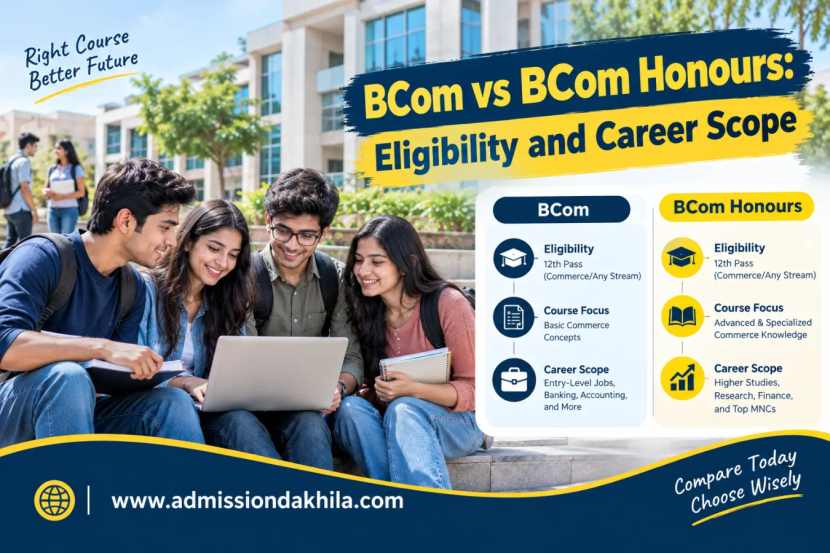
BCom is a general undergraduate commerce degree that provides a broad understanding of accounting, business, economics, taxation, and finance. BCom Honours, where offered as a distinct programme, generally provides more focused or advanced study in commerce and related subjects. Both courses are suitable for students who have completed Class 12 and meet the university's admission requirements. BCom may suit students seeking broad business knowledge and flexibility, while BCom Honours may suit those who want greater subject depth or are interested in careers involving accounting, finance, taxation, analytics, and professional qualifications. The better choice depends on the university's curriculum, eligibility rules, career goals, and plans for higher education. Admission Dakhila helps students explore course options and make informed admission decisions.
BCom vs BCom Honours: Eligibility and Career Scope
1. Introduction to BCom and BCom Honours
Choosing the right undergraduate course after Class 12 is an important decision for students interested in commerce, accounting, finance, taxation, banking, business management, and entrepreneurship. Two popular options in this field are Bachelor of Commerce (BCom) and Bachelor of Commerce Honours (BCom Honours).
Although both qualifications belong to the commerce discipline, they may differ in curriculum depth, specialisation, credit structure, duration, and academic expectations. Understanding these differences helps students select a programme that aligns with their interests, academic strengths, financial circumstances, and long-term career plans.
For example, a student who wants a broad understanding of business and commerce may prefer a general BCom programme. Another student who enjoys accounting, corporate finance, financial analysis, or taxation may prefer a BCom Honours programme that provides more in-depth study in those areas.
However, the course title alone does not determine the quality of education or employment prospects. The university's curriculum, faculty, practical training, internship opportunities, accreditation status, industry exposure, and the student's own skills are equally important.
The University Grants Commission's undergraduate curriculum framework promotes flexibility, multidisciplinary learning, and multiple entry and exit pathways, meaning students should check the structure of the particular programme rather than assume that every BCom degree follows the same pattern.
This guide by Admission Dakhila explains the eligibility requirements, admission process, syllabus, career scope, salary expectations, and higher-study options for both courses.
2. What Is BCom?
BCom stands for Bachelor of Commerce. It is an undergraduate degree designed to introduce students to the principles and practices of commerce, accounting, business, economics, taxation, and financial management.
The course helps students understand how businesses maintain accounts, manage money, prepare financial statements, comply with tax regulations, and make commercial decisions.
BCom is suitable for students who want to build a foundation in commerce before entering employment, preparing for competitive examinations, pursuing professional qualifications, or continuing their education.
Key Features of BCom
-
Course level: Undergraduate
-
Eligibility: Generally Class 12 or an equivalent qualification, subject to university requirements
-
Duration: Commonly three years for a standard bachelor's degree, although programme structures vary
-
Study areas: Accounting, economics, business law, taxation, finance, and management
-
Learning approach: Broad commerce education, with electives and practical subjects depending on the university
-
Career pathways: Accounting, banking, taxation support, business operations, finance support, and further study
What Do Students Learn in BCom?
BCom programmes commonly cover several interconnected business subjects.
Financial accounting: Students learn how business transactions are recorded, classified, and presented in financial statements.
Business economics: This area introduces demand, supply, market structures, pricing, inflation, and economic decision-making.
Business law: Students study the legal principles relevant to commercial transactions, contracts, companies, and business operations.
Taxation: Depending on the curriculum, students learn introductory concepts of income tax, indirect taxation, tax compliance, and related procedures.
Business management: Students explore organisational structures, planning, leadership, coordination, and decision-making.
Financial management: This subject introduces budgeting, working capital, investment decisions, and financial planning.
Business communication: Students develop professional writing, presentation, reporting, and workplace communication skills.
The combination of these subjects provides a foundation for understanding how businesses operate. Students can strengthen this knowledge through internships, accounting software practice, Excel, communication training, and professional certifications.
Who Should Choose BCom?
BCom can be a good choice for students who:
-
Want a broad foundation in commerce.
-
Are still exploring different business career paths.
-
Plan to prepare for banking, government, or other competitive examinations alongside graduation.
-
Want to pursue an MBA, MCom, or a professional qualification.
-
Prefer a general commerce programme with opportunities to select electives where available.
-
Want to develop accounting and business knowledge without committing to a narrow specialisation immediately.
Students should compare the actual syllabi of shortlisted colleges because a general BCom programme at one institution may offer different electives, projects, or practical components from a similar programme elsewhere.
3. What Is BCom Honours?
BCom Honours, also written as BCom (Hons), is a commerce degree that generally provides more focused or advanced study in commerce and related disciplines. Its exact structure depends on the institution and the applicable curriculum framework.
The programme may emphasise areas such as advanced accounting, corporate finance, business statistics, financial reporting, taxation, auditing, economics, and analytical decision-making.
In some universities, Honours programmes have a longer duration or additional credit requirements. In others, the degree structure may include an Honours pathway within a flexible undergraduate framework.
For example, the Central University of Himachal Pradesh describes its BCom Honours programme as a four-year undergraduate course with a flexible credit system and eligibility based on the qualifying examination. The University of Delhi publishes separate BCom and BCom Honours syllabus materials.
These examples demonstrate why applicants should review the specific university's programme regulations before deciding.
Key Features of BCom Honours
-
Course level: Undergraduate
-
Eligibility: Class 12 or an equivalent qualification, subject to programme-specific rules
-
Duration: Commonly three or four years, depending on the programme
-
Study areas: Commerce fundamentals alongside more focused or advanced subjects
-
Learning approach: May involve advanced coursework, analytical assignments, projects, and research-oriented learning
-
Career pathways: Accounting, financial analysis, taxation, audit support, banking, business analysis, and higher education
What Do Students Learn in BCom Honours?
The syllabus varies by university, but it may include the following subjects.
Advanced financial accounting: Students explore more complex accounting transactions, financial statements, and reporting practices.
Corporate accounting: The subject may cover company accounts, share capital, corporate financial statements, and related accounting procedures.
Cost and management accounting: Students learn how organisations measure costs, prepare budgets, evaluate performance, and support internal decisions.
Financial management: This area examines capital budgeting, financing decisions, working capital, and financial planning.
Business statistics and analytics: Students may develop quantitative skills for interpreting data, measuring business performance, and evaluating financial information.
Auditing: Students learn about audit procedures, internal controls, verification of financial records, and the purpose of independent examination.
Taxation and business law: Depending on the programme, students study tax principles and legal requirements relevant to businesses.
Research and project work: Some programmes include projects, presentations, case studies, or research components that help students investigate practical business problems.
Who Should Choose BCom Honours?
BCom Honours may suit students who:
-
Have a strong interest in accounting, finance, taxation, economics, or business analysis.
-
Prefer studying selected commerce subjects in greater depth.
-
Enjoy quantitative work, financial interpretation, and structured problem-solving.
-
Want to pursue professional courses such as CA, CMA, CS, or finance-related certifications.
-
Are interested in specialised entry-level roles or postgraduate education.
-
Are willing to manage a demanding academic workload when the chosen programme requires it.
An Honours qualification does not automatically guarantee a better job or higher salary. Employers also consider practical knowledge, internships, communication skills, professional qualifications, and the quality of the student's work.
4. Difference Between BCom and BCom Honours
The most important distinction is usually the programme's curriculum and depth of study. The exact difference depends on the university.
BCom vs BCom Honours: Comparison Table
|
Comparison factor |
BCom |
BCom Honours |
|---|---|---|
|
Full form |
Bachelor of Commerce |
Bachelor of Commerce Honours |
|
Main focus |
Broad commerce education |
More focused or advanced commerce study |
|
Course duration |
Often 3 years |
3 or 4 years, depending on the structure |
|
Subjects |
Core commerce subjects and possible electives |
Core subjects plus potentially more advanced or specialised papers |
|
Academic depth |
Broad foundational knowledge |
Greater depth in selected subjects in many programmes |
|
Eligibility |
Class 12 or equivalent, as prescribed |
Class 12 or equivalent, with programme-specific conditions |
|
Admission method |
Merit, entrance examination, or other prescribed process |
Merit, entrance examination, or other prescribed process |
|
Quantitative learning |
Depends on the curriculum |
May include more advanced quantitative or analytical coursework |
|
Research opportunities |
Depends on the institution and programme |
Some programmes offer an additional research pathway |
|
Career options |
Accounting, banking, business operations, taxation support, and more |
Similar broad career areas, with potentially deeper subject preparation |
|
Higher education |
MCom, MBA, professional qualifications, and other eligible programmes |
MCom, MBA, professional qualifications, and other eligible programmes |
|
Best suited for |
Students wanting broad commerce exposure |
Students seeking more in-depth study in commerce-related areas |
The table describes common patterns, not universal rules. A three-year BCom Honours degree can differ from a four-year Honours degree, and some general BCom programmes offer substantial specialisation through electives.
Which Course Is More Difficult?
BCom Honours may be more demanding when it includes advanced accounting, quantitative subjects, additional credits, research projects, or a heavier specialisation requirement.
However, difficulty depends on the curriculum, teaching quality, assessment methods, and the student's strengths. A student who enjoys financial analysis may find an Honours programme engaging, while another student may perform better in a broader course.
Students should review the semester-wise syllabus and assessment structure instead of choosing a course solely because its title sounds more prestigious.
Which Course Has Better Value?
The value of either degree depends on the learning outcomes and the student's plans.
A general BCom degree from a well-regarded college with strong teaching, practical accounting exposure, and internship opportunities may be an excellent choice. Similarly, a well-designed BCom Honours programme can be useful for students seeking advanced commerce knowledge.
The better decision is the programme that provides the right mix of recognised qualifications, affordable fees, relevant skills, practical exposure, and progression opportunities.
5. BCom vs BCom Honours: Eligibility Criteria
Eligibility is a crucial consideration for students applying after Class 12. Although the basic entry requirement is commonly a recognised higher-secondary qualification, individual universities set their own conditions.
Basic Educational Qualification
Most BCom and BCom Honours programmes require applicants to have completed Class 12 or an equivalent examination from a recognised board.
Accepted boards may include CBSE, CISCE, state boards, and other recognised educational boards, subject to the university's admission regulations.
For example, the University of Allahabad's published 2026–27 undergraduate eligibility table lists a Class 12 or equivalent qualification for BCom and specifies eligible streams. This is an institutional example, not a universal rule for every college.
Minimum Percentage Requirements
The minimum marks required for admission vary by institution.
Some colleges may accept students who have passed Class 12, while others prescribe a minimum aggregate percentage or subject-specific marks. More competitive programmes may admit students according to merit rankings, entrance scores, or a combination of eligibility and selection criteria.
Students should check:
-
Minimum Class 12 aggregate marks.
-
Whether marks in Accountancy, Mathematics, Economics, or other subjects are considered.
-
Whether the university calculates an aggregate from all subjects or a prescribed subject combination.
-
Applicable category-based relaxations, if any.
-
Rules for students awaiting final results.
-
Requirements for applicants from boards outside the relevant state or country.
Never assume that one percentage requirement applies to every BCom or BCom Honours college.
Is Commerce Stream Compulsory?
No, not at every institution.
Many universities accept students from the Commerce stream, while some also allow students from Science or other streams. Certain programmes may require Mathematics, a commerce subject, or a prescribed combination of subjects.
Students from Humanities or Arts backgrounds should check the eligibility rules of each college rather than assume that BCom is unavailable to them.
Is Mathematics Compulsory for BCom Honours?
Mathematics is not universally compulsory for BCom Honours. Requirements vary according to the university, programme, and admission year.
Some institutions accept Commerce students without Mathematics. Others may specify Mathematics, Accountancy, or particular domain subjects as eligibility conditions.
Mathematics can be useful for finance, statistics, economics, and analytics, but whether it is mandatory is an institutional decision. Verify the latest prospectus before submitting an application.
Can Students with 50% Marks Apply?
Students with 50% marks may be eligible for several BCom and BCom Honours programmes, depending on the college's minimum requirements and selection process.
However, eligibility does not guarantee admission. If a college has a higher minimum requirement, a competitive merit list, or an entrance examination, applicants must satisfy those additional conditions.
Students should prepare a shortlist containing colleges with different admission requirements so that they have realistic alternatives.
Can Students from Science or Arts Apply?
Yes, where the relevant university permits it.
A Science student may be eligible for a BCom course even without studying Commerce in Class 12. Some universities also accept students from Arts or Humanities backgrounds.
The key is to confirm whether the course requires particular subjects or minimum marks. Students who did not study Accountancy may also need to spend extra time building their accounting fundamentals.
BCom vs BCom Honours Eligibility: Quick Checklist
Before applying, confirm the following:
-
Class 12 or equivalent qualification completed or expected.
-
Required aggregate percentage achieved.
-
Subject combination satisfies the programme rules.
-
Entrance test or centralised admission requirements checked.
-
Category certificate available, if applicable.
-
Application deadline and counselling requirements verified.
-
Official documents are ready for verification.
Admission Dakhila tip: Compare eligibility requirements before paying an application fee. This helps you avoid applying to programmes for which you do not satisfy the published entry conditions.
6. Admission Process for 2027
The admission process for BCom and BCom Honours depends on the university and the admission route. For the 2027 intake, applicants should use the relevant university's official admission notification once it is released.
Step 1: Research Colleges
Start by identifying colleges that offer BCom or BCom Honours in your preferred location.
Compare the programme title, university affiliation, curriculum, annual fees, available seats, teaching facilities, and career support.
Do not shortlist a college based only on advertisements or claims about placements. Check the institution's official website and published programme details.
Step 2: Check Eligibility
Read the latest admission prospectus carefully.
Confirm your Class 12 stream, aggregate marks, subject requirements, entrance-test conditions, and any additional eligibility criteria.
Step 3: Understand the Selection Method
Depending on the institution, admission may be based on:
-
Class 12 merit.
-
An entrance examination.
-
A centralised university admission process.
-
Counselling or preference filling.
-
Additional selection requirements prescribed by the institution.
Do not assume that CUET-UG is compulsory for every BCom college. Check whether the university and programme use CUET-UG for the relevant admission cycle.
Step 4: Complete the Application
Fill in the application form using accurate personal, academic, and contact information. Upload the documents in the required format and check the form carefully before submission.
Step 5: Track Merit Lists or Entrance Results
Monitor the official admission portal for merit lists, entrance results, counselling notices, and document-verification dates.
If an institution requires preference filling, list eligible programmes in an order that reflects your genuine priorities.
Step 6: Verify Documents
Commonly requested documents include:
-
Class 10 marksheet or certificate.
-
Class 12 marksheet or provisional result.
-
Valid identity proof.
-
Recent photographs.
-
Transfer or migration certificate, where required.
-
Category or reservation certificate, where applicable.
-
Entrance scorecard, if applicable.
-
Other documents prescribed by the institution.
Requirements differ, so the official checklist should take priority over this general list.
Step 7: Confirm the Seat
After selection, complete the prescribed fee payment and admission formalities within the deadline. Save your payment receipt and admission confirmation.
For 2027 admissions, applicants should rely on official notifications rather than assuming that previous years' dates or rules will remain unchanged.
7. Course Duration and Education Structure
Course duration is an important difference to investigate when comparing BCom and BCom Honours.
A conventional BCom degree is commonly offered as a three-year undergraduate programme. BCom Honours may be available as a three-year or four-year programme, depending on the university's regulations and curriculum framework.
Under the UGC's undergraduate framework, students may encounter different degree pathways, credit requirements, and options for continuing into additional semesters. The precise award depends on the programme structure and the applicable regulations.
Three-Year BCom Programme
A conventional three-year programme commonly covers six semesters. Students build knowledge of accounting, economics, taxation, business law, finance, and management.
The programme may also include electives, skill-enhancement courses, internships, or project work.
Three-Year BCom Honours Programme
Some universities offer BCom Honours over three years. These programmes may provide focused commerce education within the prescribed degree structure.
Students should examine the number of core papers, advanced subjects, electives, and practical components to understand how the course differs from the institution's general BCom programme.
Four-Year BCom Honours Programme
Some institutions offer a four-year Honours pathway under their applicable undergraduate framework. This may include additional credits, advanced coursework, specialised electives, projects, or a research component.
A four-year programme is not automatically a research degree. Students must check whether the formal qualification is BCom Honours or BCom Honours with Research, as well as the specific conditions for receiving that award.
Does a Longer Course Guarantee Better Career Opportunities?
No. A longer programme may provide additional learning opportunities, but its value depends on the curriculum, practical experience, recognition, and the student's career plans.
Students should consider the additional tuition fees, living costs, time commitment, and benefits of the extra year before enrolling.
8. Subjects and Syllabus Comparison
The syllabus is one of the most useful ways to evaluate BCom vs BCom Honours. The degree title gives only a general indication of the learning experience; the actual subject list reveals what students will study.
Common BCom Subjects
Depending on the university, a BCom syllabus may include:
-
Financial Accounting
-
Business Economics
-
Business Organisation and Management
-
Business Law
-
Corporate Accounting
-
Income Tax
-
Cost Accounting
-
Financial Management
-
Auditing
-
Business Statistics
-
Marketing Management
-
Entrepreneurship
-
Business Communication
-
Computer Applications in Business
These subjects help students understand commercial operations, financial reporting, business regulations, and organisational decision-making.
Common BCom Honours Subjects
BCom Honours programmes may include many of the same foundational subjects, alongside advanced or more focused coursework.
Possible subjects include:
-
Advanced Financial Accounting
-
Corporate Financial Reporting
-
Cost and Management Accounting
-
Advanced Financial Management
-
Business Statistics and Quantitative Methods
-
Auditing and Assurance
-
Taxation and Tax Planning
-
Corporate and Commercial Law
-
Financial Markets
-
Investment Analysis
-
Business Research Methods
-
Data Analysis for Business
Not every Honours programme includes all these subjects. Some focus more on taxation, some on finance, and others on general commerce or accounting.
How to Compare Two Syllabi
When choosing between two colleges, use this approach:
-
Download the official syllabus for each programme.
-
Compare the core subjects semester by semester.
-
Identify the advanced subjects and elective options.
-
Check for practical assignments, case studies, and internships.
-
Review the software and analytical skills taught.
-
Find out whether the programme includes research or a final-year project.
-
Check whether the curriculum supports your intended professional qualification or postgraduate course.
For example, a student interested in financial analysis should look for financial management, statistics, Excel-based analysis, financial reporting, and investment-related subjects.
A student interested in taxation should examine tax law, tax return preparation, accounting practice, and the opportunities for practical exposure.
9. Skills Developed in Both Courses
A commerce degree should develop more than theoretical knowledge. Employers value graduates who can apply concepts, communicate effectively, solve problems, and work responsibly with business information.
Accounting and Financial Skills
Both degrees can develop the ability to record transactions, interpret financial statements, understand basic accounting principles, and recognise financial reporting requirements.
Students can strengthen these skills by practising with spreadsheets and accounting software.
Analytical Thinking
Commerce graduates often need to interpret numerical information, compare financial results, and identify business trends.
BCom Honours may provide additional opportunities for advanced analytical study where the curriculum includes statistics, financial modelling, or research methods.
However, students in either course can build analytical ability through independent projects and practical exercises.
Communication Skills
Accounting and finance professionals frequently explain information to colleagues, clients, managers, or auditors. Clear communication is therefore important.
Students should practise writing business emails, preparing reports, presenting findings, and explaining numerical results in straightforward language.
Digital Skills
Useful tools and capabilities include:
-
Microsoft Excel and spreadsheet analysis.
-
Accounting and bookkeeping software.
-
Digital documentation and reporting.
-
Basic data visualisation.
-
Familiarity with business information systems.
-
Responsible handling of confidential financial information.
The level of software training varies by college, so students should verify whether practical classes are included.
Professional Ethics
Commerce professionals work with financial records, business decisions, and sensitive information. Integrity, confidentiality, accuracy, and compliance with applicable rules are essential.
Both courses can provide a foundation for ethical professional practice, but students must continue developing these qualities throughout their careers.
10. BCom vs BCom Honours: Career Scope
Both qualifications can support career opportunities in accounting, banking, finance, taxation, business operations, administration, and related sectors.
The roles available to a graduate depend on the employer's requirements, the student's practical skills, internship experience, academic performance, and any additional qualifications required for the position.
Career Options After BCom
A BCom graduate may consider the following entry-level roles.
1. Accounts Assistant
Accounts assistants help maintain financial records, organise invoices, record transactions, and support the preparation of financial statements.
Knowledge of bookkeeping, spreadsheets, and accounting software is useful.
2. Junior Accountant
Junior accountants support routine accounting operations, reconciliations, ledger maintenance, and financial documentation. Some employers prefer candidates with practical accounting software experience.
3. Tax Assistant
Tax assistants may help organise documents, maintain tax records, prepare supporting calculations, and assist qualified professionals with compliance work.
Independent professional services may require additional qualifications, registration, or authorisation.
4. Banking Operations Executive
Graduates may explore customer operations, documentation, account services, and other entry-level banking or financial-service positions. Some banking roles require competitive examinations or specific recruitment qualifications.
5. Business Operations Executive
This role involves supporting daily business activities, maintaining records, coordinating teams, and monitoring operational processes.
6. Accounts Payable or Receivable Executive
These professionals help manage supplier invoices, customer payments, outstanding balances, and transaction records.
7. Audit Assistant
Audit assistants support the examination of records, collection of evidence, preparation of working papers, and review of financial documentation under appropriate supervision.
8. Sales or Customer Relationship Executive
Commerce graduates may also enter business development, sales support, customer service, or relationship management.
These roles can help students understand how organisations operate and develop communication and commercial skills.
Career Options After BCom Honours
BCom Honours graduates can explore many of the same entry-level roles, with possible advantages where their curriculum provides deeper subject knowledge.
Potential options include:
1. Financial Analyst Trainee
Trainees may assist with financial data collection, reporting, budgeting, performance analysis, and spreadsheet-based calculations.
Advanced roles usually require additional technical experience, specialised skills, or professional qualifications.
2. Financial Reporting Assistant
These professionals help prepare reports, reconcile information, and support compliance with an organisation's reporting procedures.
3. Audit and Assurance Associate
Graduates may support audit teams by checking documentation, testing records, preparing working papers, and assisting with audit procedures. Certain responsibilities require professional qualifications or supervision.
4. Taxation Associate
Taxation associates help with documentation, calculations, compliance tasks, and research into applicable tax rules.
5. Credit Analyst Trainee
Credit-related roles may involve reviewing financial information, checking documentation, and supporting assessments of repayment capacity and financial risk.
6. Business Analyst Trainee
Some employers recruit commerce graduates for entry-level analytical positions where spreadsheet skills, data interpretation, communication, and business knowledge are relevant.
More technical business analyst positions may require additional training in databases, statistics, or business intelligence tools.
7. Investment Operations Associate
These roles can involve transaction processing, record maintenance, reporting, and operational support for financial institutions.
Specialised investment advice, portfolio management, and regulated financial activities may require additional qualifications or regulatory approvals.
8. Corporate Finance Support Executive
Graduates may assist with budgeting, financial documentation, reporting, and analysis under the supervision of experienced professionals.
Which Course Offers More Job Opportunities?
Neither degree guarantees more jobs by itself.
BCom Honours may be particularly relevant when the job requires deeper knowledge of accounting, statistics, finance, or analytical subjects. A general BCom graduate with strong software skills, practical experience, and professional certifications can also compete effectively for many positions.
Employers commonly evaluate the candidate's complete profile, including:
-
Subject knowledge.
-
Practical accounting or financial skills.
-
Internship experience.
-
Communication and presentation.
-
Problem-solving ability.
-
Software proficiency.
-
Professional qualifications, where required.
Students should use college years to build these skills instead of depending exclusively on the name of their degree.
11. Salary Expectations and Job Opportunities
Salary is an important factor when comparing undergraduate courses, but there is no single salary figure that applies to every BCom or BCom Honours graduate.
Pay varies according to location, employer, industry, role, practical experience, and additional qualifications. A graduate entering a small business as an accounts assistant may receive a different offer from someone recruited into a structured financial-services training programme.
The figures below are illustrative planning ranges, not verified current salary averages or guaranteed offers.
|
Entry-level role |
Illustrative annual salary range |
|---|---|
|
Accounts Assistant |
₹1.8–3.0 lakh |
|
Junior Accountant |
₹2.0–3.6 lakh |
|
Tax Assistant |
₹2.0–3.6 lakh |
|
Banking Operations Executive |
₹2.2–4.0 lakh |
|
Audit Associate |
₹2.2–4.2 lakh |
|
Financial Analyst Trainee |
₹2.5–4.8 lakh |
|
Business Analyst Trainee |
₹2.5–5.0 lakh |
These ranges are broad estimates for career planning and can fall outside the stated amounts in either direction. They should not be interpreted as course-specific salary premiums.
Does BCom Honours Offer a Higher Salary?
Not automatically. Some Honours graduates may be better prepared for analytical or finance-oriented roles if they have studied relevant subjects and developed practical skills.
However, employers do not necessarily pay more simply because a degree contains the word "Honours." A general BCom graduate with a recognised professional qualification, strong technical skills, and relevant experience may earn more than an Honours graduate without those advantages.
How Can Commerce Graduates Improve Their Salary Prospects?
Students can strengthen their employment prospects by:
-
Completing internships during college.
-
Learning Excel, accounting software, and basic financial analysis.
-
Practising interview questions and business communication.
-
Building a portfolio of academic or practical projects.
-
Pursuing relevant professional qualifications.
-
Developing specialisations based on actual job requirements.
-
Applying for positions that match their knowledge and experience.
A degree creates a foundation; career progression depends on what the graduate learns and does with it.
12. Higher Education After BCom and BCom Honours
Both qualifications can provide pathways to postgraduate education and professional development. Eligibility depends on the requirements of the institution and the chosen programme.
Master of Commerce (MCom)
MCom is suitable for students who want to study commerce at a postgraduate level.
Depending on the university, specialisation areas may include accounting, finance, taxation, economics, business studies, or related subjects.
It can be relevant for students interested in advanced commerce knowledge, teaching pathways subject to additional requirements, research, or specialised business roles.
Master of Business Administration (MBA)
An MBA provides education in management and business functions. Common specialisations include finance, marketing, human resources, operations, business analytics, and international business.
Students should check the admission requirements, entrance examinations, fees, placement information, and eligibility criteria of each MBA programme.
Both BCom and BCom Honours graduates can apply to many MBA programmes if they meet the stated requirements.
Postgraduate Diplomas and Specialised Programmes
Graduates may also consider postgraduate diplomas or specialised programmes in areas such as:
-
Financial management.
-
Banking and financial services.
-
Business analytics.
-
Taxation.
-
Digital business.
-
Accounting and reporting.
-
Supply chain management.
Before enrolling, verify the awarding institution, recognition status where applicable, course content, fees, and employment relevance.
Other Study Options
Depending on their interests, students can explore economics, finance, international business, management, analytics, or other related postgraduate programmes.
Admission may require specific undergraduate subjects, minimum marks, entrance examinations, or other conditions.
A four-year Honours qualification may have different eligibility implications for some postgraduate pathways than a three-year degree. Applicants should check the precise rules of their intended institution rather than assume that all qualifications are interchangeable.
13. Professional Courses After Graduation
Professional qualifications can complement a BCom or BCom Honours degree and may be particularly useful for students who want to specialise.
Chartered Accountancy (CA)
CA is a professional pathway for students interested in accounting, auditing, taxation, financial reporting, and related areas.
It involves a separate examination and training structure. A BCom degree does not itself make a graduate a Chartered Accountant.
Students should review the current Institute of Chartered Accountants of India rules for entry, examinations, practical training, and qualification requirements.
Company Secretary (CS)
The Company Secretary qualification is relevant to corporate law, governance, regulatory compliance, and secretarial practice.
Students interested in legal and compliance functions can explore the applicable Institute of Company Secretaries of India pathway.
Cost and Management Accountancy (CMA)
CMA is suited to students interested in cost accounting, budgeting, management accounting, cost control, and business performance.
The relevant course structure, examination stages, and training requirements should be checked with the Institute of Cost Accountants of India.
ACCA
The Association of Chartered Certified Accountants qualification focuses on accounting, finance, reporting, audit, and business-related competencies.
Exemptions, eligibility, examinations, fees, and membership requirements depend on the applicable rules and the student's prior qualifications.
CFA and Other Finance Qualifications
Students interested in investment analysis and portfolio-related careers may investigate the Chartered Financial Analyst programme and other relevant finance qualifications.
They should understand the examination requirements, costs, practical experience requirements, and role-specific expectations before committing.
Which Professional Course Is Best?
The right qualification depends on your intended career.
-
Accounting and audit: Consider the CA pathway and relevant accounting qualifications.
-
Corporate governance and compliance: Explore the CS pathway.
-
Cost control and management accounting: Consider CMA.
-
International accounting: Investigate ACCA and related pathways.
-
Investment analysis: Research CFA and relevant finance education.
-
Business leadership: Consider an MBA after meeting the programme's entry requirements.
Students should not enrol in a professional course only because it is popular. Compare the syllabus, time commitment, examination structure, total cost, and suitability for your career goals.
14. Which Course Is Better for CA, MBA, Banking and Finance?
The best course depends on the career you want to pursue. Both degrees can provide a foundation, but the right choice also depends on the subjects you enjoy and the additional qualifications you plan to earn.
BCom vs BCom Honours for CA
Both BCom and BCom Honours can complement CA preparation by helping students develop accounting, taxation, auditing, and financial knowledge.
BCom Honours may provide greater depth in relevant subjects where the syllabus is more advanced. However, students should evaluate the college timetable and workload alongside their CA preparation schedule.
Recommendation: Choose the programme that offers a suitable balance between university study and preparation for the CA examinations.
BCom vs BCom Honours for MBA
Both qualifications can be suitable for MBA admission, subject to the requirements of the chosen institution.
MBA admissions may consider entrance examination scores, academic performance, work experience where relevant, interviews, and other selection criteria.
Recommendation: Select a course that helps you maintain good academic performance while developing quantitative ability, communication, leadership, and problem-solving skills.
BCom vs BCom Honours for Banking
Both degrees can provide useful knowledge of accounting, economics, business, and finance.
For banking careers in India, eligibility depends on the specific recruitment process. Some roles require a recognised bachelor's degree, while others may have additional qualifications or professional requirements.
Recommendation: Check the eligibility rules for your target banking examination or job and prepare for the required selection process alongside your degree.
BCom vs BCom Honours for Finance
BCom Honours may be particularly attractive to students interested in corporate finance, financial reporting, investment analysis, and financial analytics if its curriculum offers deeper coverage of these areas.
However, a BCom student can also pursue a finance career by developing Excel, financial modelling, accounting, and analytical skills.
Recommendation: Compare the actual finance subjects, practical training, internships, and industry exposure offered by the colleges you are considering.
BCom vs BCom Honours for Government Jobs
Both degrees may meet the educational requirements of many graduate-level government examinations, depending on the relevant recruitment notification.
A specialised degree is not necessarily an advantage in every examination. Candidates should prioritise the official eligibility conditions and the syllabus of the examination they intend to take.
Recommendation: Choose a manageable course structure that allows you enough time to prepare for your target examinations.
15. Advantages and Disadvantages of BCom and BCom Honours
Understanding the benefits and limitations of each programme can help students make a balanced decision.
Advantages of BCom
-
Offers a broad foundation in commerce.
-
Can introduce students to several business functions.
-
Provides pathways to postgraduate study and professional qualifications.
-
May offer flexibility through electives, depending on the university.
-
Can suit students who are still deciding on a specialisation.
Limitations of BCom
-
The curriculum may provide less depth in particular subjects than some Honours programmes.
-
Practical training may be limited at institutions that focus mainly on theory.
-
Students may need additional courses to develop specialised technical skills.
-
Employment prospects still depend on practical competence and the employer's requirements.
Advantages of BCom Honours
-
May provide deeper study in accounting, finance, taxation, or related disciplines.
-
Can support the development of analytical and quantitative skills.
-
May offer advanced electives, research, or project opportunities.
-
Can provide a useful academic foundation for finance-related postgraduate study.
-
May help students explore specialised commerce career paths.
Limitations of BCom Honours
-
The workload may be demanding where advanced subjects or additional credits are required.
-
Some programmes take longer to complete.
-
Tuition and living costs may be higher if the programme lasts an additional year.
-
The Honours title alone does not guarantee better placements or a higher salary.
-
Students should avoid assuming that every Honours programme has the same academic depth.
The key is to evaluate the specific course, not just its label.
16. How to Choose the Right Course
Before making your final decision, consider the following factors.
Factor 1: Your Academic Interests
If you enjoy accounting, finance, economics, and numerical analysis, you may appreciate a programme that offers advanced study in these subjects.
If you prefer exploring a broad range of business disciplines before choosing a specialisation, a general BCom programme may be more suitable.
Factor 2: Your Career Goal
Think about what you want to do after graduation.
-
For accounting, compare the accounting and taxation curriculum.
-
For financial analysis, examine statistics, finance, and data-related subjects.
-
For management, consider the programme's business and organisational subjects.
-
For professional qualifications, check the curriculum alongside your planned examination schedule.
-
For government examinations, review eligibility and ensure you can manage preparation time.
Factor 3: Course Duration
Compare whether the programme lasts three or four years and what additional learning opportunities the extra time provides.
A longer programme may be valuable if it offers relevant advanced study or research, but you should also consider the cost.
Factor 4: College Quality
Investigate the university's recognition, faculty, curriculum, teaching facilities, academic support, internship opportunities, and published placement information.
Do not treat promotional claims as verified outcomes. Seek information about placement methodology, median salaries where available, the number of students placed, and the employers involved.
Factor 5: Total Fees
Calculate the full cost, including tuition, examination fees, transport, accommodation, books, and other mandatory expenses.
A course with lower tuition fees may offer better value if it meets your academic needs and provides suitable support.
Factor 6: Practical Learning
Look for opportunities to develop real-world skills through projects, internships, presentations, accounting software, case studies, and industry interaction.
Practical learning can make a substantial difference when moving from classroom study to employment.
Factor 7: Future Study Plans
If you intend to pursue an MBA, MCom, CA, CS, CMA, ACCA, or another qualification, review its entry requirements and workload before choosing your undergraduate course.
A clear plan can help you choose a suitable combination of degree subjects and additional preparation.
17. College Selection Checklist for BCom and BCom Honours
Use this checklist when comparing colleges for the 2027 admission cycle.
Before you apply
0 of 10 completed
Confirm university recognition and the exact degree awarded.
Read the official eligibility criteria for the 2027 intake.
Compare semester-wise syllabi and credit requirements.
Check total tuition fees and additional charges.
Review faculty qualifications and academic facilities.
Check internships, projects, and practical software training.
Review published placement reports and their methodology.
Compare transport, hostel facilities, and location.
Confirm admission deadlines and selection procedures.
Read refund rules and scholarship eligibility.
Reset checklist
18. Why Use Admission Dakhila for Course and College Research?
Choosing between BCom and BCom Honours involves more than comparing two degree names. Students need to understand admission requirements, course structure, fees, college facilities, and career opportunities before making a decision.
Admission Dakhila is an education information platform that students can use to explore course and college-related information as they plan their next academic step.
Students researching BCom and BCom Honours can use the platform to:
-
Explore undergraduate commerce courses and college options.
-
Understand common eligibility and admission requirements.
-
Compare important factors such as programme structure and fees.
-
Research higher-study options and potential career pathways.
-
Prepare questions to ask colleges before applying.
Visit Admission Dakhila to explore education and admission information.
Before making a final decision, verify course details, eligibility, fees, recognition, and admission dates directly with the relevant university or college. Admission information can change between academic years.
19. Frequently Asked Questions (FAQs)
The following FAQs are designed to answer common student questions clearly. Use the questions as visible headings on the published page, with each answer immediately below its heading.
FAQ 1. What is the main difference between BCom and BCom Honours?
BCom generally provides broad knowledge of accounting, economics, taxation, finance, and business. BCom Honours often offers more focused or advanced study in commerce-related subjects. The exact difference depends on the university's curriculum, credit structure, and programme duration.
FAQ 2. Which is better, BCom or BCom Honours?
Neither course is universally better. BCom may suit students who want broad commerce education, while BCom Honours may suit students seeking greater depth in accounting, finance, taxation, or related subjects. Compare the syllabus, college quality, fees, and career goals before deciding.
FAQ 3. What is the eligibility for BCom Honours after Class 12?
Applicants generally need to pass Class 12 or an equivalent examination from a recognised board. Minimum marks, accepted streams, subject requirements, and entrance-test conditions vary by university. Students should check the latest official prospectus for their intended admission year.
FAQ 4. Can a Science student apply for BCom or BCom Honours?
Yes, some universities accept students from the Science stream for BCom and BCom Honours. However, other institutions may require specific subjects, such as Mathematics or Accountancy. Check the eligibility rules of the individual programme before applying.
FAQ 5. Is Mathematics compulsory for BCom Honours?
Mathematics is not compulsory for every BCom Honours programme. Requirements depend on the university and its subject combination rules. Students should verify whether Mathematics, Accountancy, or other specific subjects are required for admission.
FAQ 6. What is the duration of BCom and BCom Honours?
A conventional BCom programme commonly lasts three years. BCom Honours may last three or four years, depending on the institution and programme structure. Check the official curriculum to confirm the duration and the degree awarded.
FAQ 7. Which course is better for CA: BCom or BCom Honours?
Both degrees can support CA preparation by providing a foundation in accounting, taxation, auditing, and finance. The better choice depends on the syllabus, workload, class schedule, and the time available for CA examinations. Students must meet the separate CA qualification requirements.
FAQ 8. Can I pursue an MBA after BCom Honours?
Yes, BCom Honours graduates can apply for MBA programmes if they meet the admission requirements of the relevant institution. Requirements may include a recognised bachelor's degree, minimum marks, entrance examination scores, interviews, or other selection criteria.
FAQ 9. What are the career options after BCom Honours?
Career options may include accounts executive, audit associate, taxation associate, financial reporting assistant, banking operations executive, and financial analyst trainee. The roles available depend on practical skills, experience, employer requirements, and any additional qualifications needed.
FAQ 10. Does BCom Honours guarantee a higher salary than BCom?
No, BCom Honours does not guarantee a higher salary. Pay depends on the job role, employer, location, practical skills, internships, and professional qualifications. An Honours graduate may benefit from advanced subject knowledge, but both graduates need relevant skills and experience to improve their prospects.
20. Conclusion: BCom vs BCom Honours — Which Should You Choose?
BCom and BCom Honours are both valuable undergraduate options for students who want to build a career in commerce, accounting, finance, taxation, banking, or business management. The right choice depends on your academic interests, future plans, budget, and the quality of the programme you select.
A general BCom programme can provide a broad understanding of business and commerce, making it a suitable option for students who want flexibility in exploring different career paths. BCom Honours may be more suitable for students who prefer in-depth study of commerce-related subjects and want to develop stronger foundations in areas such as accounting, finance, taxation, and business analysis.
However, students should remember that the degree alone does not determine career success. Practical skills, internships, professional qualifications, communication, analytical thinking, and the ability to apply classroom knowledge all contribute to future opportunities.
Before selecting a college, compare its curriculum, eligibility criteria, fees, faculty, practical learning opportunities, and placement information. Students planning to pursue CA, CMA, CS, ACCA, an MBA, or an MCom should also examine the requirements of their intended qualification.
For the 2027 admission cycle, always check the latest official university notifications instead of relying solely on previous years' admission rules.
Take your next step with Admission Dakhila. Visit https://www.admissiondakhila.com to explore course information, research college options, and prepare for your undergraduate admission journey.
Choose the programme that fits your goals, invest in practical learning, and build a strong foundation for your future career.