Best Engineering Branches for Future Jobs in India: Complete Career Guide 2027
The best engineering branches for future jobs in India include Computer Science Engineering (CSE), Artificial Intelligence and Machine Learning (AI/ML), Data Science, Electronics and Communication Engineering (ECE), Electrical Engineering, Robotics and Automation, Cybersecurity, Mechanical Engineering, Civil Engineering, and Renewable Energy Engineering. CSE, AI, Data Science, and Cybersecurity offer opportunities in software and digital industries, while ECE, Electrical, Mechanical, and Renewable Energy Engineering connect students with electronics, semiconductor manufacturing, electric vehicles, automation, and infrastructure. The right branch depends on a student's interests, aptitude, college quality, practical skills, and career goals. Admission Dakhila helps students explore engineering courses and admission options before making an informed decision.
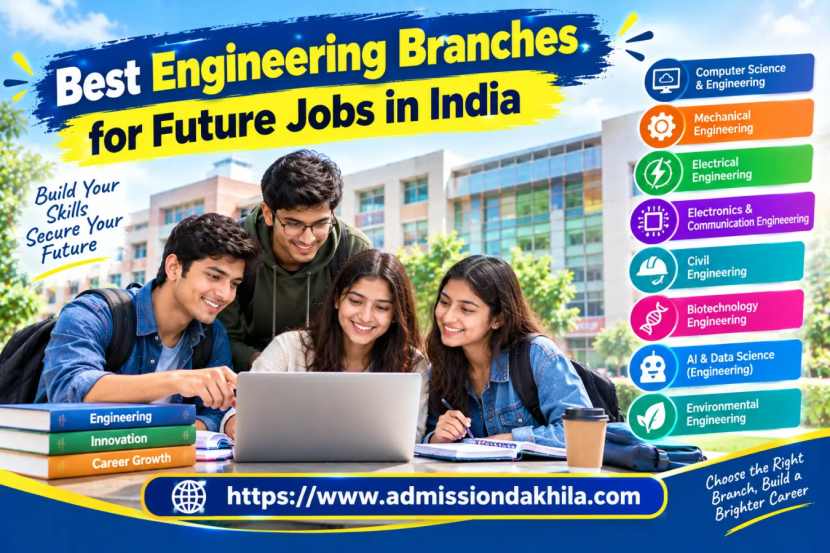
Best Engineering Branches for Future Jobs in India
1. Introduction: Why Engineering Branch Selection Matters
Engineering remains an important route into India's technology, manufacturing, infrastructure, energy, electronics, and research sectors. However, the career opportunities available to graduates vary according to specialization, technical ability, industry conditions, and experience.
A few years ago, many students chose Computer Science Engineering primarily because of software employment opportunities. Today, the picture is broader. Artificial intelligence, semiconductor manufacturing, electric mobility, automation, sustainable construction, and renewable energy are expanding the range of technical careers available to engineering graduates.
At the same time, traditional engineering disciplines continue to matter. Mechanical engineers contribute to product design and manufacturing, civil engineers support infrastructure development, electrical engineers work on power and industrial systems, and electronics engineers develop technologies used in communication, automotive systems, and connected devices.
This means there is no single engineering branch that guarantees the best future for every student.
A student who enjoys mathematics and programming may perform exceptionally well in Computer Science Engineering. Someone who enjoys circuits and physical devices may prefer Electronics and Communication Engineering. A student interested in machines, production, and design might find Mechanical Engineering more rewarding.
The best approach is to choose a branch with a promising industry outlook while building the skills required by employers.
Why engineering careers are changing
Several developments are influencing the demand for engineers in India:
-
Artificial intelligence: Businesses are adopting intelligent tools, automation, and machine-learning systems.
-
Digital transformation: Companies require software engineers, cloud specialists, data professionals, and cybersecurity experts.
-
Semiconductor development: Chip design, testing, electronics, and embedded systems create opportunities for specialized graduates.
-
Electric mobility: Electric vehicles require battery technology, power electronics, embedded software, and control systems.
-
Renewable energy: Solar power, wind energy, energy storage, and smart grids require electrical and related engineering expertise.
-
Infrastructure development: Transportation, urban development, water management, and sustainable buildings create opportunities for civil engineers.
-
Advanced manufacturing: Robotics, industrial automation, computer-aided design, and smart factories connect traditional engineering with digital technologies.
These developments do not mean every related job will grow at the same rate. They indicate areas worth exploring when selecting a course.
The best engineering branch depends on your interests and career goals. Computer Science Engineering is a strong option for students interested in software development, while Artificial Intelligence, Data Science, and Cybersecurity suit students interested in intelligent systems, analytics, and digital security. Electronics and Communication Engineering is relevant to semiconductors and embedded systems, while Electrical Engineering, Mechanical Engineering, and Renewable Energy Engineering offer opportunities in power systems, electric vehicles, manufacturing, and clean energy. Before choosing a BTech branch, compare the syllabus, college placements, fees, internships, and future career opportunities. You can use Admission Dakhila to explore engineering colleges and admission pathways in India.
2. How to Choose an Engineering Branch for Future Jobs
Before comparing individual branches, students should understand the factors that make a specialization suitable for long-term career development.
2.1 Evaluate industry demand
Research the industries that employ graduates from a particular branch. Software, electronics, energy, manufacturing, construction, and telecommunications have different hiring patterns.
Look for opportunities across multiple sectors rather than relying on a single company or job title. For example, Electrical Engineering graduates may work in power generation, electric vehicles, industrial automation, renewable energy, and electrical equipment manufacturing.
A branch with several possible career paths can provide flexibility when market conditions change.
2.2 Consider your interests and aptitude
Engineering courses involve technical subjects, laboratory work, mathematics, projects, and problem-solving. Students are more likely to develop strong skills when they genuinely enjoy their field.
Consider these broad connections:
-
Programming and logical reasoning: Computer Science Engineering.
-
Intelligent software and mathematical modelling: AI and Machine Learning.
-
Statistics, databases, and analytical thinking: Data Science.
-
Circuits, communication, and electronic devices: ECE.
-
Power systems, motors, and energy: Electrical Engineering.
-
Machines, manufacturing, and product design: Mechanical Engineering.
-
Structures, transportation, and construction: Civil Engineering.
-
Biological systems and medical technology: Biomedical Engineering.
These are starting points, not rigid rules. Many engineering careers overlap.
2.3 Compare the complete course curriculum
A specialization's name alone does not reveal the quality of its academic programme.
Review the subjects taught each semester, laboratory facilities, elective choices, internship opportunities, and final-year project requirements. A strong programme should develop foundational knowledge alongside current technical skills.
For instance, an AI programme should teach mathematics, algorithms, programming, data structures, and computing fundamentals, not merely introduce popular AI tools.
Similarly, an ECE programme should provide a solid grounding in electronic circuits, signals, communication systems, and practical laboratory work.
2.4 Check college-specific placement outcomes
Placement outcomes depend on the institution, graduating batch, economic conditions, student performance, and the employers visiting campus.
Before admission, examine:
-
Branch-wise placement percentages.
-
Median salary, where published.
-
Number and type of recruiting companies.
-
Internship and project opportunities.
-
Roles offered to graduates.
-
Whether placement data covers the entire batch or only eligible students.
-
Accreditation, faculty experience, and laboratory infrastructure.
Do not select a college solely because its advertisement mentions a very high package. Ask whether the reported figure represents a typical graduate or an exceptional individual offer.
2.5 Balance fees with career opportunities
A higher-fee programme is not automatically better. Compare tuition, hostel expenses, transport, examination fees, scholarships, and other costs against the education and opportunities provided.
A well-equipped college with good teaching, meaningful projects, and affordable fees may be a better decision than a more expensive institution with limited practical training.
Students researching BTech admissions can explore college options through Admission Dakhila and verify course details directly with the respective institutions.
3. Top 12 Engineering Branches for Future Careers in India
The following branches are worth considering for students planning a BTech degree in 2027. The order is a practical guide based on the breadth of career pathways and emerging applications, not a guaranteed ranking of future salaries or job openings.

1. Computer Science Engineering (CSE)
Broad career flexibility
Computer Science Engineering is a strong choice for students interested in programming, software systems, cloud platforms, databases, and digital products. Graduates can pursue careers across technology companies, financial services, healthcare technology, e-commerce, consulting, and other industries.
Popular jobs: Software developer, backend engineer, cloud engineer, systems engineer, DevOps engineer, and application developer.
Important skills: Data structures, algorithms, programming, operating systems, databases, networking, software testing, and cloud computing.
Future outlook: Strong opportunities for skilled developers, although entry-level competition and automation make practical experience increasingly important.
Best for: Students who enjoy logic, coding, and solving problems with computers.

2. Artificial Intelligence and Machine Learning (AI/ML)
AI and Machine Learning engineering focuses on systems that identify patterns, make predictions, process language, and support intelligent decisions.
Students study programming, probability, statistics, linear algebra, machine learning, deep learning, and data processing. Depending on the programme, they may also explore computer vision, natural language processing, and generative AI.
Popular jobs: Machine learning engineer, AI application developer, applied AI engineer, computer vision engineer, and AI solutions engineer.
Important skills: Python, mathematics, algorithms, model evaluation, data handling, and software engineering.
Future outlook: Promising as businesses develop AI applications, but advanced research roles can require postgraduate study or substantial specialized experience.
Best for: Students interested in mathematics, programming, experimentation, and intelligent systems.

3. Data Science Engineering
Data Science combines computing, statistics, data management, and analytical methods to extract useful insights from large datasets.
Graduates may work in banking, retail, logistics, healthcare, technology, telecommunications, and business consulting. Their work can involve forecasting demand, identifying patterns, improving operations, and supporting data-driven decisions.
Popular jobs: Data engineer, analytics engineer, data analyst, machine learning associate, and data scientist.
Important skills: Python, SQL, statistics, data visualization, databases, data pipelines, and experimental design.
Future outlook: Attractive where organizations have meaningful data and need professionals who can turn it into reliable business decisions.
Best for: Students who enjoy statistics, logical reasoning, programming, and interpreting information.

4. Electronics and Communication Engineering (ECE)
ECE connects hardware, communication technologies, electronic devices, and embedded computing. It offers routes into semiconductor design, telecommunications, automotive electronics, instrumentation, and connected devices.
India's semiconductor ambitions and demand for electronics across vehicles, communications, and data centres make this a branch worth evaluating. NITI Aayog's semiconductor industry roadmap discusses the opportunities associated with chip design, packaging, and the wider electronics ecosystem.
Popular jobs: Electronics design engineer, VLSI engineer, verification engineer, embedded systems engineer, and communication engineer.
Important skills: Digital electronics, circuit design, Verilog or VHDL, embedded C/C++, signal processing, and semiconductor fundamentals.
Future outlook: Promising for students who build strong hardware and design skills; specialized roles may require additional training.
Best for: Students who like physics, electronics, circuits, and the connection between hardware and software.

5. Cybersecurity Engineering
Cybersecurity focuses on protecting networks, applications, devices, and digital information against unauthorized access and attacks.
The field is relevant to financial services, government systems, cloud computing, telecommunications, healthcare, and enterprises that manage sensitive information. Students can enter through CSE or a dedicated cybersecurity specialization.
Popular jobs: Security analyst, application security engineer, penetration tester, cloud security engineer, and incident response specialist.
Important skills: Networking, operating systems, secure coding, identity management, cryptography fundamentals, threat analysis, and ethical security testing.
Future outlook: A valuable specialization as organizations face changing digital risks, although some positions expect certifications, experience, or advanced technical knowledge.
Best for: Students who enjoy investigating problems, understanding systems, and thinking defensively.

6. Electrical Engineering
Electrical Engineering deals with power generation, transmission, motors, control systems, electrical equipment, and power electronics.
It supports industries ranging from utilities and manufacturing to electric vehicles, renewable energy, railways, and industrial automation.
Popular jobs: Electrical design engineer, power systems engineer, protection engineer, electrical maintenance engineer, and power electronics engineer.
Important skills: Circuit analysis, electrical machines, control systems, power systems, simulation tools, and electrical safety.
Future outlook: Particularly relevant to grid modernization, electrification, energy storage, and renewable power integration.
Best for: Students interested in physics, electrical systems, energy, and practical engineering applications.

7. Robotics and Automation Engineering
Robotics and Automation combines mechanical design, electronics, sensors, control engineering, and programming to create machines that perform tasks with limited human intervention.
Applications include industrial manufacturing, warehouses, inspection, agriculture, healthcare equipment, and automated production lines.
Popular jobs: Robotics engineer, automation engineer, controls engineer, mechatronics engineer, and industrial systems engineer.
Important skills: Sensors, control systems, C/C++, Python, embedded systems, CAD, and robotics simulation.
Future outlook: Attractive for candidates with strong interdisciplinary skills, but the number of specialized positions varies by location and industry.
Best for: Students who like machines, electronics, coding, and hands-on projects.

8. Mechanical Engineering
Mechanical Engineering focuses on the design, analysis, manufacturing, and maintenance of machines, equipment, and mechanical systems.
It remains relevant to automobiles, industrial machinery, aerospace components, manufacturing, energy systems, product development, and electric mobility.
Popular jobs: Design engineer, manufacturing engineer, thermal engineer, quality engineer, and product development engineer.
Important skills: Engineering mechanics, thermodynamics, materials science, CAD, finite element analysis, manufacturing processes, and simulation.
Future outlook: Strongest for students who combine core mechanical knowledge with automation, simulation, advanced manufacturing, and digital tools.
Best for: Students who enjoy physics, design, machinery, and understanding how physical systems work.

9. Civil Engineering
Civil Engineering involves the planning, design, construction, and maintenance of buildings, roads, bridges, water systems, transport networks, and other infrastructure.
Graduates can work with construction firms, infrastructure developers, engineering consultants, government departments, and project management organizations.
Popular jobs: Structural engineer, site engineer, planning engineer, quantity surveyor, and transportation engineer.
Important skills: Structural analysis, surveying, geotechnical engineering, construction management, CAD, and building information modelling.
Future outlook: Linked to infrastructure investment, urban development, transport projects, and climate-resilient construction.
Best for: Students who enjoy structures, design, fieldwork, and solving physical infrastructure problems.

10. Renewable Energy Engineering
Renewable Energy Engineering deals with technologies for generating, converting, storing, and managing cleaner energy.
Students may work on solar systems, wind power, energy storage, smart grids, hydrogen technologies, and energy efficiency. Relevant entry routes include Electrical Engineering, Mechanical Engineering, Energy Engineering, and related interdisciplinary programmes.
India's clean-energy transition is creating workforce opportunities across renewable-energy deployment and manufacturing. A 2026 CEEW–NRDC study examines employment associated with the sector's development.
Popular jobs: Solar design engineer, renewable energy engineer, energy analyst, storage systems engineer, and power systems engineer.
Important skills: Electrical systems, energy conversion, power electronics, simulation, energy auditing, and project analysis.
Future outlook: Worth considering as clean-energy infrastructure expands, while actual hiring depends on project investment and technical specialization.
Best for: Students interested in energy, sustainability, electrical systems, and climate-related technology.

11. Chemical Engineering
Chemical Engineering applies chemistry, mathematics, physics, and process design to the large-scale production of materials and chemicals.
Graduates can work in pharmaceuticals, specialty chemicals, food processing, fertilizers, petrochemicals, materials manufacturing, and environmental technology.
Popular jobs: Process engineer, production engineer, quality engineer, process safety engineer, and materials process engineer.
Important skills: Thermodynamics, transport phenomena, process control, plant design, safety, and process simulation.
Future outlook: Relevant to advanced materials, industrial production, energy processes, and sustainable manufacturing, with opportunities varying across sectors.
Best for: Students interested in chemistry, physical processes, manufacturing, and industrial problem-solving.

12. Biomedical Engineering
Biomedical Engineering combines engineering methods with healthcare and biological applications. It can involve medical equipment, diagnostic devices, rehabilitation technology, imaging systems, and health-related research.
Popular jobs: Biomedical equipment engineer, medical device engineer, clinical applications specialist, quality engineer, and medical technology product engineer.
Important skills: Electronics, instrumentation, signal processing, materials, medical-device standards, and data analysis.
Future outlook: An interdisciplinary option as healthcare technology develops, although the availability of dedicated engineering positions differs by region and employer.
Best for: Students interested in technology, medical devices, biology, and healthcare innovation.
Which engineering branch is the best overall?
For students seeking broad access to software and digital careers, CSE is a strong general option. AI/ML and Data Science are attractive for students with the required mathematical and programming aptitude. ECE is worth considering for electronics and semiconductor careers, while Electrical, Mechanical, Robotics, and Renewable Energy Engineering connect students with physical infrastructure, energy, and industrial technologies.
The most suitable choice is the branch where your interests, academic strengths, college facilities, and career goals overlap.
4. Comparison of Engineering Branches and Job Opportunities
The table below compares common engineering specializations, their core focus, and example career paths. These are illustrative opportunities, not a forecast of guaranteed hiring.
|
Engineering branch |
Main focus |
Example career paths |
|---|---|---|
|
Computer Science Engineering |
Software and computing |
Software developer, cloud engineer |
|
AI and Machine Learning |
Intelligent systems |
ML engineer, AI application engineer |
|
Data Science |
Statistics and data |
Data engineer, data analyst |
|
Electronics and Communication |
Circuits and communications |
VLSI engineer, embedded engineer |
|
Cybersecurity |
Digital protection |
Security analyst, security engineer |
|
Electrical Engineering |
Power and electrical systems |
Power engineer, electrical design engineer |
|
Robotics and Automation |
Intelligent machines |
Robotics engineer, controls engineer |
|
Mechanical Engineering |
Machines and manufacturing |
Design engineer, manufacturing engineer |
|
Civil Engineering |
Infrastructure and structures |
Structural engineer, site engineer |
|
Renewable Energy Engineering |
Clean energy systems |
Solar engineer, energy analyst |
|
Chemical Engineering |
Industrial processes |
Process engineer, production engineer |
|
Biomedical Engineering |
Healthcare technology |
Medical device engineer, applications specialist |
CSE vs AI/ML vs Data Science
These three options overlap, but they are not identical.
-
CSE: Usually provides broad computing foundations and allows students to specialize through electives, projects, and work experience.
-
AI/ML: Concentrates more heavily on algorithms that learn from data, mathematical modelling, and intelligent applications.
-
Data Science: Emphasizes statistics, data preparation, analysis, visualization, and predictive modelling.
A student who is unsure about a specific technology may prefer a broad CSE curriculum with strong elective options. A student who already enjoys statistics and machine learning may consider a dedicated specialization after reviewing its syllabus.
ECE vs Electrical Engineering
ECE generally emphasizes electronic devices, communication, digital systems, and embedded computing. Electrical Engineering generally emphasizes power systems, electrical machines, power electronics, and energy distribution.
Both can lead to careers in electric vehicles and industrial technology, but the preferred specialization depends on the role. Embedded vehicle electronics may align with ECE, while motors, charging infrastructure, and power systems may align more closely with Electrical Engineering.
Mechanical vs Robotics Engineering
Mechanical Engineering offers a broad foundation in machines, materials, design, and manufacturing. Robotics Engineering integrates mechanical systems with electronics, control systems, and software.
Students who prefer a wider range of conventional engineering roles may value Mechanical Engineering's breadth. Students who are particularly interested in automation may prefer a robotics-focused programme, provided it has strong laboratories and a sound engineering foundation.
5. Engineering Branches with High Salary Potential
Many students search for engineering branches with the highest salaries. The important distinction is between a branch's potential and the typical outcome for its graduates.
5.1 Computer Science Engineering
Software engineering can offer strong earning opportunities in product companies, cloud services, financial technology, enterprise software, and global technology organizations. However, salary differences between employers can be substantial.
Candidates with strong programming, problem-solving, system design, and project experience may have access to more competitive roles.
5.2 AI and Machine Learning
AI professionals may earn well in specialized roles involving model development, deployment, infrastructure, and applied research. However, not every AI graduate enters an advanced machine-learning position immediately after graduation.
Strong mathematics, software development, and the ability to evaluate AI systems are important differentiators.
5.3 Data Science and Data Engineering
Salary potential varies between reporting-focused roles, data engineering, analytics, and advanced modelling positions. Students should understand that data engineering and software development often require strong database, programming, and system-design skills.
5.4 Electronics and Semiconductor Engineering
Semiconductor design, verification, embedded systems, and specialized hardware engineering can offer valuable career paths. These roles may require focused preparation, advanced laboratory experience, or additional coursework.
5.5 Electrical, Robotics, and Specialized Core Engineering
Electrical power electronics, industrial controls, robotics, and advanced manufacturing can offer competitive careers for appropriately skilled candidates. Compensation depends on the company, role, location, and experience, rather than the course title alone.
How to evaluate salary claims
Before comparing colleges, request reliable, recent placement data. Prefer branch-wise median compensation and the percentage of eligible students placed over an isolated highest-package figure.
Also distinguish between fixed salary, total cost-to-company (CTC), bonuses, stock-based compensation, and internship stipends. These figures are not interchangeable.
For a student choosing a branch in 2027, the more useful question is not simply, "Which branch has the highest salary?" It is, "Which branch can I become genuinely skilled in, and which colleges will help me develop those skills?"
6. Emerging Technologies Creating Engineering Jobs in India
Understanding emerging technologies can help students choose electives, internships, and project topics during their BTech degree.
6.1 Artificial intelligence and generative AI
AI is being used in customer support, software development, manufacturing, healthcare technology, logistics, and business analytics. Engineers may develop applications, integrate existing models, manage data pipelines, or evaluate system performance.
Students should build a strong foundation in programming, mathematics, data handling, and software development. Learning to use AI tools is useful, but understanding their limitations and verifying their outputs is equally important.
6.2 Semiconductor manufacturing and chip design
Semiconductors are essential to computers, smartphones, automobiles, telecommunications equipment, industrial electronics, and AI computing infrastructure.
ECE is a common route into chip design and embedded electronics, while related opportunities may be available to students from Electrical Engineering, Materials Science, and other relevant disciplines.
Useful skills include digital logic, circuit design, hardware description languages, verification, semiconductor devices, and electronics testing.
India's semiconductor roadmap identifies chip design, advanced packaging, and system-level capabilities as important areas in the industry's development.
6.3 Electric vehicles and battery technology
Electric mobility requires expertise in batteries, motors, charging systems, thermal management, power electronics, control systems, and embedded software.
Mechanical, Electrical, ECE, Chemical, and Materials Engineering graduates may all find relevant pathways, depending on their skills and the position.
Students interested in this sector can build projects involving battery monitoring, motor control, energy efficiency, vehicle electronics, and charging systems.
6.4 Renewable energy and smart grids
Solar and wind energy require engineering expertise in design, installation, testing, electrical integration, energy storage, and maintenance.
Electrical Engineering is a particularly relevant foundation for power systems and grid integration, while Mechanical and Chemical Engineering can support other parts of energy technology and industrial processes.
The CEEW–NRDC workforce study published in 2026 examines the employment implications of India's renewable-energy transition.
6.5 Robotics and smart manufacturing
Manufacturing facilities are increasingly using sensors, automated inspection, programmable controllers, robots, and data-driven production systems.
Mechanical, Electrical, ECE, Robotics, and CSE graduates can contribute to different parts of these systems.
A practical student portfolio might include an automated sorting mechanism, a sensor-based monitoring system, a machine-vision prototype, or a programmable industrial control project.
6.6 Cybersecurity and cloud computing
Businesses need secure applications, reliable cloud infrastructure, identity management, and effective monitoring systems.
CSE graduates can enter these areas through coursework, projects, internships, and professional training. Dedicated cybersecurity degrees can also be suitable if they teach strong computing fundamentals.
6.7 Sustainable construction and smart infrastructure
Civil Engineering is evolving through digital construction models, advanced surveying, project analytics, structural monitoring, and sustainable materials.
Students can explore building information modelling, geographic information systems, structural analysis, construction planning, and water-management systems.
The long-term value of these technologies depends on actual adoption, project investment, and employer needs. Students should use emerging trends as guidance rather than assuming that every new technology will generate immediate mass hiring.
7. Engineering Branches for Different Student Interests
The following guide helps connect personal interests with possible specializations.
|
Your interest |
Branches to explore |
Why they may suit you |
|---|---|---|
|
Coding and software |
CSE, IT |
Software and computing foundations |
|
AI and intelligent applications |
CSE, AI/ML |
Programming, algorithms, and mathematical models |
|
Statistics and analytics |
Data Science, CSE |
Data analysis and predictive methods |
|
Circuits and electronic devices |
ECE |
Hardware, communication, and embedded systems |
|
Electricity and energy |
Electrical Engineering |
Power, motors, grids, and electrical equipment |
|
Machines and product design |
Mechanical Engineering |
Design, manufacturing, and physical systems |
|
Automation and intelligent machines |
Robotics, Mechatronics |
Integration of mechanical, electronic, and computing systems |
|
Buildings and transport |
Civil Engineering |
Infrastructure, structures, and construction |
|
Chemistry and industrial production |
Chemical Engineering |
Processes, materials, and manufacturing |
|
Medical devices and health technology |
Biomedical Engineering |
Engineering applications in healthcare |
|
Sustainability and clean power |
Renewable Energy, Electrical |
Energy systems and environmental applications |
Is CSE the safest option for every student?
No. CSE offers broad opportunities, but it is not automatically the best choice for every student.
The field has competition for entry-level roles, and employers may expect demonstrable programming ability, internships, and project experience. Students who dislike coding may find it difficult to maintain motivation throughout the degree.
A student who enjoys electronics or electrical systems could build a more suitable career through ECE or Electrical Engineering. Similarly, students interested in machines and industrial processes should not dismiss Mechanical or Chemical Engineering merely because these branches receive less attention in some college-admission discussions.
The right decision should combine interest, ability, realistic employment options, and the quality of the available programme.
8. How to Select the Right Engineering College in India
Choosing the branch is only half of the decision. The college determines the learning environment, practical exposure, peer group, and access to internships and employers.
8.1 Verify recognition and programme approval
Check the institution's legal status, university affiliation where applicable, and the relevant programme's approval or accreditation requirements. Do not assume that every programme offered by a college has the same status.
Students can consult the AICTE official website for relevant technical education information and approval resources. Admission rules should also be verified with the institution and the appropriate counselling authority.
8.2 Examine laboratory facilities
For CSE and AI, look at computing resources, project opportunities, and access to appropriate software. For ECE, investigate electronics laboratories, embedded systems, and hardware facilities. For Mechanical Engineering, assess workshops, CAD facilities, and manufacturing equipment.
A college should demonstrate how students actually use its facilities, not merely list them in a brochure.
8.3 Compare faculty and curriculum
Review faculty qualifications, subject coverage, elective options, project supervision, and industry collaboration. Ask whether students work on meaningful projects before the final year.
A modern course title cannot compensate for weak fundamentals or limited practical training.
8.4 Investigate placement data
Look at branch-specific results and the roles offered to students. Where possible, compare multiple graduating batches.
Check whether internships are supported by the college, whether recruiters return regularly, and whether students can access opportunities outside campus placements.
8.5 Compare the total cost
Prepare a realistic budget covering:
-
Tuition fees for the entire programme.
-
Hostel and food costs, if applicable.
-
Transport and living expenses.
-
Examination, registration, and laboratory charges.
-
Laptop, software, books, and project materials.
-
Scholarships and applicable financial assistance.
Compare the total cost with your family's budget and the quality of the education offered.
8.6 Use a structured college comparison
You can use this simple framework when reviewing engineering colleges.
|
Selection factor |
What to check |
|---|---|
|
Academic quality |
Faculty, curriculum, teaching methods |
|
Practical exposure |
Labs, workshops, projects |
|
Employability |
Branch-wise placements, internships |
|
Affordability |
Total fees and living costs |
|
Student support |
Mentoring, career services |
|
Recognition |
Applicable approvals and accreditation |
|
Location |
Transport, accommodation, access to industry |
|
Flexibility |
Electives, minors, interdisciplinary options |
Students comparing engineering institutions can explore Admission Dakhila for course and admission-related information, then confirm fees, eligibility, and application deadlines through official college websites.
9. Skills Required to Succeed in Future Engineering Careers
Your branch establishes the academic foundation, but employability also depends on the skills you develop throughout college.
9.1 Technical fundamentals
Master the core subjects of your branch before focusing exclusively on trending technologies. For CSE students, this includes programming, data structures, databases, and operating systems. For ECE students, it includes circuits, digital electronics, and signals. For Mechanical students, it includes mechanics, thermodynamics, materials, and design.
Strong fundamentals make it easier to learn new tools when technologies change.
9.2 Practical projects
Projects show how well you can apply theoretical knowledge. Build projects that solve a specific problem, document your decisions, and explain the results.
Examples include:
-
CSE: A useful web application or a database-driven system.
-
AI/ML: A predictive model evaluated on suitable data.
-
Data Science: A data analysis project with clear conclusions.
-
ECE: A sensor-based embedded system.
-
Electrical: A power-monitoring or motor-control prototype.
-
Mechanical: A CAD design with engineering calculations.
-
Civil: A structural modelling or construction-planning project.
-
Renewable Energy: A solar energy monitoring system.
Quality matters more than the number of projects listed on a résumé.
9.3 Internships and industrial exposure
Internships help students understand actual workplace expectations. They can also reveal which technical areas they enjoy before graduation.
Begin exploring opportunities early. College laboratories, faculty projects, technical communities, and recognized training programmes can provide useful starting points.
9.4 Communication and teamwork
Engineers often work with designers, managers, clients, researchers, and colleagues from other technical disciplines.
Develop the ability to explain technical decisions, write clear documentation, present findings, and collaborate on shared projects.
9.5 Adaptability and continuous learning
Tools and industry practices change over time. Engineers who can learn new systems, evaluate unfamiliar problems, and improve their existing knowledge are better prepared for changing job requirements.
The Economic Survey 2025–26 includes discussion of AI, industry transformation, infrastructure, and skill development, reinforcing the importance of adapting education and skills to economic change.
10. BTech Admission Process for 2027
Students interested in future-oriented engineering branches should start preparing their admission plans well before the application deadlines.
Step 1: Check eligibility
For many BTech programmes, applicants need to complete Class 12 with Physics and Mathematics and the required additional subject or subjects. Minimum marks and other conditions vary by institution, programme, category, and admission route.
Some programmes have additional requirements, so check the official eligibility criteria rather than relying on a general rule.
Step 2: Choose an admission route
Common routes include:
-
JEE Main and the relevant counselling processes.
-
State-level engineering entrance examinations and counselling.
-
University-specific entrance examinations.
-
Other admission routes permitted by the relevant institution and regulations.
JEE Advanced is relevant to admission into IIT undergraduate programmes under the applicable eligibility rules. Students should not assume that qualifying for one examination automatically guarantees admission to every engineering college.
For participating institutions, check the official JoSAA and CSAB information through the national admissions portal and the relevant examination websites.
Step 3: Shortlist branches and colleges
Prepare a shortlist that includes preferred branches, realistic alternatives, fee limits, location preferences, and the entrance examinations accepted by each institution.
Do not rank colleges exclusively by reputation. Check the specific branch, its curriculum, and recent outcomes.
Step 4: Prepare documents
Depending on the admission route, applicants may need:
-
Class 10 and Class 12 marksheets or certificates.
-
Entrance examination scorecard and application details.
-
Government-issued identity documents, where required.
-
Recent photographs and signatures in the specified format.
-
Category, domicile, or other certificates, where applicable.
-
Transfer, migration, or other institutional documents, if required.
The exact list depends on the institution and counselling authority.
Step 5: Complete counselling and seat acceptance
Register for the appropriate counselling process, submit choices carefully, and monitor allotment results. Follow instructions for document verification, fee payment, and reporting within the official deadlines.
For private colleges with their own admissions processes, confirm the offer directly with the institution and retain official payment receipts.
Step 6: Verify fees and scholarships
Before accepting a seat, review the full fee schedule, refund policy, scholarship conditions, and any hostel charges. Obtain written confirmation of important terms.
Admission Dakhila can be a starting point for exploring engineering admission options and understanding the questions to ask before applying. Always verify final eligibility, fees, seats, and deadlines through official sources.
11. Common Mistakes to Avoid When Choosing an Engineering Branch
Following trends without understanding the course
AI and Data Science are popular, but a popular name does not guarantee a strong programme. Compare actual subjects, laboratory facilities, and practical learning opportunities.
Choosing only on the basis of salary
Compensation differs widely across companies and job roles. A student should consider aptitude, long-term learning, work preferences, and the quality of available institutions.
Ignoring core engineering disciplines
Electrical, Mechanical, Civil, and Chemical Engineering remain relevant to important parts of the economy. Their career opportunities may be less visible on social media, but they support manufacturing, infrastructure, energy, and industrial production.
Selecting a college based on one placement advertisement
The highest package may represent a single student. Examine median salaries, branch-wise placement rates, eligible student counts, and the types of roles offered.
Neglecting internships and projects
A degree provides the foundation, but practical skills demonstrate what a student can do. Start building relevant experience before the final year.
Assuming that a specialization guarantees a particular job
An AI degree does not automatically make someone an AI researcher, and a cybersecurity degree does not automatically qualify someone for advanced security roles. Job readiness depends on the curriculum, skills, experience, and employer requirements.
Ignoring financial constraints
Choose a programme that is academically suitable and financially manageable. Scholarships and affordable institutions can make a significant difference to the overall value of an engineering degree.
12. Career Planning After Engineering
A strong career plan should begin during the degree, not after graduation.
First year: Build your foundation
Focus on mathematics, programming or branch fundamentals, communication, and study habits. Explore student technical clubs and introductory projects.
Second year: Explore specializations
Identify subjects that interest you. Learn relevant software and tools, participate in technical competitions, and build small but complete projects.
Third year: Develop employable skills
Pursue internships, improve your project portfolio, and prepare for technical interviews or core engineering assessments. Seek feedback from faculty and industry professionals.
Final year: Prepare for placements or further study
Research employers and job descriptions. Prepare a clear résumé, practise technical interviews, and complete a substantial final-year project.
Students interested in postgraduate study can evaluate MTech, MS, research programmes, or management education depending on their goals and eligibility.
Should you pursue higher studies after BTech?
Higher studies may be valuable for specialized research, advanced engineering roles, or career changes. However, they are not compulsory for every engineering career.
Compare the cost, time, curriculum, entry requirements, and expected benefits before choosing postgraduate education.
The most effective long-term strategy is to combine a sound engineering foundation with practical experience and continuous professional development.
13. Frequently Asked Questions About the Best Engineering Branches for Future Jobs in India
These FAQs are designed for students comparing BTech specializations and researching engineering careers for 2027. They use direct questions and concise answers to improve readability and support search visibility.
FAQ 1. Which engineering branch is best for future jobs in India?
Computer Science Engineering, Artificial Intelligence and Machine Learning, Data Science, Electronics and Communication Engineering, Cybersecurity, Electrical Engineering, and Robotics are important options to consider. The best branch depends on your interests, technical strengths, college quality, and preferred industry.
FAQ 2. Which engineering branch has the highest salary in India?
There is no universally highest-paying engineering branch. Skilled software, AI, semiconductor, cybersecurity, and other specialized engineers may earn competitive salaries. Actual compensation depends on the employer, role, experience, technical skills, and location.
FAQ 3. Is CSE better than AI and Machine Learning?
CSE generally provides a broader foundation in computing, while AI/ML focuses more on intelligent systems and machine-learning techniques. CSE may suit students who want flexibility across software careers, whereas AI/ML may suit those who specifically enjoy mathematics, programming, and intelligent applications.
FAQ 4. Is Data Science a good engineering branch for the future?
Data Science can be a good choice for students who enjoy mathematics, statistics, programming, and analytical problem-solving. Opportunities may exist in data engineering, analytics, predictive modelling, and related fields. Students should check whether their chosen programme teaches strong computing and statistical fundamentals.
FAQ 5. Which engineering branch is best for government jobs?
Civil, Mechanical, Electrical, Electronics, and Computer Science Engineering can be relevant to different government technical positions. Eligibility depends on the particular recruitment examination, department, and post. Some technical roles require specific engineering disciplines, so always check the official recruitment notification.
FAQ 6. Which engineering branch is best for students who do not like coding?
Mechanical Engineering, Civil Engineering, Electrical Engineering, Chemical Engineering, and certain other core disciplines may be suitable alternatives. However, many engineering branches now use programming, simulation, or digital tools, so students should expect to learn some relevant computing skills.
FAQ 7. Which engineering branches are best for electric vehicle jobs?
Electrical Engineering, ECE, Mechanical Engineering, Mechatronics, and relevant Chemical or Materials Engineering programmes can lead to electric vehicle careers. Opportunities include battery systems, power electronics, embedded software, motor design, thermal management, and vehicle testing.
FAQ 8. Are traditional engineering branches still valuable in India?
Yes. Civil, Mechanical, Electrical, and Chemical Engineering continue to support infrastructure, manufacturing, energy, transportation, and industrial production. Graduates can strengthen their prospects through internships, practical projects, relevant software, and specialization in emerging applications.
FAQ 9. Which engineering branch should I choose after Class 12 with PCM?
Choose a branch based on your interests and strengths. Students who enjoy programming can explore CSE; those interested in electronic devices can consider ECE; students who enjoy machines may prefer Mechanical Engineering; and those interested in energy may consider Electrical Engineering. Compare college quality, curriculum, fees, and career options before deciding.
FAQ 10. How can Admission Dakhila help students choose an engineering college?
Students can use Admission Dakhila as a starting point for researching engineering courses, colleges, eligibility, and admission-related information. Before applying, verify the latest fees, course approval, entrance requirements, placements, and deadlines directly with the relevant institution or official counselling authority.
14. Conclusion: Choose an Engineering Branch That Builds Your Future
The best engineering branches for future jobs in India are those that combine a strong academic foundation with relevant industry applications and opportunities to develop practical skills.
CSE, AI/ML, Data Science, and Cybersecurity are attractive for students interested in digital technologies. ECE provides pathways into electronics, semiconductors, and embedded systems. Electrical Engineering connects students with power systems, electrification, and energy infrastructure. Mechanical Engineering, Robotics, Civil Engineering, Chemical Engineering, Biomedical Engineering, and Renewable Energy Engineering offer other valuable routes into specialized industries.
There is no guarantee that choosing a particular branch will secure a high salary or a job immediately after graduation. Industry demand changes, and successful careers depend on individual skills, college quality, internships, communication, and continued learning.
Before choosing a BTech programme, compare the curriculum, practical facilities, placement records, fees, entrance requirements, and long-term career options. Select a specialization that matches both your interests and the type of work you want to pursue.
Start your engineering admission research with Admission Dakhila. Visit https://www.admissiondakhila.com to explore engineering education and admission-related information. Shortlist suitable colleges, confirm the official eligibility criteria, compare total costs, and prepare for the 2027 admission cycle.
A thoughtful branch selection, supported by consistent learning and practical experience, can help you build a strong foundation for a rewarding engineering career.