Best Professional Courses After BCom in India: Career Options, Fees, Eligibility and Scope
The best professional courses after BCom in India include Chartered Accountancy (CA), Cost and Management Accountancy (CMA), Company Secretary (CS), MBA, ACCA, CFA, banking and financial services certifications, data analytics, taxation, and financial modelling. CA is suitable for accounting and auditing, CMA for costing and management accounting, CS for corporate governance, MBA for management careers, and CFA for investment-related roles. The right choice depends on your career goals, budget, eligibility, preferred study duration, and professional interests. Students can explore course options and admission guidance through Admission Dakhila at https://www.admissiondakhila.com.
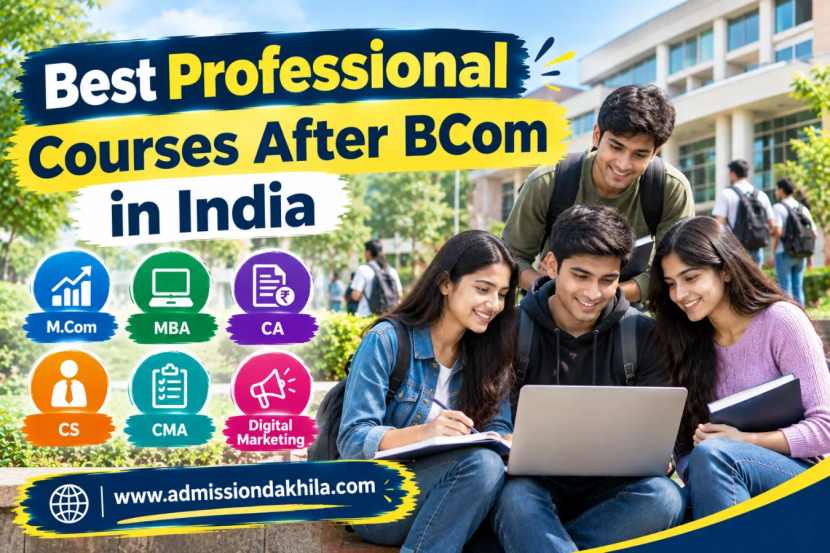
Choosing the right professional course after a Bachelor of Commerce (BCom) can help graduates develop industry-relevant skills, improve their employment prospects, and build a successful career in finance, accounting, taxation, banking, management, analytics, or business.
This comprehensive guide is designed for students planning their next step after BCom in 2027. It covers professional courses, eligibility, estimated fees, duration, career opportunities, salary considerations, and practical advice for choosing the right qualification. It also includes SEO metadata, AI Result and Featured Snippet answers, Voice Search Optimized Answers, FAQs, and an On-Page SEO Checklist for Admission Dakhila.
The information below is intended as original, reader-focused educational content. Fees, eligibility requirements, salaries, and admission rules can vary by institution, professional body, location, and year; verify the latest official details before applying.
If you have completed BCom, you can consider CA, CMA, CS, MBA, ACCA, CFA, banking certifications, or data analytics courses. Choose CA for auditing and taxation, CMA for cost management, CS for corporate law and compliance, MBA for business management, and CFA for investment analysis. If you want practical skills for quicker entry into employment, consider financial modelling, accounting software, taxation, or data analytics. Admission Dakhila can help you explore suitable courses, colleges, and admission options in India.
Best Professional Courses After BCom in India
1. Introduction: Career Planning After BCom
A Bachelor of Commerce is a widely chosen undergraduate degree for students interested in accounting, finance, economics, taxation, banking, and business. However, completing BCom is often only the beginning of a professional journey.
Many graduates face an important question: what should they study next to build a stable and rewarding career?
Some students want to qualify as professional accountants. Others want to work in corporate finance, banking, consulting, investment management, marketing, or business operations. Some want a postgraduate degree, while others prefer shorter courses that teach practical workplace skills.
There is no single course that is best for every BCom graduate. The right option depends on your academic background, interests, financial situation, career timeline, and willingness to prepare for professional examinations.
For example, a student who enjoys accounting and auditing may prefer CA. Someone interested in corporate governance may choose CS. A graduate who wants to become a business manager may pursue an MBA, while someone interested in investment research may explore the CFA qualification.
Graduates who prefer a shorter learning pathway can also consider financial modelling, GST, accounting software, Excel, Power BI, and data analytics.
Admission Dakhila can be included as an educational resource for students comparing courses, colleges, admission requirements, and career pathways. Before enrolling, always confirm professional eligibility and recognition directly with the relevant university or professional body.
2. Why Pursue a Professional Course After BCom?
A professional course can help bridge the gap between academic knowledge and the practical skills employers expect. While a BCom degree provides a foundation in commerce, a specialised qualification can help graduates prepare for a specific job role or professional field.
2.1 Develop specialised knowledge
Professional qualifications focus on particular areas of business. CA develops expertise in accounting, auditing, taxation, and financial reporting. CMA focuses on cost management and business performance. CFA is associated with investment analysis and portfolio management.
Specialisation can help you identify the type of work you want to pursue rather than applying for unrelated entry-level jobs.
2.2 Improve employability
Employers often look for a combination of academic knowledge, technical skills, communication, and practical experience. A course that teaches accounting software, financial analysis, spreadsheet modelling, or data visualisation can strengthen a graduate's job application.
However, completing a certificate does not guarantee employment. Projects, internships, interview preparation, and relevant experience also matter.
2.3 Explore higher earning potential
Certain professional qualifications can lead to specialised roles with higher earning potential over time. The actual outcome depends on examination results, experience, employer, city, job responsibilities, and industry demand.
Graduates should compare the total cost of a course with the realistic entry-level roles it can help them pursue.
2.4 Prepare for long-term career growth
Professional courses can create a foundation for advancement into positions such as financial analyst, management accountant, tax consultant, company secretary, finance manager, business analyst, or investment professional.
The strongest career strategy is to combine a relevant qualification with communication skills, practical experience, and continuous learning.
2.5 Build a career aligned with personal interests
Students do not need to select a course solely because it is popular. Someone who enjoys problem-solving may prefer analytics, while a person who enjoys legal documentation and corporate regulations may find CS more suitable.
Career satisfaction is more likely when the course matches your interests and preferred working style.
3. Best Professional Courses After BCom in India
The following courses cover major career paths for commerce graduates. Some lead to formal professional designations, some are postgraduate degrees, and others are skill-based certifications.
|
Course |
Main career focus |
Indicative duration |
|---|---|---|
|
Chartered Accountancy (CA) |
Audit, taxation, accounting |
Several years; varies by progress |
|
Cost and Management Accountancy (CMA) |
Costing, budgeting, internal finance |
Several years |
|
Company Secretary (CS) |
Corporate law and compliance |
Several years |
|
MBA |
Management, finance, marketing, HR |
Usually 2 years |
|
ACCA |
Accounting and financial reporting |
Varies by exemptions and exam progress |
|
CFA |
Investment research and portfolio management |
Varies by exam progress |
|
Banking certifications |
Banking operations and financial services |
A few months to over a year |
|
Financial modelling |
Corporate finance and valuation |
A few weeks to several months |
|
Data analytics |
Business intelligence and reporting |
A few months to a year |
|
Taxation and GST |
Tax compliance and accounting |
A few weeks to several months |
|
Digital marketing |
Marketing, advertising and business growth |
A few months to a year |
|
Supply chain management |
Procurement, logistics and operations |
Varies by qualification |
These are broad planning estimates, not guaranteed completion times. Professional examinations, practical training, exemptions, and university schedules can significantly change the duration.
3.1 Chartered Accountancy (CA) After BCom
Chartered Accountancy is one of the most established professional routes for commerce graduates in India. It is administered by the Institute of Chartered Accountants of India (ICAI).
CA is particularly suitable for students interested in financial accounting, auditing, taxation, financial reporting, and advisory services.
What does the CA course cover?
The qualification develops knowledge in areas such as:
-
Accounting and financial reporting
-
Auditing and assurance
-
Direct and indirect taxation
-
Corporate and economic laws
-
Financial management
-
Business strategy and professional ethics
Eligibility and admission
Eligible commerce graduates may enter the Intermediate level through the applicable direct-entry route. Under ICAI's published scheme, commerce graduates generally need at least 55% marks for this route; graduates from other streams generally need at least 60%, subject to the official eligibility rules.
Students should confirm current registration, study-period, examination, and practical-training requirements with ICAI before applying.
Career opportunities after CA
A qualified Chartered Accountant may pursue roles such as:
-
Chartered Accountant
-
Audit Associate or Audit Manager
-
Tax Consultant
-
Financial Reporting Specialist
-
Corporate Finance Professional
-
Risk and Assurance Professional
-
Finance Controller, with relevant experience
-
Independent practitioner, subject to applicable rules
Is CA the right course for you?
Choose CA if you enjoy accounting, taxation, financial regulations, and analytical work. It requires disciplined preparation, and the overall timeline depends on examination performance and completion of practical training.
3.2 Cost and Management Accountancy (CMA) After BCom
Cost and Management Accountancy is suitable for students interested in understanding how businesses control costs, measure profitability, allocate resources, and improve financial performance.
In India, the course is offered by the Institute of Cost Accountants of India (ICMAI).
Main subjects
The curriculum generally covers cost accounting, management accounting, corporate laws, taxation, financial management, strategic management, and performance evaluation.
Eligibility
Eligible graduates can generally register directly for the CMA Intermediate programme under the institute's rules. Applicants should check the current course structure and exemptions before registering.
Career options
CMA graduates and qualified professionals may work in:
-
Cost accounting
-
Budgeting and forecasting
-
Management reporting
-
Financial planning and analysis
-
Internal controls
-
Cost audit, where legally eligible
-
Manufacturing finance
-
Business performance management
Who should choose CMA?
CMA is a strong option for graduates who prefer understanding business costs and operational performance rather than focusing primarily on external audit or corporate legal compliance.
3.3 Company Secretary (CS) After BCom
The Company Secretary qualification focuses on corporate governance, company law, regulatory compliance, board procedures, and securities-related regulations.
It is offered by the Institute of Company Secretaries of India (ICSI).
What will you study?
Students learn about company law, corporate governance, compliance frameworks, securities laws, business regulations, and the responsibilities of corporate decision-makers.
Eligibility and course structure
BCom graduates may be eligible for direct entry into the CS Executive programme under ICSI's applicable rules. The complete route includes the prescribed programme stages, examinations, training, and other requirements. Check the current ICSI prospectus for applicable exemptions and registration details.
Career opportunities
-
Company Secretary
-
Corporate Compliance Executive
-
Governance Professional
-
Secretarial Audit Professional, subject to statutory eligibility
-
Legal and Regulatory Compliance Associate
-
Corporate Advisory Professional
Is CS suitable for you?
CS is appropriate if you enjoy interpreting regulations, preparing corporate documentation, managing compliance deadlines, and working with boards, legal teams, and senior management.
3.4 Master of Business Administration (MBA) After BCom
An MBA is a postgraduate management degree that develops knowledge of business operations, organisational leadership, strategy, and decision-making.
It is especially relevant for BCom graduates who want to move into management, consulting, marketing, finance, human resources, or business analytics.
Popular MBA specialisations
-
MBA in Finance
-
MBA in Marketing
-
MBA in Human Resource Management
-
MBA in Business Analytics
-
MBA in International Business
-
MBA in Operations Management
-
MBA in Banking and Financial Services
-
MBA in Supply Chain Management
Eligibility and admission
Many MBA programmes require a recognised bachelor's degree and a minimum percentage specified by the institution. Admission may depend on CAT, XAT, CMAT, MAT, state-level examinations, university tests, academic performance, interviews, or other selection criteria.
Requirements differ among institutions. Always check the official admission brochure.
Career opportunities after MBA
MBA graduates may pursue positions such as management trainee, financial analyst, marketing executive, HR associate, business development manager, operations analyst, or consultant. Senior leadership positions generally require additional experience.
Is MBA better than CA after BCom?
Neither is universally better.
CA focuses on accounting, audit, taxation, and financial reporting. MBA develops broader business and management capabilities, although the actual depth depends on the specialisation and institution.
If you want a professional accounting qualification, consider CA. If you want structured management education and access to business-oriented career pathways, compare MBA programmes, entrance requirements, placement reports, and total costs.
3.5 ACCA After BCom
The Association of Chartered Certified Accountants (ACCA) is an international professional accountancy body. Its qualification can be relevant for graduates seeking careers in accounting, audit, financial reporting, and finance functions in organisations with international operations.
What does ACCA cover?
The qualification develops knowledge in financial reporting, taxation, audit, performance management, business strategy, and financial management.
Eligibility and exemptions
Entry eligibility and exemptions depend on the applicant's education and the accreditation or recognition of the specific degree. A BCom graduate may receive exemptions for certain examinations, but exemptions should never be assumed automatically.
Check the official ACCA exemption calculator and current registration requirements before budgeting for the course.
Career opportunities
-
Financial Accountant
-
Reporting Analyst
-
Audit Associate
-
Finance Executive
-
Management Accountant
-
Financial Planning Analyst
Who should consider ACCA?
ACCA may suit students interested in international accounting standards, multinational finance teams, or accounting careers with a global orientation. Compare examination fees, annual subscription costs, exemption rules, and practical experience requirements before enrolling.
3.6 Chartered Financial Analyst (CFA) After BCom
The CFA programme is offered by the CFA Institute and focuses on investment analysis, valuation, portfolio management, and financial markets.
It can be relevant for commerce graduates who enjoy interpreting financial statements, studying companies, understanding investments, and analysing market information.
Major learning areas
-
Ethical and professional standards
-
Financial statement analysis
-
Economics
-
Equity and fixed-income investments
-
Corporate issuers
-
Portfolio management
-
Alternative investments
-
Risk and investment decision-making
Eligibility
CFA enrolment is subject to the institute's current education, graduation timing, and other eligibility requirements. A completed bachelor's degree can satisfy the degree-based requirement, but applicants should check all current conditions on the official website.
Career opportunities
CFA candidates and charterholders may pursue investment research, equity analysis, portfolio support, wealth management, and risk-related roles depending on their qualifications and experience.
Important: Passing examinations or holding the CFA designation does not automatically guarantee an investment job. Relevant experience, analytical ability, and professional conduct remain important.
3.7 Banking and Financial Services Courses
Banking is another possible career direction for BCom graduates. Students can explore banking operations, financial services, credit analysis, retail banking, lending, compliance, and financial product support.
Potential learning pathways include short-term banking certifications, financial services programmes, and preparation for recruitment examinations.
Career opportunities
-
Banking Operations Executive
-
Relationship Executive
-
Loan Processing Associate
-
Credit Operations Analyst
-
Customer Service Officer
-
Financial Services Associate
-
Banking Compliance Support
For public-sector banking jobs, recruitment is governed by the relevant examination and eligibility notification. A private banking certificate is not a substitute for an official recruitment examination.
Before paying for a banking programme, check whether it is offered by a recognised institution, whether any claimed placement arrangement is verifiable, and whether the course actually teaches skills required for the intended role.
3.8 Financial Modelling and Investment Banking Courses
Financial modelling is a practical skill area for commerce graduates who want to understand how businesses forecast revenue, estimate costs, assess investments, and value companies.
A well-designed course may cover spreadsheet modelling, valuation, financial statement analysis, budgeting, forecasting, and presentation of financial information.
Typical course topics
-
Advanced Excel
-
Financial statement analysis
-
Discounted cash flow valuation
-
Comparable-company analysis
-
Budgeting and forecasting
-
Business valuation
-
Scenario and sensitivity analysis
-
Financial presentations
Career opportunities
-
Financial Modelling Analyst
-
Junior Financial Analyst
-
Corporate Finance Associate
-
FP&A Analyst
-
Valuation Support Analyst
-
Investment Banking Analyst, where recruitment requirements are met
Investment banking is competitive, and a short certificate alone is rarely sufficient for highly selective positions. Build practical projects, develop financial knowledge, and research the entry requirements of target employers.
3.9 Data Analytics and Business Analytics
Data analytics is increasingly relevant to business functions because organisations use data to understand customers, measure performance, monitor costs, and support decisions.
Commerce graduates can apply their understanding of accounting and business to analytical work.
Skills to learn
-
Advanced Excel
-
SQL fundamentals
-
Power BI or similar visualisation tools
-
Basic statistics
-
Data cleaning
-
Dashboard development
-
Business reporting
-
Introductory Python, where relevant
Career opportunities
-
Junior Data Analyst
-
Business Analyst
-
Reporting Analyst
-
MIS Executive
-
Sales Operations Analyst
-
Finance Data Analyst
A BCom graduate does not necessarily need to become a software developer to work in analytics. However, the student should be comfortable with numbers, structured problem-solving, and learning technical tools.
A good portfolio might contain a sales dashboard, expense analysis, budget variance report, or customer segmentation project built using sample or publicly available data.
3.10 Taxation and GST Courses
Taxation courses are particularly relevant for graduates who want to work in accounting firms, tax consultancies, businesses, or finance departments.
They may focus on GST compliance, income tax fundamentals, tax documentation, TDS, bookkeeping, and return preparation.
Topics to consider
-
GST concepts and compliance
-
Income tax fundamentals
-
TDS and payroll-related compliance
-
Accounting entries
-
Financial record management
-
Reconciliation
-
Return preparation using relevant software
-
Regulatory updates
Career opportunities
-
Tax Assistant
-
Accounts Executive
-
GST Executive
-
Tax Documentation Associate
-
Junior Tax Consultant, within the person's competence
-
Accounting Support Professional
A practical course should include exercises and realistic case studies rather than relying only on recorded theory.
Tax rules change, so students must learn how to verify current provisions and official guidance. A certificate does not independently authorise a person to perform every regulated professional service.
3.11 Digital Marketing After BCom
Digital marketing is a possible alternative for students who enjoy communication, creativity, business growth, and online consumer behaviour.
A BCom background can be useful in understanding pricing, revenue, customers, and return on marketing investment.
Core skills
-
Search engine optimisation
-
Paid advertising
-
Social media marketing
-
Content strategy
-
Email marketing
-
Web analytics
-
Conversion rate optimisation
-
Marketing campaign reporting
Career options
-
Digital Marketing Executive
-
SEO Executive
-
Content Marketing Associate
-
Performance Marketing Assistant
-
Social Media Executive
-
Marketing Analyst
Students should look for courses with practical assignments, campaign simulations, analytics exercises, and measurable projects. Avoid programmes that promise guaranteed salaries or employment without verifiable evidence.
3.12 Supply Chain and Operations Management
Supply chain management involves procurement, inventory planning, warehousing, transportation, logistics, and coordination between suppliers and customers.
BCom graduates interested in organised business processes may explore short-term supply chain courses or postgraduate programmes in operations and logistics.
Skills and subjects
-
Inventory control
-
Procurement fundamentals
-
Demand forecasting
-
Logistics coordination
-
Enterprise resource planning concepts
-
Vendor management
-
Operations reporting
-
Supply chain analytics
Career opportunities
-
Logistics Coordinator
-
Procurement Assistant
-
Inventory Analyst
-
Operations Executive
-
Supply Chain Analyst
-
Warehouse Operations Associate
For a longer-term management career, a postgraduate qualification in operations or supply chain management may be worth considering. Compare the course curriculum, industry projects, internship support, and placement outcomes before making a decision.
3.13 Other Professional and Skill-Based Courses
In addition to the main pathways above, BCom graduates can explore several related fields.
Human resource management: Suitable for students interested in recruitment, payroll coordination, employee engagement, and HR operations.
Business communication: Useful for improving presentations, professional writing, client interaction, and interview performance.
Entrepreneurship: Relevant to students planning to start a business, join a family enterprise, or develop a startup idea.
Wealth management: Can provide a foundation in financial planning, investment products, and client relationship management. Verify the training provider's credibility and any applicable regulatory requirements.
Enterprise software: Courses covering ERP systems or finance modules may be useful for accounting and operations roles when they include hands-on practice.
Government recruitment preparation: BCom graduates can also explore eligible banking, staff selection, state recruitment, and other public-sector examinations. Each examination has its own eligibility conditions.
4. Course Comparison: Duration, Fees and Career Scope
One of the most important steps is comparing the financial commitment and expected learning outcomes of each course. The table below provides broad planning estimates rather than official fee quotations.
|
Course |
Indicative fee budget |
Main career direction |
|---|---|---|
|
CA |
₹1–3 lakh or more |
Accounting, audit, taxation |
|
CMA India |
₹1–2.5 lakh or more |
Costing, management accounting |
|
CS |
₹1–2.5 lakh or more |
Corporate law, governance |
|
MBA |
₹2–25 lakh or more |
Management and specialisations |
|
ACCA |
₹2–5 lakh or more |
International accounting |
|
CFA |
₹2–4 lakh or more |
Investment analysis |
|
Banking certification |
₹10,000–₹1.5 lakh or more |
Banking operations and finance |
|
Financial modelling |
₹10,000–₹1 lakh or more |
Corporate finance and valuation |
|
Data analytics |
₹15,000–₹1.5 lakh or more |
Reporting and business analysis |
|
GST and taxation |
₹5,000–₹50,000 or more |
Tax and accounting support |
|
Digital marketing |
₹10,000–₹1 lakh or more |
Marketing and online business |
Fees are indicative budgeting ranges, not verified current quotations. Actual expenses may be substantially lower or higher. They may exclude coaching, examination attempts, annual subscriptions, taxes, books, travel, accommodation, and exemptions. MBA tuition varies especially widely by institution. Verify current fee schedules with the relevant provider before enrolling.
4.1 Which course is best for a limited budget?
If your budget is limited, compare official professional-body registration and examination costs with practical short-term courses.
A student seeking an accounting job might begin with Excel, accounting software, GST fundamentals, and bookkeeping practice. A student aiming for a professional designation should compare the complete cost of registration, examinations, study materials, and practical training.
Do not choose a low-priced course merely because it is affordable. Its value depends on the skills taught, recognition where applicable, and relevance to your intended career.
4.2 Which course offers the fastest route to employment?
There is no guaranteed employment timeline. Short skill courses may help you become ready for entry-level interviews sooner, especially if you already have a BCom degree.
For example, an accounting course combined with Excel, GST practice, and a sample bookkeeping portfolio may help prepare you for junior accounts roles. A data analytics course with practical dashboards may support applications for reporting roles.
CA, CMA, CS, ACCA, and CFA follow more extensive examination or experience pathways. They should be chosen for their professional learning and longer-term career value, not simply as a quick job solution.
5. Eligibility and Admission Process After BCom
The admission process depends on whether you select a professional qualification, postgraduate degree, or short-term certification.
Step 1: Confirm your graduation status
Check whether you have completed your degree and received the required marksheets or provisional documents. Final-year students should confirm whether provisional registration is permitted.
Step 2: Check the eligibility rules
Review the official entry requirements of the course provider. Professional institutes may have specific graduate-entry rules, while universities may require minimum marks, entrance examinations, or interviews.
For example, ICAI publishes a direct-entry route for eligible commerce graduates, and ACCA provides an exemption calculator to help applicants determine whether their previous qualifications qualify for examination exemptions.
Step 3: Compare institutions and providers
For university courses, investigate recognition, programme accreditation, curriculum, faculty, internship opportunities, total tuition, and published placement reports.
For skill courses, check the trainer's experience, practical assignments, software access, assessment methods, and refund policy.
Step 4: Prepare your documents
Commonly requested documents may include:
-
Class 10 and Class 12 marksheets
-
BCom marksheets and degree or provisional certificate
-
Government-issued identity document, where required
-
Passport-size photographs
-
Entrance examination scorecard, if applicable
-
Category or reservation certificate, if applicable
-
Work experience documents, if required
-
Additional documents specified by the provider
International qualifications or professional programmes may require further documentation.
Step 5: Submit the application
Complete the official application form, upload accurate information, pay the applicable fee, and retain your registration confirmation.
Step 6: Plan your study schedule
Create a realistic weekly timetable. Professional examination routes require sustained preparation, while practical skill courses benefit from regular exercises and projects.
Step 7: Build experience alongside learning
Where possible, pursue internships, part-time work, supervised projects, or entry-level positions related to your target career.
6. How to Choose the Right Professional Course After BCom
Choosing well means matching your career objective with the qualification, budget, and time you can realistically commit.
Choose by career goal
Interested in accounts, audit and tax?
Consider CA, practical accounting, taxation, or financial reporting.
Interested in company law and compliance?
Explore CS and relevant corporate compliance learning.
Interested in investment and financial markets?
Compare CFA, financial modelling, and investment analysis pathways.
Interested in leadership and business?
Compare MBA specialisations and the quality of individual institutions.
Interested in technology and data?
Explore Excel, SQL, Power BI, and business analytics.
6.1 Assess your strengths
Ask yourself which activities you enjoy: interpreting financial statements, studying regulations, analysing numbers, communicating with customers, managing teams, or solving business problems.
Your interests should influence your decision because different courses involve different types of work.
6.2 Consider your financial position
Calculate the total cost of the course, not just its advertised tuition. Include examination fees, repeat attempts where relevant, software, transport, accommodation, and the possibility of earning less while studying.
If you need to earn soon, a shorter practical course combined with job applications may be more suitable than immediately committing to a long professional qualification.
6.3 Evaluate the time commitment
Some students can devote several hours a day to preparation. Others need to work while studying.
Choose a route that fits your responsibilities. An achievable, consistent plan is generally more useful than selecting a prestigious qualification without considering the time it demands.
6.4 Check recognition and credibility
For formal professional qualifications, use the official awarding body's website. For university degrees, verify institutional and programme recognition under the applicable rules.
For private training certificates, distinguish between a certificate of completion and a legally recognised professional qualification. They are not interchangeable.
7. Career Opportunities and Salary Expectations After BCom
BCom graduates can pursue opportunities in accounting, finance, banking, taxation, marketing, operations, analytics, and administration.
Salary depends on more than the course title. Relevant experience, location, employer size, communication skills, technical ability, professional examination results, and the quality of the institution can all influence compensation.
7.1 Entry-level career directions
|
Career direction |
Possible entry-level roles |
Useful skills |
|---|---|---|
|
Accounting |
Accounts Assistant, Junior Accountant |
Bookkeeping, Excel, accounting software |
|
Taxation |
Tax Assistant, GST Executive |
Tax fundamentals, documentation |
|
Finance |
Junior Financial Analyst |
Financial statements, Excel, analysis |
|
Banking |
Operations Associate |
Customer service, documentation |
|
Analytics |
MIS or Reporting Executive |
Excel, SQL, dashboards |
|
Marketing |
SEO or Marketing Executive |
Communication, campaign analysis |
|
Operations |
Operations Coordinator |
Reporting, organisation |
|
Corporate compliance |
Compliance Assistant |
Documentation, regulatory awareness |
These are possible pathways rather than guaranteed outcomes. Professional titles and regulated responsibilities may require specific qualifications, registration, or experience.
7.2 How to improve your salary potential
Focus on building a credible combination of knowledge and evidence of your abilities.
-
Develop strong Excel and spreadsheet skills.
-
Learn to interpret financial and business reports.
-
Complete practical projects that demonstrate your skills.
-
Improve written communication and presentation.
-
Apply for internships and relevant entry-level roles.
-
Keep your résumé focused on measurable achievements.
-
Learn tools used in your intended industry.
-
Continue professional development as your role changes.
Avoid selecting a course based entirely on online salary claims. Ask whether the reported figures refer to freshers or experienced professionals, whether they are annual CTC or take-home pay, and which employers and locations are represented.
8. Common Mistakes to Avoid When Choosing a Course
8.1 Selecting a course only because it is popular
A popular qualification may not match your strengths or career plans. Compare the actual curriculum and work involved before enrolling.
8.2 Believing guaranteed salary promises
No course can guarantee a particular salary for every graduate. Treat placement and salary claims cautiously unless they are supported by transparent, verifiable data.
8.3 Ignoring the complete fee structure
Registration, examination, training, software, and annual membership costs can add up. Ask for a written fee breakdown before paying.
8.4 Choosing a course without researching employers
Review real job advertisements for the roles you want. Note the qualifications, software, communication abilities, and experience employers request.
8.5 Enrolling in too many certifications at once
Completing several introductory certificates may be less valuable than developing strong skills in one area and applying them through practical work.
8.6 Neglecting internships and projects
Academic knowledge becomes more useful when you can demonstrate how to apply it. Even a small portfolio of well-documented projects can support interviews for relevant entry-level roles.
8.7 Failing to verify the awarding institution
Before registering, confirm who awards the certificate, what the qualification means, whether exemptions are officially recognised, and whether the provider makes claims it cannot substantiate.
9. Why Use Admission Dakhila for Course and Admission Research?
Students comparing professional courses after BCom often need information about eligibility, fees, entrance examinations, colleges, and application procedures.
Admission Dakhila can be positioned as a resource for exploring education options and researching admission-related information in India.
Before making a final decision, students should:
-
Compare suitable courses according to career objectives.
-
Research relevant colleges and institutions.
-
Check eligibility requirements and entrance examinations.
-
Compare fees, scholarships, and financial assistance.
-
Review internships and placement information.
-
Confirm important details with the official institution or awarding body.
Visit Admission Dakhila to explore educational content and admission-related guidance. Use the information as a starting point for research and verify course-specific requirements with the official provider before applying.
10. Frequently Asked Questions About the Best Professional Courses After BCom
Q1. Which is the best professional course after BCom in India?
CA, CMA, CS, MBA, ACCA, CFA, financial modelling, data analytics, and taxation are among the options worth considering. CA suits accounting and auditing, CMA suits cost management, CS suits corporate governance, MBA suits management, and CFA suits investment analysis. The best course depends on your career goals, budget, interests, and preferred study duration.
Q2. Which course after BCom can help me get a job quickly?
Short-term courses in accounting software, Excel, GST, bookkeeping, data analytics, or digital marketing can help develop practical skills for entry-level roles. Employment timing depends on your existing skills, the quality of your training, interview performance, and job availability. No short course guarantees a job.
Q3. Is CA a good career option after BCom?
Yes. CA can be a suitable choice for students interested in accounting, auditing, taxation, financial reporting, and advisory services. Eligible commerce graduates can use ICAI's direct-entry route to Intermediate, subject to the institute's current requirements.
Q4. Can I do an MBA after BCom?
Yes. BCom graduates can apply for MBA programmes if they meet the relevant university's eligibility requirements. Admission may involve CAT, MAT, CMAT, XAT, another entrance test, or an institution-specific selection process.
Q5. Is ACCA better than CA after BCom?
Neither qualification is universally better. CA is an established Indian professional accountancy route, while ACCA may appeal to graduates interested in international accounting and financial reporting. Compare the syllabus, examination structure, practical experience requirements, total fees, and intended job market before deciding.
Q6. Which professional course after BCom is suitable for finance careers?
CA, CMA, CFA, ACCA, MBA Finance, and financial modelling are potential options. CA and CMA offer different accounting and finance specialisations, CFA focuses on investment analysis, and MBA Finance provides broader management education with a finance focus.
Q7. Can I pursue a professional course after BCom without mathematics?
Yes. Many commerce-related qualifications and skill courses do not require advanced school-level mathematics as a universal entry condition. However, finance, statistics, analytics, and investment courses may involve quantitative concepts. Check the specific eligibility criteria and syllabus before applying.
Q8. Which courses after BCom are suitable for students with a limited budget?
Students can explore practical accounting, GST, Excel, bookkeeping, and introductory analytics courses. Some professional qualifications also have structured registration and examination routes, but their total costs vary. Compare official fees, study materials, coaching costs, and the time needed to qualify.
Q9. Is data analytics a good option after BCom?
Data analytics can be a useful option for commerce graduates interested in reporting, business intelligence, financial analysis, and decision support. Start with Excel and basic statistics, then learn tools such as SQL and Power BI. Practical projects can help demonstrate your ability to analyse business data.
Q10. How can Admission Dakhila help students after BCom?
Admission Dakhila can be used as a starting point for researching courses, colleges, eligibility requirements, fees, and admission procedures. Students should verify professional qualification rules, current fee structures, and application deadlines with the official institution before making a decision.
11. Conclusion: Choose the Right Professional Course After BCom
Choosing the best professional course after BCom in India is an important decision that can shape your career direction. The right qualification should align with your interests, financial resources, learning preferences, and long-term ambitions.
If you enjoy accounting, auditing, and taxation, consider CA. If you prefer cost management and business performance, explore CMA. Students interested in corporate governance may choose CS, while MBA can be appropriate for management-oriented careers. ACCA and CFA offer additional pathways for graduates interested in international accounting and investment analysis.
If you prefer developing practical skills before committing to a longer qualification, consider financial modelling, accounting software, GST, Excel, business analytics, or digital marketing. Whichever route you choose, combine your learning with practical projects, internships, communication skills, and relevant work experience.
There is no universal best course or guaranteed salary. Research the curriculum, total cost, recognition, and job requirements before enrolling.
Start planning your next step with Admission Dakhila. Visit www.admissiondakhila.com to explore education and admission-related information, compare your options, and make a more informed decision about your professional future.