Best Technical Courses After Class 12 Science: Career Options, Eligibility, Fees and Scope
The best technical courses after Class 12 Science include BTech in Computer Science, Artificial Intelligence, Data Science, Mechanical Engineering, Civil Engineering, and Electronics; BCA; BSc in Computer Science, Biotechnology and Data Science; BPharm; and technical diploma programmes. Students with PCM can explore engineering, computing and electronics, while students with PCB can consider biotechnology, pharmacy and laboratory-related fields, subject to course eligibility. The right course depends on a student's interests, subjects, budget and career goals. Admission Dakhila helps students explore courses, compare colleges and understand admission options in India.
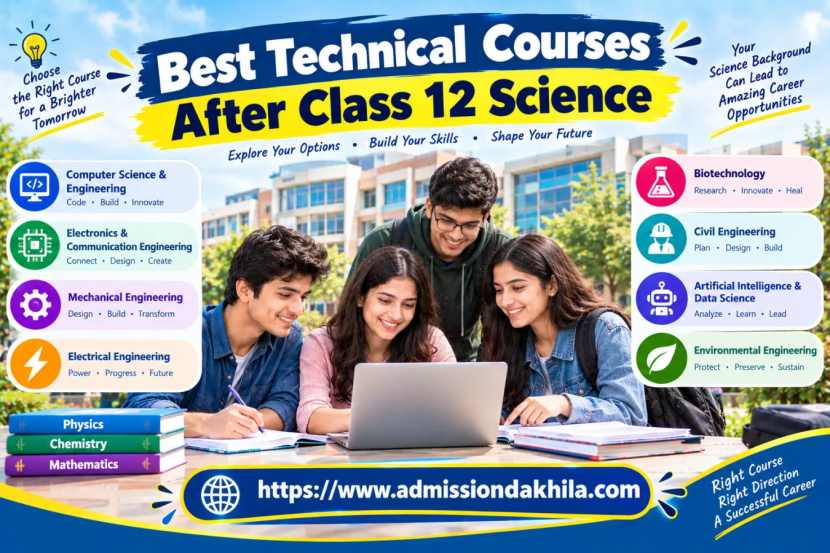
Choosing the right technical course after Class 12 Science is an important decision for students who want to build a career in engineering, computer science, information technology, healthcare technology, data science, electronics, or other professional fields. With new technologies transforming industries, students can explore a wide range of undergraduate degrees, diplomas, and job-oriented courses according to their interests, academic performance, budget, and long-term career goals.
This comprehensive guide by Admission Dakhila explains the best technical courses after Class 12 Science, including eligibility criteria, course duration, approximate fees, admission routes, career opportunities, and tips for selecting the right college.
Best Technical Courses After Class 12 Science
1. Introduction
Class 12 is an important milestone in every student's academic journey. After completing the Science stream, students must decide whether to pursue engineering, computer applications, applied sciences, healthcare technology, or a practical diploma programme.
The right decision can help students build technical expertise, gain industry exposure and prepare for long-term professional growth. However, choosing a course only because it is popular or because friends are pursuing it may not lead to the best outcome.
Technical education combines scientific knowledge with practical skills. Depending on the programme, students may learn programming, designing, laboratory techniques, electronics, manufacturing, cybersecurity, data analysis or engineering principles.
The growing use of digital systems, automation and scientific technologies has also expanded the range of technical career paths available to students. Nevertheless, career opportunities depend on a combination of qualifications, practical experience, communication skills and industry demand—not simply the name of a course.
Through this guide, Admission Dakhila aims to help students understand their options before applying to a college. Students can use this information to shortlist courses, review eligibility requirements and compare institutions based on fees, facilities and career support.
The best technical course after Class 12 Science depends on your subjects and interests. If you studied Physics, Chemistry and Mathematics, consider BTech in Computer Science, AI, Data Science, Electrical Engineering or Mechanical Engineering. If you studied Physics, Chemistry and Biology, consider Biotechnology, Pharmacy and laboratory-related courses that match your eligibility. BCA and selected computing degrees may also be available depending on university requirements. Visit Admission Dakhila at admissiondakhila.com to explore colleges, compare course options and plan your admission.
2. What Are Technical Courses?
Technical courses are educational programmes that develop specialised knowledge and practical skills for working with technology, scientific systems, equipment, software or technical processes.
These programmes may be offered as undergraduate degrees, diplomas, certificates or vocational qualifications.
Main categories of technical education
-
Engineering degrees: BTech and BE programmes in computer science, electrical, mechanical, civil and other engineering disciplines.
-
Computer and IT programmes: BCA, BSc Computer Science, Information Technology and selected AI or data science degrees.
-
Applied science programmes: Biotechnology, microbiology, electronics-related sciences and laboratory disciplines.
-
Healthcare-related technical programmes: Pharmacy, medical laboratory technology and other approved allied health programmes.
-
Diploma and vocational courses: Polytechnic, ITI and specialised skill-based programmes.
-
Emerging technology courses: Artificial intelligence, robotics, cybersecurity, cloud computing and the Internet of Things.
A degree generally provides broader academic foundations, while a diploma or certificate may concentrate on a particular skill area. The best choice depends on the student's goals, available budget and desired level of qualification.
3. Best Technical Courses After Class 12 Science
The following courses are worth exploring. Their eligibility and duration may vary by university, regulatory requirements and programme structure.

1. BTech in Computer Science Engineering
Typical duration: 4 years
Computer Science Engineering is suitable for students interested in programming, software development, algorithms, operating systems, databases and computer architecture.
Career paths: Software developer, systems engineer, application developer, software tester and backend developer.

2. BTech in Artificial Intelligence and Machine Learning
Typical duration: 4 years
This programme focuses on intelligent software, machine learning, data-driven systems, predictive models and automation. Mathematics and programming are important foundations.
Career paths: Junior machine learning engineer, AI software developer, data analyst and AI application specialist.

3. BTech or BSc in Data Science
Typical duration: 3–4 years
Data science combines statistics, programming, data visualisation and analytical methods to extract useful information from data.
Career paths: Data analyst, business intelligence analyst, junior data scientist and reporting analyst.
4. BTech in Electrical Engineering
Typical duration: 4 years
Electrical Engineering covers electrical circuits, power systems, electrical machines, control systems and related technologies.
Career paths: Electrical design engineer, maintenance engineer, power systems professional and testing engineer.

5. BTech in Mechanical Engineering
Typical duration: 4 years
Students learn about mechanics, thermodynamics, manufacturing, machine design, materials and production systems.
Career paths: Design engineer, production engineer, quality engineer and maintenance professional.

6. BTech in Civil Engineering
Typical duration: 4 years
Civil Engineering focuses on structures, construction materials, transportation, surveying, geotechnical engineering and infrastructure development.
Career paths: Site engineer, design assistant, quantity estimation professional and project engineer.

7. BTech in Electronics and Communication Engineering
Typical duration: 4 years
This field covers electronic devices, communication networks, embedded systems, signal processing and digital electronics.
Career paths: Electronics engineer, embedded systems developer, testing engineer and communication systems professional.

8. Bachelor of Computer Applications (BCA)
Typical duration: usually 3–4 years, depending on programme
BCA focuses on computer applications, software development, programming, databases and web technologies. It can be an option for students who prefer computing without choosing a conventional engineering degree.
Career paths: Junior software developer, web developer, application support analyst and QA tester.

9. BSc or BTech in Biotechnology
Typical duration: 3–4 years
Biotechnology applies biological knowledge and technology to areas such as healthcare, agriculture, food science and industrial research.
Career paths: Laboratory assistant, research support professional, quality control trainee and biotechnology production associate.

10. Bachelor of Pharmacy (BPharm)
Typical duration: 4 years
BPharm introduces pharmaceutical chemistry, pharmacology, pharmaceutics, drug quality and related subjects. It is relevant to students interested in pharmaceutical science.
Career paths: Pharmaceutical production trainee, quality control associate, regulatory support professional and pharmacy-related roles subject to applicable registration rules.

11. BSc in Information Technology or Computer Science
Typical duration: usually 3–4 years
These programmes cover programming, databases, networking, computer systems and software applications. The precise curriculum depends on the institution.
Career paths: IT support analyst, junior developer, network support professional and software testing associate.

12. BTech in Robotics and Automation
Typical duration: usually 4 years
Robotics combines mechanical systems, electronics, sensors, programming and control engineering. Students should check the laboratory facilities and actual course curriculum before enrolling.
Career paths: Automation engineer trainee, robotics technician, control systems assistant and industrial automation professional.
Other options include aerospace engineering, chemical engineering, environmental technology, instrumentation engineering, medical laboratory technology and specialised computer courses. Students should verify that their Class 12 subjects meet the relevant admission requirements.
4. Best Technical Courses After Class 12 PCM
Students who have studied Physics, Chemistry and Mathematics generally have access to a broad selection of engineering and technology programmes.
4.1 Engineering courses
BTech and BE programmes are suitable for students who enjoy mathematics, logical reasoning, design, problem-solving and applied science.
Popular branches include:
-
Computer Science Engineering
-
Artificial Intelligence and Machine Learning
-
Data Science and Engineering
-
Information Technology
-
Electrical Engineering
-
Electronics and Communication Engineering
-
Mechanical Engineering
-
Civil Engineering
-
Chemical Engineering
-
Aerospace Engineering
-
Robotics and Automation
-
Instrumentation and Control Engineering
Each specialisation has different learning requirements. Computer Science usually involves substantial programming, whereas Civil Engineering focuses more on construction, structural systems and infrastructure. Electrical Engineering covers circuits and power systems, while Mechanical Engineering emphasises machines, design and manufacturing.
Students should choose a branch based on their interests and the quality of the programme rather than relying entirely on claims about which branch offers the highest salary.
4.2 Computer and IT courses
Students interested in computers but unsure about a conventional engineering degree can explore:
-
Bachelor of Computer Applications
-
BSc Computer Science
-
BSc Information Technology
-
BSc Data Science
-
BCA with an AI or data analytics specialisation
-
Diploma in Computer Engineering
-
Diploma in Information Technology
Eligibility varies considerably. Some programmes require Mathematics in Class 12, while others accept different subject combinations. Students must confirm the exact criteria of each institution.
4.3 Architecture and design technology
Students interested in buildings, spatial planning, design and technical drawing may consider architecture or technology-oriented design programmes.
Bachelor of Architecture generally takes five years. Admission requires compliance with the applicable subject, aptitude-test and regulatory requirements. Students should review the current Council of Architecture rules and the institution's admission notification.
Other possibilities include industrial design, product design, CAD drafting and digital modelling, depending on the student's academic background.
5. Best Technical Courses After Class 12 PCB
Students who studied Physics, Chemistry and Biology can also pursue technical and applied science programmes. Not every technical degree requires Mathematics, but some programmes have strict subject requirements.
5.1 Biotechnology
Biotechnology combines biological sciences with laboratory techniques and technology. Students study subjects such as genetics, molecular biology, microbiology and bioprocessing.
Graduates may work in laboratory support, biotechnology production, quality assurance or research assistance. Advanced research positions may require postgraduate qualifications.
5.2 BSc Microbiology
Microbiology focuses on microorganisms and their applications in healthcare, food production, environmental testing and scientific research.
Possible career directions include laboratory assistant, microbiology technician and quality control roles, depending on qualifications and employer requirements.
5.3 Bachelor of Pharmacy
BPharm is a professional undergraduate programme focused on pharmaceutical science. Students interested in medicines, drug formulation, pharmaceutical manufacturing and quality assurance may find it suitable.
Applicants should check current eligibility requirements and the approval status of the institution under the relevant pharmacy regulatory framework.
5.4 Medical Laboratory Technology
Medical Laboratory Technology and related allied health programmes train students in laboratory procedures, sample handling, testing methods and laboratory safety.
Depending on the exact qualification and applicable regulations, graduates may seek laboratory technician or technologist positions in hospitals, diagnostic laboratories and healthcare organisations.
The programme's recognised qualification, clinical training arrangements and applicable registration requirements should be checked before admission.
5.5 Biomedical science and biomedical technology
Biomedical science and biomedical technology explore the relationship between biological systems, medical testing and technology. Programme names and eligibility requirements differ between universities.
Students should compare the curriculum carefully: a laboratory science degree, biomedical engineering degree and medical equipment technology diploma may lead to different career paths.
Important: PCB students should not assume that they can enter every BTech branch. Many engineering programmes require Mathematics in Class 12. Similarly, students with PCM should check whether a healthcare programme requires Biology.
6. Short-Term Technical Courses After Class 12 Science
Students who want to develop specific skills before committing to a long degree can consider technical diplomas and certificate programmes.
|
Course |
Indicative duration |
Main skills |
|---|---|---|
|
Web development |
3–12 months |
HTML, CSS, JavaScript and web applications |
|
Python programming |
3–9 months |
Programming fundamentals and automation |
|
Data analytics |
3–12 months |
Spreadsheets, SQL and data visualisation |
|
Cybersecurity fundamentals |
3–12 months |
Security basics, networks and threat awareness |
|
CAD drafting |
3–12 months |
Technical drawings and design software |
|
Computer hardware and networking |
6–18 months |
Hardware maintenance and network support |
|
Industrial automation basics |
6–18 months |
Sensors, control systems and automation fundamentals |
|
Graphic and UI/UX design |
3–12 months |
Visual design and user interface principles |
These are broad indicative ranges, not fixed course durations. Actual programmes may be shorter or longer.
Short-term training can help students build a portfolio, test their interest in a field or supplement a formal degree. However, a short certificate does not automatically replace a recognised university degree or professional qualification.
Before enrolling, students should review the course syllabus, trainer experience, practical assignments, software access, project work and assessment methods.
7. Technical Courses After 12th: Duration and Approximate Fees
Fees vary by institution type, state, location, programme, laboratory requirements and admission category. The following table offers broad planning estimates for India rather than verified quotations from individual colleges.
|
Course |
Typical duration |
Indicative tuition fee |
|---|---|---|
|
BTech / BE |
4 years |
₹2–16 lakh total |
|
BCA |
3–4 years |
₹1–6 lakh total |
|
BSc Computer Science / IT |
3–4 years |
₹60,000–6 lakh total |
|
BSc Data Science |
3–4 years |
₹1–8 lakh total |
|
BSc Biotechnology |
3–4 years |
₹60,000–6 lakh total |
|
BPharm |
4 years |
₹2–8 lakh total |
|
BArch |
5 years |
₹3–15 lakh total |
|
Polytechnic diploma |
Commonly 3 years |
₹30,000–4 lakh total |
|
ITI technical trade |
Commonly 6 months–2 years |
₹5,000–1 lakh total |
|
Short-term technical certificate |
A few months to 1 year |
₹5,000–1.5 lakh |
These ranges are deliberately broad because fees can fall outside them. Government institutions may be considerably less expensive than private institutions, while some specialised programmes have higher costs.
For reference, published course guides from Careers360 and universities provide additional examples of programme duration, eligibility and fees. Careers360 offers a technical courses after Class 12 guide, while [Guru Gobind Singh Indraprastha University-style programme comparisons are not a substitute for official fee notices] when checking specific institutions.
7.1 Additional costs students should consider
Tuition is only one part of the total education budget. Students may also need to pay for:
-
Admission and registration charges
-
Examination and university fees
-
Hostel and mess expenses
-
Transport and daily commuting
-
Laptops, books and learning materials
-
Laboratory equipment or workshop supplies
-
Internship travel and project costs
Request a written fee breakdown before paying a deposit. Also ask about refund rules, scholarships, instalment options and whether the quoted amount covers the entire programme.
8. Eligibility Criteria for Technical Courses After Class 12
Admission eligibility depends on the programme and institution. Common requirements include the following.
8.1 Academic qualifications
-
BTech and BE: generally require Class 12 with the prescribed science subjects, including Mathematics and Physics, plus any other subjects specified by the institution and applicable rules.
-
BCA: may accept students from different subject combinations, although some universities require Mathematics or Computer Science.
-
BSc Computer Science or Data Science: often requires Mathematics or related subjects.
-
Biotechnology: may accept PCM, PCB or both, depending on the programme.
-
BPharm: requires the prescribed combination of subjects, commonly Physics and Chemistry along with Mathematics or Biology.
-
BArch: requires compliance with the current academic and aptitude-test criteria.
-
Diploma and ITI programmes: eligibility depends on the trade and institute; many diploma routes begin after Class 10, while other programmes accept Class 12 candidates.
8.2 Minimum marks
Many institutions prescribe a minimum aggregate, sometimes around 45–60%, but the exact threshold is not universal. Some programmes and admission categories have different requirements.
Students should read the current official admission brochure instead of assuming that the same percentage applies to every college.
8.3 Age and additional conditions
Certain specialised programmes may have age limits, medical fitness standards, physical requirements or other conditions. Aviation and maritime programmes are examples where additional requirements may apply.
9. Entrance Exams and Admission Process
Some technical programmes admit students through national or state-level entrance examinations. Others use university-level tests, qualifying examination marks or a combination of merit and counselling.
9.1 Important entrance examinations
|
Examination |
General relevance |
|---|---|
|
JEE Main |
Admission to participating engineering institutions and other specified programmes |
|
JEE Advanced |
Admission to IIT undergraduate programmes, subject to eligibility |
|
CUET-UG |
Undergraduate admissions at participating universities and programmes |
|
BITSAT |
Undergraduate programmes at participating BITS campuses |
|
VITEEE |
Engineering admissions at VIT under its current rules |
|
State engineering entrance or counselling systems |
Admission to participating state institutions |
|
University-specific tests |
Admission to particular universities and courses |
|
NATA or applicable architecture admission route |
Architecture admissions, subject to current rules |
Not every examination is necessary for every course. Students should check the latest official notification for exam dates, subject requirements, registration procedures, score validity and participating institutions.
9.2 Step-by-step admission process
-
Identify your preferred field. Decide whether you want engineering, computing, applied science, healthcare technology or a vocational qualification.
-
Check eligibility. Confirm the required Class 12 subjects, minimum marks and any additional conditions.
-
Shortlist colleges. Compare course recognition, curriculum, fees, location, facilities and student support.
-
Register for the relevant examination. Complete the application through the official exam portal if required.
-
Apply to institutions. Follow their application deadlines and upload the requested documents.
-
Participate in counselling or selection. Follow the applicable merit list, entrance score or university selection procedure.
-
Verify the offer and fees. Read the admission letter, refund policy and payment schedule before confirming your seat.
For students planning admission in 2027, it is particularly important to distinguish between announced dates and expected schedules. Do not rely on an old year's timetable as confirmation of the next admission cycle.
10. Best Colleges for Technical Courses in India
The best college depends on the course, entrance rank, budget, location and career objectives. Rather than treating every institution as equally strong across all disciplines, compare colleges within your chosen field.
10.1 Engineering institutions
Students targeting engineering may research the Indian Institutes of Technology, National Institutes of Technology, Indian Institutes of Information Technology and other recognised public or private engineering institutions.
Admission criteria and programme availability differ. Some institutions are highly competitive, while others provide different routes to admission.
10.2 Universities offering computing and applied science
For BCA, BSc Computer Science, Data Science and Biotechnology, compare universities on the strength of their curriculum, faculty, laboratory access, project opportunities and internship support.
A university that offers a good computing degree may not necessarily be the strongest choice for biotechnology or another laboratory-based programme.
10.3 Colleges in Uttar Pradesh and Delhi NCR
Students interested in studying closer to home can compare colleges in Noida, Greater Noida, Ghaziabad, Delhi and other cities in Uttar Pradesh.
Important factors include:
-
Relevant programme and branch availability
-
Affiliation and recognition status
-
Actual tuition and hostel costs
-
Faculty and laboratory facilities
-
Internship and placement support
-
Distance from home and transport options
-
Scholarship eligibility and payment terms
Admission Dakhila can be used as a starting point for researching college options, understanding admission requirements and preparing a shortlist. Always verify the final information with the official college website and relevant regulator.
11. Career Opportunities After Technical Courses
Technical qualifications can lead to careers in several sectors, but the exact opportunities depend on the student's specialisation, skills and experience.
11.1 Information technology and software
Computer-related graduates may pursue software development, application support, web development, testing, database management and IT operations.
Employers may evaluate programming ability, problem-solving, practical projects, internships and communication skills alongside academic qualifications.
11.2 Artificial intelligence and data
AI and data-related careers often require strong foundations in programming, statistics, mathematics and data handling.
Entry-level roles may include data analyst, reporting analyst, junior AI developer and machine learning support positions. Advanced research and engineering roles may require additional experience or postgraduate study.
11.3 Manufacturing and engineering
Mechanical, electrical, electronics and industrial engineering graduates can explore design, production, maintenance, quality assurance, testing, automation and project-related work.
Hands-on experience, safety awareness and familiarity with industry tools can improve job readiness.
11.4 Construction and infrastructure
Civil engineering graduates may work in construction management, site supervision, structural design support, surveying, quantity estimation and infrastructure projects.
The nature of work can vary substantially between office-based design roles and site-based positions.
11.5 Biotechnology and pharmaceuticals
Students in biotechnology and pharmacy can explore laboratory operations, production, quality control, regulatory support and research assistance, subject to their qualifications and applicable professional requirements.
Some specialist roles require a master's degree, a recognised professional registration or additional training.
11.6 Freelancing and entrepreneurship
Students with practical digital skills may eventually build careers in web development, software services, technical design, IT support or digital product development.
Freelancing requires more than course completion. Students need demonstrable work, customer communication, project management and an understanding of contracts and payments.
12. Expected Salary After Technical Courses
Salary is a common consideration when choosing a technical programme. However, no course guarantees a specific salary, and advertised placement packages should not be treated as typical outcomes.
The following figures are broad illustrative ranges for some entry-level roles in India, not verified current salary averages or promises.
|
Career path |
Illustrative annual starting range |
|---|---|
|
Junior software developer |
₹3–8 lakh |
|
IT support or network support |
₹2–5 lakh |
|
Junior data analyst |
₹3–7 lakh |
|
AI/ML-related entry-level role |
₹4–10 lakh |
|
Junior mechanical engineer |
₹2.5–5 lakh |
|
Junior civil engineer |
₹2.5–5 lakh |
|
Electrical or electronics engineer |
₹2.5–6 lakh |
|
Laboratory or biotechnology support role |
₹2–5 lakh |
|
Pharmaceutical production or quality trainee |
₹2.5–5 lakh |
Actual compensation can be lower or higher depending on the employer, city, technical skills, degree, internship experience and hiring conditions. AI/ML positions in particular may require stronger mathematical and programming skills than introductory course descriptions suggest.
When reviewing placement reports, check the number of students placed, the number eligible for placement, median salary, highest package, employer list and whether figures apply to the relevant branch.
13. How to Choose the Right Technical Course
A practical decision should consider at least five factors.
13.1 Your academic strengths
Students who enjoy Mathematics and logical problem-solving may prefer engineering, computing, electronics or data-related courses.
Students who enjoy Biology and laboratory work may prefer biotechnology, microbiology, pharmacy or eligible allied health programmes.
These are general suggestions, not strict rules. Students should consider their interests and the actual subject requirements of the programmes.
13.2 Your long-term career goals
Ask yourself whether you want to develop software, design machines, work in a laboratory, build infrastructure, manage technical systems or gain practical vocational skills.
A clear career direction makes it easier to compare course content and internship opportunities.
13.3 Your budget
Calculate the total cost of studying, including tuition, accommodation, transport and equipment.
A more expensive college is not automatically better. Compare the learning experience, recognition, support services and career outcomes against the total expense.
13.4 Course quality
Review the syllabus, faculty profiles, practical facilities, project work and internship arrangements. In technical fields, access to equipment and opportunities to practise can be especially important.
13.5 Flexibility for further study
Consider whether the programme provides a suitable pathway to postgraduate education, professional certifications or specialised employment.
A three-year degree, a four-year degree and a vocational diploma may serve different goals. Choose according to the pathway you actually want to follow.
14. Technical Degree vs Diploma: Which Is Better?
Neither option is universally better. The appropriate choice depends on your intended occupation, financial circumstances and willingness to pursue further education.
|
Factor |
Undergraduate degree |
Technical diploma |
|---|---|---|
|
Main purpose |
Broader academic and professional foundation |
Focused technical or vocational training |
|
Typical duration |
3–5 years, depending on course |
Often 1–3 years |
|
Learning style |
Theory, projects and practical work |
Often more concentrated practical training |
|
Further education |
May support postgraduate study, subject to eligibility |
May support employment or progression through eligible routes |
|
Cost |
Varies widely |
May be lower, but depends on institution |
|
Best suited for |
Students seeking a full undergraduate qualification |
Students seeking targeted skills or a shorter training route |
Students should confirm whether a diploma is recognised and whether it provides eligibility for the next qualification they intend to pursue. Lateral-entry opportunities are governed by specific rules and should never be assumed automatically.
15. Benefits of Technical Education
Technical education can help students develop practical and analytical abilities that are useful across multiple industries.
Industry-oriented learning
Technical programmes often include laboratory work, workshops, software projects, technical drawing, internships or industrial training.
Specialisation
Students can build expertise in a particular area instead of studying only broad introductory subjects.
Diverse career pathways
Technical skills can be applied in IT, engineering, manufacturing, healthcare, infrastructure, research and digital services.
Opportunities for continued learning
Many technical careers evolve rapidly. Students can continue learning through postgraduate study, professional certifications and independent projects.
Potential for self-employment
Some technical fields allow skilled professionals to provide services independently, build products or establish small businesses. Success depends on competence, customer demand and business execution.
16. Common Mistakes Students Should Avoid
Choosing a technical course is easier when students avoid the following mistakes:
-
Selecting a course only because it is currently trending.
-
Assuming a specialised degree guarantees a high-paying job.
-
Ignoring eligibility requirements and entrance examinations.
-
Applying without checking recognition and affiliation.
-
Comparing colleges only by their highest advertised placement package.
-
Overlooking hostel, transport and other additional costs.
-
Enrolling in a short certificate while assuming it is equivalent to a professional degree.
-
Ignoring the syllabus and practical training facilities.
-
Missing application deadlines because of reliance on unofficial announcements.
-
Paying admission fees without understanding the refund policy.
Students should maintain a shortlist of multiple suitable institutions and compare them using the same criteria. This makes it easier to identify realistic options rather than concentrating on a single college.
17. How Admission Dakhila Can Help Students
Selecting a course is only the first step. Students must also identify suitable colleges, understand admission procedures, compare tuition fees and check which entrance examinations are required.
Admission Dakhila is an education information platform that students can use to explore college and course-related information and plan their next steps after Class 12.
Students preparing for technical admissions can use Admission Dakhila to research topics such as:
-
Engineering colleges and BTech specialisations
-
Computer Science and IT courses
-
College fees and admission requirements
-
Diploma and vocational programmes
-
Entrance examinations and counselling
-
Scholarships and college selection
-
Admission opportunities in Uttar Pradesh and Delhi NCR
Before applying, students should verify all important information with the official college, university, examination authority or relevant regulatory body. Admission Dakhila can support the research process, but final eligibility and admission decisions depend on the applicable official rules.
18. Frequently Asked Questions (FAQs)
Q1. Which are the best technical courses after Class 12 Science?
Popular options include BTech in Computer Science, AI, Data Science, Electrical Engineering, Mechanical Engineering and Civil Engineering. Students can also consider BCA, BSc Computer Science, Biotechnology, BPharm and technical diploma programmes. The best option depends on academic subjects, interests, eligibility and career goals.
Q2. Which technical course is best after 12th Science with PCM?
Students with PCM can explore BTech, BE, BCA, BSc Computer Science, Data Science, Electronics, Robotics and other eligible technical programmes. They should compare the curriculum, fees, entrance requirements and practical training before selecting a course.
Q3. Which technical courses are available after 12th Science PCB?
PCB students can consider Biotechnology, Microbiology, BPharm, selected biomedical science programmes and eligible medical laboratory or allied health courses. Requirements differ by programme, so students should confirm the accepted subject combination before applying.
Q4. Can I pursue a technical course without Mathematics in Class 12?
Yes, some technical and applied science courses accept students without Mathematics, including certain biotechnology, pharmacy, BCA and allied health programmes. However, many engineering programmes require Mathematics. Always check the eligibility criteria of the specific course and institution.
Q5. Which technical course has the highest salary potential?
Computer Science, AI, Data Science, cybersecurity and specialised engineering can offer strong earning potential. However, salary depends on technical ability, employer, experience, location and market demand. No course guarantees a high salary.
Q6. What are the best short-term technical courses after Class 12 Science?
Options include web development, Python programming, data analytics, cybersecurity fundamentals, CAD drafting, computer hardware and networking, and UI/UX design. Course quality, practical projects and recognised certification matter more than duration alone.
Q7. What is the duration of technical courses after 12th Science?
Many BTech and BE programmes take four years, BCA and BSc programmes usually take three to four years, BPharm takes four years, and BArch takes five years. Technical diplomas and certificates may take several months to three years, depending on the qualification.
Q8. Are technical courses expensive in India?
Costs vary considerably. Government institutions may offer relatively affordable education, while some private and specialised programmes charge higher fees. Students should compare total tuition, hostel, transport, examination and other expenses before deciding.
Q9. Which entrance exams are required for technical courses after Class 12?
Depending on the course and institution, students may need JEE Main, JEE Advanced, BITSAT, VITEEE, CUET-UG, a state-level examination or a university-specific test. Some courses admit students through merit-based selection. Check the current official admission notification.
Q10. How can Admission Dakhila help me choose a technical course?
Admission Dakhila helps students research courses, explore college options and understand admission-related information. Students can visit admissiondakhila.com to begin comparing available options and should verify final eligibility, fees and deadlines with official sources.
19. Conclusion: Choose the Best Technical Course After Class 12 Science
The best technical course after Class 12 Science is the one that matches your academic strengths, interests, financial circumstances and long-term career objectives. Students with PCM can explore engineering, computer applications, electronics, AI and data science, while students with PCB can investigate biotechnology, pharmacy, laboratory science and other eligible applied science programmes.
Before making a decision, compare the course curriculum, admission requirements, total fees, practical training, recognition and career opportunities. Do not select a college based only on advertising or a single placement figure. A well-informed decision can help you build a strong foundation for further education and professional development.
Start your admission research with Admission Dakhila. Visit www.admissiondakhila.com to explore technical courses, compare college options and prepare for your next academic step. Verify important details through official institutional sources before submitting applications or paying fees.