BTech in Electrical Engineering Colleges in Delhi NCR: Admission, Fees, Eligibility, Placements & Career Scope 2027
Delhi NCR offers several options for studying BTech in Electrical Engineering, including institutions in Delhi, Noida, Greater Noida, Ghaziabad, and Faridabad. Students can investigate institutions such as Delhi Technological University (DTU), Netaji Subhas University of Technology (NSUT), Jamia Millia Islamia, Indira Gandhi Delhi Technical University for Women (IGDTUW), YMCA-affiliated engineering institutions now operating under J.C. Bose University of Science and Technology, and other universities offering electrical or related engineering programs. Admission routes, course availability, fees, and eligibility vary by institution. Students can use Admission Dakhila to explore admission information, compare suitable colleges, and understand application requirements before making a decision.
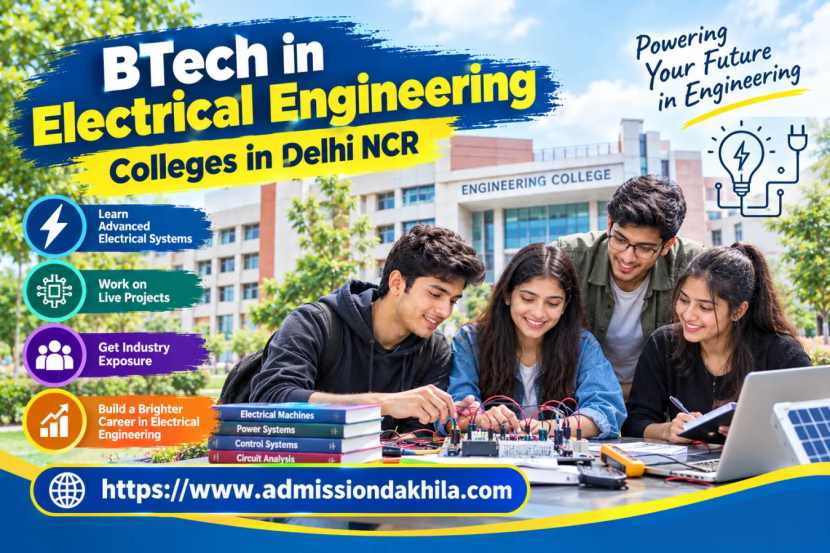
BTech in Electrical Engineering Colleges in Delhi NCR
1. Introduction to BTech in Electrical Engineering Colleges in Delhi NCR
Electrical engineering is one of the core engineering disciplines responsible for the generation, transmission, distribution, control, and efficient use of electrical energy. It also contributes to modern technologies such as electric vehicles, renewable energy, industrial automation, smart grids, power electronics, and intelligent control systems.
Delhi NCR is an attractive region for engineering students because it combines educational institutions, industrial areas, technology companies, manufacturing businesses, and access to internships and professional networking opportunities. Students can explore colleges across Delhi, Noida, Greater Noida, Ghaziabad, Faridabad, and nearby parts of the National Capital Region.
Students searching for BTech in Electrical Engineering colleges in Delhi NCR should compare institutions on academic quality rather than relying on popularity alone. Important factors include university recognition, the availability of the exact electrical engineering branch, laboratory facilities, faculty expertise, internships, placement data, tuition fees, and the admission process.
Institutions such as Delhi Technological University, Netaji Subhas University of Technology, the University of Delhi's Faculty of Technology, and other universities offering relevant engineering programmes are worth researching. The official JAC Delhi admission information and individual university websites should be consulted to verify current course availability and eligibility.
Admission Dakhila can be used as an additional research resource for students comparing engineering colleges and planning their admission journey.
To get admission to BTech Electrical Engineering colleges in Delhi NCR, complete Class 12 with Physics and Mathematics and the other subjects required by your target institution. Check the applicable entrance examination, such as JEE Main, and each college's counselling or university-specific admission process. Compare tuition fees, laboratories, faculty, internships, placement records, and accreditation before applying. For help researching colleges and understanding admission options, visit Admission Dakhila at https://www.admissiondakhila.com.
2. Why Study Electrical Engineering in Delhi NCR?
Delhi NCR offers a combination of educational opportunities and access to several industries that use electrical engineering expertise.
2.1 Access to Engineering Institutions
Students can investigate government-funded universities, public institutions, private universities, and engineering colleges across the region. Each institution may have different admission routes, fee structures, specialisations, and academic resources.
The best choice depends on the student's entrance examination performance, financial circumstances, preferred location, and career plans.
2.2 Exposure to Industrial Applications
Electrical engineers work in power plants, manufacturing facilities, renewable energy projects, building services, railways, electric vehicle companies, and automation businesses.
Industrial locations around Noida, Greater Noida, Ghaziabad, Faridabad, and other NCR areas can offer opportunities to understand how classroom concepts are applied in professional environments. However, internship and industrial-visit opportunities depend on the college and its industry partnerships.
2.3 Opportunities in Emerging Technologies
The electrical engineering sector is expanding beyond conventional power systems. Students may develop skills relevant to:
-
Solar and wind energy systems.
-
Electric vehicle charging infrastructure.
-
Battery management and energy storage.
-
Smart grids and power distribution.
-
Industrial robotics and automation.
-
Power electronics and embedded control.
-
Energy efficiency and electrical safety.
These areas can provide alternative career directions for graduates who build relevant technical skills.
2.4 Career Flexibility
Electrical engineering graduates can apply for technical positions, pursue higher education, prepare for competitive examinations, or transition into related fields after gaining suitable skills.
Career options include electrical design, power systems, maintenance engineering, automation, renewable energy, technical consulting, and research.
3. What Is BTech in Electrical Engineering?
BTech in Electrical Engineering is an undergraduate engineering degree that generally takes four years to complete. It combines mathematics, physics, electrical circuits, machines, power systems, electronics, control systems, programming, laboratory work, and engineering design.
The programme helps students understand how electrical energy is generated, converted, controlled, transmitted, and used in homes, industries, infrastructure, and transportation systems.
3.1 Core Subjects
The syllabus varies between universities, but common subjects include:
-
Engineering Mathematics.
-
Engineering Physics.
-
Electrical Circuit Theory.
-
Electrical Machines.
-
Electromagnetic Fields.
-
Power Generation and Distribution.
-
Power System Analysis.
-
Electrical Measurements and Instrumentation.
-
Power Electronics.
-
Control Systems.
-
Signals and Systems.
-
Electrical Drives.
-
Renewable Energy Systems.
-
Electrical Protection and Switchgear.
-
Project Work and Industrial Training.
3.2 Practical Learning
Practical work is essential because electrical engineers must understand not only theoretical principles but also how equipment behaves under real operating conditions.
Students may work with circuit boards, electrical machines, measuring instruments, transformers, simulation software, control systems, and power electronics equipment. The exact facilities depend on the institution.
Before admission, students should ask whether the department offers regular laboratory sessions, modern instruments, simulation facilities, supervised projects, and opportunities to work on industry-relevant problems.
3.3 Who Should Choose This Course?
Electrical engineering may suit students who enjoy mathematics, physics, circuits, energy systems, problem-solving, and understanding how electrical equipment works.
It can also be appropriate for students interested in renewable energy, electric mobility, industrial automation, and power infrastructure.
Students who prefer software development exclusively may wish to compare electrical engineering with computer science, electronics, instrumentation, or interdisciplinary programmes before deciding.
4. Best Colleges to Research in Delhi NCR
There is no single college that is best for every student. The following institutions provide useful starting points for researching electrical engineering or closely related engineering opportunities.
Important: Verify that the institution offers the exact BTech Electrical Engineering programme for the intended admission year. Some institutions listed for comparison offer related branches rather than electrical engineering itself.
4.1 Delhi Technological University (DTU), Delhi
DTU is a prominent public technical university in Delhi. Its undergraduate engineering offerings include Electrical Engineering.
Students should review its official website for curriculum details, fee notices, department facilities, placement information, and admission updates.
-
Location: Shahbad Daulatpur, Delhi.
-
Institution type: Public technical university.
-
Programme to investigate: BTech Electrical Engineering.
-
Admission route: Check the applicable JAC Delhi counselling rules.
-
Suitable for: Students seeking a public technical university with a broad engineering environment.
Official website: Delhi Technological University.
4.2 Netaji Subhas University of Technology (NSUT), Delhi
NSUT is another major public technical university in Delhi. Its engineering offerings include Electrical Engineering at the main campus.
Students should compare the relevant branch's curriculum, laboratories, elective options, faculty, and placement opportunities before preparing their college preferences.
-
Location: Dwarka, Delhi, for the main campus.
-
Institution type: Public technical university.
-
Programme to investigate: BTech Electrical Engineering.
-
Admission route: Review the JAC Delhi admission brochure.
-
Suitable for: Students interested in engineering education in Delhi.
Official website: Netaji Subhas University of Technology.
4.3 University of Delhi – Faculty of Technology
The University of Delhi's Faculty of Technology includes Electrical Engineering among its BTech programme offerings.
Students should review the current admission bulletin, eligibility conditions, fee schedule, counselling or allocation rules, and campus-specific information before applying.
-
Institution type: Public university.
-
Programme to investigate: BTech Electrical Engineering.
-
Admission information: University of Delhi admissions.
-
Suitable for: Students interested in the university's engineering programmes.
The university published BTech admission information for the 2026–27 academic session, including Electrical Engineering. Applicants for 2027–28 should wait for and follow the new session's official bulletin.
4.4 Jamia Millia Islamia, New Delhi
Jamia Millia Islamia is a central university with engineering programmes. It is worth researching when comparing technical education options in Delhi NCR.
Students must verify the exact undergraduate electrical engineering programme, current intake, admission route, and eligibility requirements through the university's official prospectus.
-
Location: Jamia Nagar, New Delhi.
-
Institution type: Central university.
-
Research priority: Current undergraduate engineering offerings and admission rules.
-
Official website: Jamia Millia Islamia.
Do not assume that every electrical or electronics-related course is equivalent to a BTech in Electrical Engineering. Check the degree title and approved programme details carefully.
4.5 J.C. Bose University of Science and Technology, YMCA, Faridabad
J.C. Bose University of Science and Technology is a public technical university in Haryana. It is another institution students may investigate when comparing engineering colleges in the broader NCR region.
Check the university's current engineering prospectus to establish whether the desired electrical engineering programme is available, along with its intake, eligibility, entrance requirements, and fees.
-
Location: Faridabad, Haryana.
-
Institution type: Public technical university.
-
Research priority: Current electrical engineering programme and department facilities.
-
Official website: J.C. Bose University of Science and Technology.
4.6 Other Private Universities in Delhi NCR
Students may also investigate private universities in Greater Noida, Ghaziabad, and nearby NCR areas. Before shortlisting a private institution, confirm the exact branch, degree-awarding university, applicable regulatory approvals, curriculum, laboratory resources, and placement records.
For example, SRM Institute of Science and Technology's Delhi-NCR campus publishes engineering admissions information, but its listed engineering programmes must be checked carefully to distinguish Electrical and Electronics Engineering from a degree specifically titled Electrical Engineering.
The same verification process should be followed for every private university.
5. Electrical Engineering Colleges by Location
Students often begin their search by location because travel, accommodation, and living expenses influence the total cost of a degree.
5.1 Electrical Engineering Colleges in Delhi
Delhi offers several public technical institutions and universities. Students can research DTU, NSUT, and the University of Delhi's Faculty of Technology for their electrical engineering offerings.
When comparing Delhi colleges, examine the latest admission rules, branch-specific opening and closing ranks, total programme fees, hostel availability, and commuting arrangements.
Government-funded institutions can be attractive for students seeking a strong technical environment, but admission may be competitive.
5.2 Electrical Engineering Colleges in Noida
Noida is a major education and business centre in Uttar Pradesh. Students searching for BTech Electrical Engineering colleges in Noida should check university campuses and affiliated engineering institutions in and around the city.
Important comparison points include:
-
Whether the exact degree is offered.
-
Whether admission is based on JEE Main, another entrance test, or an authorised merit process.
-
Electrical machines and power systems laboratory facilities.
-
Industrial training and internships.
-
Tuition fees and additional charges.
-
Travel time and hostel availability.
The location alone does not establish a college's academic quality. Department-specific evidence is more useful.
5.3 Electrical Engineering Colleges in Greater Noida
Greater Noida has multiple universities and engineering institutions, making it a relevant area for students seeking private or university-based engineering education.
Students should investigate the current programme list of each institution rather than relying solely on a general list of engineering colleges.
Ask for the latest fee schedule and clarify whether tuition is charged annually or semester-wise. Also check examination fees, registration charges, hostel costs, transport charges, and any refundable security deposit.
5.4 Electrical Engineering Colleges in Ghaziabad
Ghaziabad is another option for students who want to study engineering within the NCR region.
A useful shortlist should include institutions with a verified electrical engineering programme, experienced faculty, functioning laboratories, appropriate recognition, and transparent admission procedures.
Students should also assess the distance between campus and industrial areas, opportunities for internships, and access to public transport.
5.5 Electrical Engineering Colleges in Faridabad
Faridabad provides access to manufacturing and industrial activity in Haryana. Students can investigate public and private institutions in the city and surrounding areas.
When considering a college, ask how its curriculum covers industrial power systems, electrical maintenance, automation, energy efficiency, and electrical safety.
6. Eligibility Criteria for BTech Electrical Engineering
Eligibility requirements differ by institution and admission route. Students should read the current prospectus instead of assuming that one percentage requirement applies everywhere.
6.1 Class 12 Educational Qualification
Candidates are generally expected to have passed Class 12 or an equivalent examination with Physics and Mathematics and any additional subjects prescribed by the institution.
Chemistry or another approved technical or science subject may be required under the relevant admission rules.
6.2 Minimum Marks
Some colleges require a minimum aggregate in the qualifying examination or specified subjects. The percentage can differ by institution and category.
For example, a private university may set a different eligibility threshold from a public university participating in centralised counselling. Reserved-category relaxations, where applicable, must be confirmed in the current rules.
6.3 Entrance Examination
Admission to many public engineering institutions in Delhi is based on JEE Main rank through the applicable counselling process. Other universities may use JEE Main, their own entrance examinations, or other officially specified methods.
Students should check the exact route for their target institution before paying an application fee.
6.4 Lateral Entry
Some universities provide lateral-entry opportunities for eligible diploma holders, allowing admission into a later stage of an engineering programme.
However, lateral entry is not available at every institution or in every branch. Applicants must verify the relevant diploma discipline, minimum marks, entrance requirements, and seat availability.
7. Entrance Examinations and Selection
7.1 JEE Main
JEE Main is an important entrance examination for engineering admissions in India. It is used for admissions to participating institutions according to their respective rules.
For many participating Delhi universities, JAC Delhi conducts centralised counselling using JEE Main results. Candidates should consult the official JAC Delhi portal for the applicable year's participating institutions, eligibility, seat matrix, and counselling instructions.
7.2 University-Specific Entrance Tests
Certain private universities may conduct their own entrance examinations or accept other approved examination scores.
Applicants should confirm which examinations are accepted for the particular campus and programme. An examination accepted for one university should not be assumed to be accepted by another.
7.3 Merit-Based Admissions
Some institutions may use qualifying-examination marks or other officially prescribed merit criteria for selected programmes or admission categories.
Candidates should verify whether merit-based admission is available for the exact electrical engineering degree and whether any counselling, entrance score, or additional selection stage is compulsory.
7.4 Cut-Off Ranks
Cut-off ranks depend on several factors, including the number of seats, entrance examination performance, category, home-state or region-related eligibility where applicable, and candidate preferences.
Past cut-offs can help students estimate their options, but they cannot guarantee admission in a future year.
8. BTech Electrical Engineering Admission Process for 2027
Students planning admission in the 2027–28 academic session should begin preparing in advance.
-
Identify suitable colleges. Prepare a list of institutions that offer the exact BTech Electrical Engineering degree.
-
Check eligibility. Confirm Class 12 subject requirements, minimum marks, age rules if applicable, and category-related provisions.
-
Prepare for the entrance examination. Follow the current syllabus and schedule for JEE Main or another accepted examination.
-
Complete registration. Submit applications through the official examination, university, or counselling portal.
-
Review results and cut-offs. Compare your rank or qualifying marks with previous admission trends, keeping future variation in mind.
-
Participate in counselling. Register, fill in choices, and follow the official seat-allocation procedure.
-
Verify the allotted seat. Confirm the institution, branch, fee payment deadline, and document requirements.
-
Complete admission. Pay the required fees through the authorised channel and finish document verification.
Admission Planning Tip
The 2027 admission calendar, eligibility requirements, and fee structures may differ from those published for 2026. Students should use the 2026 documents only as historical references until the official 2027–28 information is released.
Admission Dakhila can serve as an additional resource for organising college research and identifying questions to ask admissions offices.
9. BTech Electrical Engineering Fees in Delhi NCR
The cost of a BTech degree varies according to the institution, campus, accommodation choice, and additional facilities.
Public universities and private institutions can have substantially different fee structures. A meaningful comparison should consider the entire four-year cost rather than tuition alone.
9.1 Tuition Fees
Tuition is usually the largest academic expense. Students should obtain the latest official fee notice for their admission year.
As an illustration of why institution-specific verification matters, the University of Delhi published a total fee of ₹2,35,200 for its Faculty of Technology BTech programmes for the 2025–26 academic session. This is a historical figure, not a guaranteed fee for 2027–28.
9.2 Other Expenses
The total cost may include:
-
Registration and admission charges.
-
Examination and university fees.
-
Laboratory and other academic charges.
-
Hostel accommodation.
-
Food and personal expenses.
-
Transport and commuting.
-
Books, software, and equipment.
-
Internship or project-related expenses where applicable.
9.3 Estimated Budgeting Framework
The following is a planning framework, not a verified price list for any particular college.
|
Expense category |
What to verify |
|---|---|
|
Tuition |
Annual and semester-wise charges |
|
Admission |
One-time registration and enrolment |
|
Hostel |
Room type, deposits, and annual charges |
|
Meals |
Included or separately payable |
|
Transport |
Route and annual transport fee |
|
Academic costs |
Books, laboratory materials, and software |
|
Miscellaneous |
Examination, student services, and other charges |
Ask the admissions office for a written fee schedule covering all compulsory charges. Clarify the refund policy before paying a seat-confirmation amount.
10. Course Duration and Curriculum
BTech Electrical Engineering generally follows a four-year undergraduate structure divided into eight semesters.
The first year usually develops a foundation in mathematics, physics, computing, basic engineering, and introductory electrical subjects. Later semesters focus more deeply on electrical systems, machines, power, control, and specialist electives.
10.1 First-Year Subjects
Students commonly study engineering mathematics, physics, programming fundamentals, basic electrical engineering, workshop practice, and communication skills.
These subjects establish the analytical and practical foundations needed for advanced courses.
10.2 Second-Year Subjects
The curriculum may introduce electrical circuits, electrical machines, electromagnetic fields, analogue and digital electronics, measurements, and signals.
Laboratory work helps students connect mathematical models with practical measurements.
10.3 Third-Year Subjects
Students may study power systems, control systems, power electronics, electrical drives, protection, and electrical system design.
This stage often provides opportunities to explore electives, technical projects, and internships.
10.4 Final-Year Subjects
The final year commonly includes advanced electives, project work, seminars, and potentially industrial training.
Students interested in renewable energy might develop a solar monitoring project, while those interested in automation could work on motor control or a sensor-based system.
The actual semester-wise syllabus should be obtained from the department.
11. Important Electrical Engineering Specializations
11.1 Power Systems
Power systems focus on generating, transmitting, distributing, and managing electrical energy. Graduates may pursue work in utilities, infrastructure projects, power equipment, and electrical consultancy.
11.2 Renewable Energy
Renewable energy combines electrical engineering with solar, wind, storage, and grid integration technologies. Career development may require knowledge of energy conversion, power electronics, system design, and relevant industry standards.
11.3 Electric Vehicles
Electric vehicle technologies use electrical machines, power electronics, charging systems, and battery-management concepts. Students can prepare through electives, technical projects, and relevant internships.
11.4 Industrial Automation
Industrial automation involves motors, sensors, control systems, programmable logic controllers, and process monitoring. Practical experience with industrial control tools can improve job readiness.
11.5 Power Electronics
Power electronics concerns the conversion and control of electrical power using electronic devices. Applications include inverters, motor drives, renewable-energy systems, and electric vehicles.
11.6 Control and Instrumentation
This area focuses on measuring, monitoring, and controlling engineering processes. It can lead towards industrial instrumentation, automation, testing, and control-system engineering.
Not every college offers these subjects as formal specialisations. Students should check the elective list and available laboratories before assuming a particular specialisation is available.
12. Infrastructure and Laboratory Facilities
Laboratory quality is one of the most important factors when evaluating an electrical engineering department.
12.1 Electrical Machines Laboratory
Students should have opportunities to study the operation and characteristics of motors, generators, transformers, and other electrical machines under supervised conditions.
12.2 Power Systems Laboratory
This laboratory may support experiments related to power flow, system protection, electrical faults, and power system simulation.
12.3 Power Electronics Laboratory
Facilities may include converters, rectifiers, inverters, switching devices, and related measurement equipment.
12.4 Control Systems Laboratory
Students can gain experience with feedback systems, motor control, simulation, and process-control experiments.
12.5 Computing and Simulation Facilities
Electrical engineers increasingly use software to analyse circuits, simulate systems, and model electrical networks. Students should ask about access to relevant tools, software licences, and computer laboratories.
12.6 Safety Standards
Electrical laboratory work involves risks. Appropriate safety equipment, supervised experiments, emergency procedures, and safe handling practices are essential.
A campus visit, departmental brochure, or discussion with current students may help applicants understand whether the facilities support meaningful hands-on learning.
13. Placements and Internship Opportunities
Placements are important, but they should be evaluated carefully. A university's overall placement package does not necessarily represent the typical outcome for electrical engineering students.
13.1 Potential Recruiting Sectors
Electrical engineering graduates may seek opportunities in:
-
Power generation and distribution.
-
Electrical equipment manufacturing.
-
Renewable energy.
-
Industrial automation.
-
Infrastructure and building services.
-
Electric mobility.
-
Engineering design and consulting.
-
Technical testing and maintenance.
-
Information technology and engineering services.
Actual recruitment depends on employer requirements, the student's skills, and the available vacancies.
13.2 Internship Opportunities
Internships can help students apply classroom knowledge and gain workplace experience.
Useful internship areas include electrical maintenance, power system analysis, solar installation and monitoring, motor drives, automation, and electrical design.
Students should look for colleges that support internships through faculty guidance, industry contacts, project supervision, and placement-cell assistance.
13.3 How to Evaluate Placement Claims
Before choosing a college, ask for:
-
Branch-wise placement statistics.
-
Number of eligible students and students placed.
-
Median or average salary, with the calculation method explained.
-
Relevant electrical engineering job roles.
-
Employers recruiting specifically for electrical roles.
-
Internship conversion rates, where available.
-
The distinction between core engineering and non-core placements.
A very high maximum package may represent a small number of students or a different branch. It should not be treated as the expected salary of every electrical engineering graduate.
14. Career Opportunities After BTech Electrical Engineering
Graduates can pursue several technical career paths depending on their skills and interests.
14.1 Electrical Design Engineer
Electrical design engineers help prepare electrical layouts, equipment specifications, circuit designs, and system documentation. Knowledge of design software, standards, calculations, and safety is valuable.
14.2 Power Systems Engineer
Power systems engineers work with electrical networks, generation, transmission, distribution, protection, and reliability.
14.3 Electrical Maintenance Engineer
Maintenance engineers inspect equipment, identify faults, plan preventive maintenance, and help reduce equipment downtime in industrial and infrastructure environments.
14.4 Automation Engineer
Automation engineers work with control systems, industrial sensors, motor drives, PLCs, and process-control equipment.
14.5 Renewable Energy Engineer
Renewable energy engineers support the design, installation, operation, monitoring, or maintenance of solar and other renewable-energy systems.
14.6 Testing and Quality Engineer
These professionals test electrical equipment, evaluate product performance, maintain records, and help ensure compliance with relevant technical specifications.
14.7 Government and Public-Sector Careers
Depending on the recruitment notice and eligibility requirements, electrical engineering graduates may apply for technical roles in public-sector organisations, government departments, utilities, railways, and other engineering services.
Recruitment can involve examinations, interviews, GATE scores, or other selection methods. Eligibility must be checked for each vacancy.
14.8 Higher Education
Graduates may pursue MTech, specialised postgraduate programmes, research, or other professional qualifications. GATE can be relevant for certain postgraduate admissions and recruitment pathways, depending on the institution and employer.
15. Salary Expectations and Career Growth
Electrical engineering salaries vary according to the employer, location, job role, practical skills, academic performance, and relevant experience.
Rather than relying on a single advertised salary figure, students should compare entry-level offers for jobs that match their intended career path.
|
Career path |
Skills that may improve prospects |
|---|---|
|
Electrical design |
Electrical calculations, design tools, standards |
|
Power systems |
Network analysis, protection, system simulation |
|
Maintenance |
Fault diagnosis, preventive maintenance, safety |
|
Automation |
PLCs, sensors, drives, control systems |
|
Renewable energy |
Solar systems, inverters, energy monitoring |
|
Testing and quality |
Measurement, documentation, testing methods |
|
Research and development |
Mathematics, simulation, project work |
Fresh graduates may begin in trainee, graduate engineer, junior design, testing, or maintenance roles. With experience, further training, and demonstrated competence, they may progress into senior engineering, project management, specialist technical, or leadership positions.
Salary advice: Ask colleges for branch-specific placement data and verify the role, employer, salary structure, and number of students represented. Do not assume that the highest reported package is typical.
16. Government vs Private Electrical Engineering Colleges
Both government and private institutions can offer worthwhile educational opportunities. The correct choice depends on academic quality, affordability, facilities, and career goals.
|
Factor |
Government/public institution |
Private institution |
|---|---|---|
|
Fees |
May be more affordable, but varies |
Can range from moderate to high |
|
Admission |
Often entrance-based and competitive |
Entrance-based or other approved routes |
|
Facilities |
Depend on funding and department |
Depend on institutional investment |
|
Industry links |
Vary by university and department |
Vary by university and department |
|
Scholarships |
Government and institutional schemes may apply |
Institutional and government schemes may apply |
|
Location |
Depends on the campus |
Depends on the campus |
|
Placement outcomes |
Must be checked branch-wise |
Must be checked branch-wise |
Do not automatically reject a private institution or select a government institution without comparing the programme itself. Examine the degree recognition, curriculum, laboratories, fees, faculty, internships, and outcomes.
17. How to Choose the Right College
A systematic selection process can reduce the risk of making an expensive decision based only on advertising.
17.1 Verify the Exact Degree
Check that the university offers BTech Electrical Engineering, not just a similar-sounding course. Electrical and Electronics Engineering, Electronics and Communication Engineering, and Electrical Engineering overlap in some areas but are not identical degrees.
17.2 Verify Recognition and Approval
Check the legal status of the degree-awarding institution and the applicable regulatory requirements for the programme. Review official university information and relevant government or regulatory sources.
17.3 Compare the Total Cost
Calculate tuition for the full programme, hostel and food expenses, travel, examination charges, and other compulsory costs.
17.4 Assess Practical Learning
Ask about laboratory equipment, technical projects, simulation software, industrial training, and faculty supervision.
17.5 Examine Placement Evidence
Review branch-wise placement reports and the types of roles offered to electrical engineering graduates.
17.6 Evaluate the Location
Consider commuting time, accommodation, campus safety, access to transport, and the cost of living.
17.7 Speak to the Admissions Office
Request written clarification on admission eligibility, entrance exams, branch availability, fees, scholarships, refund rules, and deadlines.
17.8 Prepare a Balanced Shortlist
Include ambitious choices, realistic options based on your expected rank, and suitable alternatives that fit your budget. Keep the official counselling process in mind when ranking preferences.
18. Scholarships and Education Financing
Scholarships can reduce the financial burden of engineering education, but eligibility and funding availability differ.
Students should investigate government scholarships, category-based schemes where eligible, income-based assistance, merit scholarships, and university-specific financial support.
Before applying, verify:
-
Income and academic requirements.
-
Category or domicile conditions.
-
Application deadlines.
-
Required certificates.
-
Renewal criteria.
-
Whether the award covers tuition, accommodation, or other expenses.
-
Whether it can be combined with another scholarship.
Education loans are another option for some families. Compare interest rates, repayment conditions, moratorium rules, processing charges, and any collateral requirements before accepting an offer.
Never assume that a scholarship is guaranteed simply because a college advertises financial assistance.
19. Documents Required for Admission
Requirements vary by university and admission category. Students should prepare a document folder and verify the final checklist from the official prospectus.
Commonly requested documents may include:
-
Class 10 marksheet or certificate.
-
Class 12 marksheet and passing certificate.
-
JEE Main scorecard or other accepted entrance result.
-
Counselling registration and seat-allocation documents.
-
Government-issued identity proof.
-
Recent photographs and signature.
-
Category certificate, where applicable.
-
Domicile or region-related documents, where required.
-
Transfer or migration certificate, if applicable.
-
Medical fitness or other prescribed forms.
-
Fee payment receipt.
Some institutions require original documents for verification and copies for submission. Check the prescribed formats, certificate dates, and validity requirements well before the deadline.
20. Common Admission Mistakes to Avoid
20.1 Choosing a College Only by Its Name
A familiar name does not automatically mean the desired branch has the right facilities or career outcomes.
20.2 Ignoring the Exact Branch
Always confirm whether the programme is Electrical Engineering or another engineering discipline.
20.3 Using Old Fee Information
Fees and admission rules can change each academic year. Use current official notices before budgeting or making payments.
20.4 Believing Unverified Placement Claims
Ask for branch-wise data, role descriptions, and a clear explanation of salary figures.
20.5 Missing Counselling Deadlines
Missing a registration, choice-filling, payment, or reporting deadline can affect admission even when a student has a suitable entrance rank.
20.6 Paying Without Checking Refund Rules
Read the refund policy and verify that payments are made through official channels.
20.7 Overlooking Living Expenses
A college with lower tuition may not be the cheapest overall if travel or accommodation costs are high.
21. How Admission Dakhila Can Help Students
Choosing an engineering college involves more than searching for a list of names. Students need to understand the admission route, compare programme options, check fee details, and make decisions based on their academic and financial circumstances.
Admission Dakhila can be included as an educational research resource for students exploring BTech Electrical Engineering colleges in Delhi NCR.
Students can use Admission Dakhila to explore education-related information, organise their college research, and identify questions to verify with individual institutions.
Before making a final decision, applicants should confirm all critical information directly with the university or official counselling authority. Admission Dakhila should complement—not replace—official prospectuses, regulatory information, fee notices, and admission portals.
A Practical College-Selection Checklist
-
Does the college offer the exact electrical engineering degree?
-
Is the degree-awarding institution recognised?
-
Have I checked the latest admission eligibility?
-
Do I understand the entrance examination and counselling process?
-
Have I compared total fees and accommodation costs?
-
Are the electrical laboratories suitable for practical learning?
-
Have I reviewed branch-specific placement data?
-
Are internships and technical projects available?
-
Have I checked scholarships and financial assistance?
-
Have I verified the application deadlines?
A college that satisfies these requirements is easier to evaluate objectively than one selected solely on promotional claims.
22. Frequently Asked Questions About BTech Electrical Engineering Colleges in Delhi NCR
These FAQs are written in a concise, question-and-answer format to support search visibility, featured-snippet eligibility, and voice-search queries.
Q1. Which are the best BTech in Electrical Engineering colleges in Delhi NCR?
Delhi Technological University, Netaji Subhas University of Technology, and the University of Delhi's Faculty of Technology are important institutions to research for BTech Electrical Engineering. Students should compare current admission criteria, fees, faculty, laboratories, and placement outcomes before selecting a college.
Q2. What is the eligibility for BTech Electrical Engineering admission?
Candidates generally need to pass Class 12 with Physics, Mathematics, and any additional subjects required by their chosen institution. Minimum marks, entrance examination requirements, and category-related relaxations vary by college.
Q3. Is JEE Main compulsory for BTech Electrical Engineering in Delhi NCR?
JEE Main is required for many engineering admissions through participating Delhi counselling systems. However, other institutions may have different approved admission routes. Candidates should verify the entrance requirements of each target college.
Q4. What is the fee for BTech Electrical Engineering colleges in Delhi NCR?
Fees vary significantly between public universities and private institutions. Students should check the latest official fee schedule and calculate the total cost of tuition, accommodation, transport, examinations, and other compulsory charges.
Q5. Can I study BTech Electrical Engineering in Noida or Greater Noida?
Students can research engineering institutions in Noida and Greater Noida, but they should confirm that the specific college offers BTech Electrical Engineering for their intended admission year. Programme availability, eligibility, and fees should be verified through official sources.
Q6. What is the duration of BTech Electrical Engineering?
BTech Electrical Engineering generally takes four years to complete, divided into eight semesters. The programme combines theoretical subjects, laboratory sessions, engineering projects, and other practical learning activities.
Q7. What jobs can I get after BTech Electrical Engineering?
Graduates can pursue careers as electrical design engineers, power systems engineers, maintenance engineers, automation engineers, renewable energy engineers, testing engineers, and other technical professionals. Opportunities depend on qualifications, skills, experience, and employer requirements.
Q8. What is the salary after BTech Electrical Engineering?
Salary depends on the employer, job role, location, technical skills, and experience. Students should compare verified entry-level offers and branch-specific placement reports rather than relying on the highest package advertised by a college.
Q9. Are scholarships available for BTech Electrical Engineering students?
Yes, eligible students may apply for government scholarships, merit-based assistance, income-based support, and university-specific scholarships. Eligibility, funding, and renewal conditions vary, so applicants should check the relevant official guidelines.
Q10. How can Admission Dakhila help me choose an electrical engineering college?
Admission Dakhila can be used as an additional education research resource to explore college information and organise admission research. Students should verify course availability, fees, eligibility, recognition, and application deadlines directly with the relevant institution before applying.
23. Conclusion: Choose the Right BTech Electrical Engineering College in Delhi NCR
BTech in Electrical Engineering can provide a strong foundation for students interested in electrical power, energy systems, industrial automation, electric vehicles, renewable energy, and electrical equipment design. Delhi NCR offers a range of educational institutions, but the right choice depends on the student's entrance rank, budget, academic interests, and career objectives.
Before applying, verify the exact degree offered, the institution's recognition, admission requirements, total programme fees, laboratory facilities, faculty expertise, internship opportunities, and branch-specific placement outcomes. Students planning for the 2027–28 academic session should also monitor official admission announcements because eligibility requirements, counselling schedules, and fees may change.
Do not select a college based only on its popularity or advertised placement package. A well-informed decision should balance academic quality, practical learning, affordability, location, and long-term career opportunities.
Start your college research with Admission Dakhila. Visit https://www.admissiondakhila.com to explore education-related information and organise your admission research. Shortlist suitable institutions, compare their official details, prepare your documents, and follow the applicable entrance examination and counselling process.
Your engineering journey starts with the right research and a clear admission plan.