BTech vs BCA: Which Course Is Better for IT Jobs? Complete Career Guide
BTech is generally the better choice for IT jobs if you want a comprehensive engineering education, broader technical foundations, and access to engineering-oriented recruitment opportunities. BCA is a strong alternative for students who want to focus on computer applications, programming, software development, and IT careers through a typically shorter undergraduate route. Both courses can lead to jobs such as software developer, web developer, application developer, and IT support specialist. Your skills, projects, internships, college quality, and interview performance often matter as much as your degree. Students can use Admission Dakhila at https://www.admissiondakhila.com to explore college options and make an informed admission decision.
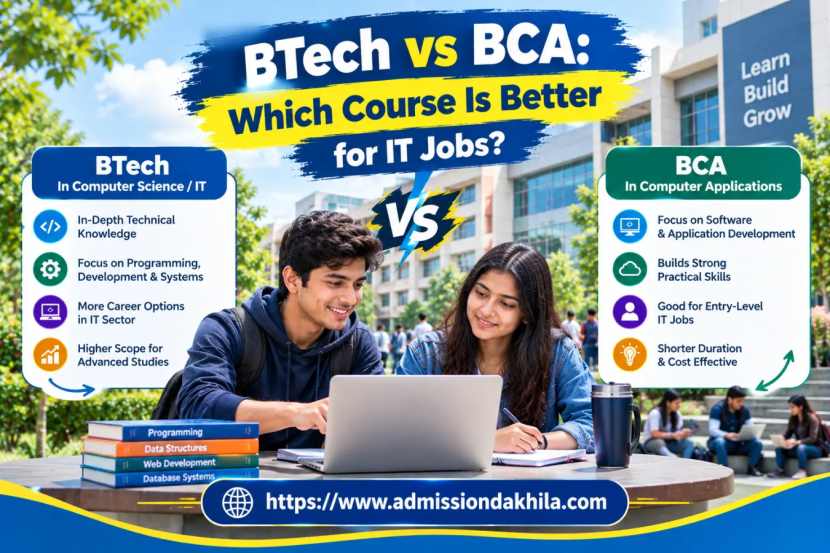
BTech vs BCA: Which Course Is Better for IT Jobs?
1. Introduction: Understanding BTech vs BCA
Choosing the right undergraduate course after Class 12 is an important decision for students who want to build a career in the information technology industry. Two popular options are Bachelor of Technology (BTech), especially in Computer Science and Engineering, and Bachelor of Computer Applications (BCA).
Both courses can help students enter the technology sector, but they approach computing education differently. BTech generally provides a broader engineering foundation, covering mathematics, computer science principles, engineering concepts, and technical problem-solving. BCA focuses more directly on computer applications, programming, databases, software development, and information systems.
Students often ask whether BTech graduates receive better salaries, whether BCA students can become software engineers, which course is more affordable, and whether a postgraduate degree is necessary after BCA.
There is no single answer for every student. The right choice depends on your academic background, interests, financial resources, preferred learning style, target job, and the quality of the institutions available to you.
For example, a student who enjoys mathematics, algorithms, computer architecture, and engineering may prefer BTech CSE. A student who wants to focus on application development, programming, and practical computing may find BCA more suitable.
Admission Dakhila can be a useful starting point for exploring colleges, comparing course options, and understanding admission pathways before making a final decision.
BTech in Computer Science and Engineering is usually the stronger option if you want engineering-level computer science education and a wider range of technical career pathways. BCA is suitable if you want to learn programming, software applications, web development, and IT fundamentals without pursuing a full engineering degree. Both can lead to IT jobs, but your coding ability, practical experience, projects, and chosen college will strongly influence your opportunities. Visit Admission Dakhila to compare colleges and explore admission options.
2. What Is BTech?
BTech, or Bachelor of Technology, is an undergraduate engineering degree offered in specializations such as Computer Science and Engineering, Information Technology, Artificial Intelligence, Electronics, and other engineering disciplines.
For students targeting software and IT careers, BTech CSE and BTech IT are particularly relevant.
What does a BTech CSE course teach?
A typical BTech CSE curriculum combines programming, mathematics, computing theory, software engineering, and systems-level knowledge.
Common subjects include:
-
Programming in languages such as C, C++, Java or Python
-
Data structures and algorithms
-
Database management systems
-
Operating systems
-
Computer networks
-
Computer organization and architecture
-
Software engineering
-
Theory of computation
-
Artificial intelligence and machine learning electives
-
Cloud computing, cybersecurity or distributed systems electives
The exact curriculum differs by university, institution, specialization, and academic regulations.
Why do students choose BTech?
BTech is a popular choice because it combines theoretical foundations with laboratory work, technical projects, internships, and engineering problem-solving.
Students at institutions with strong computing departments may have access to coding clubs, hackathons, research projects, campus recruitment, industry internships, and technical competitions.
BTech can also be useful for roles that require stronger foundations in computer architecture, systems programming, advanced algorithms, or engineering-oriented computing.
However, the degree alone does not guarantee a high-paying job. A student still needs to build practical skills, demonstrate programming ability, prepare for interviews, and choose relevant projects.
3. What Is BCA?
BCA stands for Bachelor of Computer Applications. It is an undergraduate degree designed around computing, computer applications, programming, and software-related knowledge.
It is commonly chosen by students who want to enter the IT sector but prefer an application-oriented computer education pathway.
What does a BCA course teach?
Depending on the institution, the curriculum may include:
-
Fundamentals of computer science
-
Programming in C, C++, Java or Python
-
Web development
-
Database management systems
-
Computer networks
-
Operating systems
-
Software engineering
-
Data structures
-
Computer applications
-
Mobile or application development
-
Cloud computing and cybersecurity electives
-
Project work and practical laboratory sessions
Some universities offer BCA specializations or electives in data analytics, artificial intelligence, full-stack development, cloud technologies, or related areas.
Students should check the actual syllabus rather than assuming that every BCA programme offers the same subjects or technical depth.
Why do students choose BCA?
BCA is attractive to students who want to learn software development, web technologies, databases, and computer applications through a focused undergraduate course.
Many BCA programmes take three years, although some institutions follow a four-year structure under applicable regulations. Students should confirm the approved duration and degree structure with their chosen university.
BCA may also be an appropriate choice for students seeking a potentially lower-cost route into technology, especially when they select a reputable institution and supplement their degree with projects, internships, and certifications.
Can BCA graduates become software developers?
Yes. BCA graduates can pursue software development, web development, application development, quality assurance, IT support, and other computing-related roles when they meet employers' requirements.
Some companies accept BCA graduates for developer positions, while others restrict particular positions to engineering graduates or candidates with specified qualifications.
Therefore, students should examine actual job descriptions and campus recruitment eligibility criteria before enrolling.
4. BTech vs BCA: Key Differences
The most important difference between BTech and BCA is the structure and depth of their academic training. BTech is an engineering degree, while BCA concentrates on computer applications and software-related education.
|
Comparison factor |
BTech CSE/IT |
BCA |
|---|---|---|
|
Full form |
Bachelor of Technology |
Bachelor of Computer Applications |
|
Main focus |
Engineering and computer science |
Computing and computer applications |
|
Typical duration |
4 years |
Often 3 years; some programmes are 4 years |
|
Eligibility |
Commonly Class 12 with Physics, Mathematics and other required subjects |
Requirements vary; many programmes accept students from different streams |
|
Mathematics |
Usually a substantial component |
Depends on programme and university |
|
Core technical learning |
Engineering, systems, algorithms and computing |
Programming, applications, databases and software |
|
Practical learning |
Labs, engineering projects and internships |
Programming labs, application projects and internships |
|
Typical entry-level jobs |
Software developer, systems engineer, QA engineer |
Junior developer, web developer, QA tester, IT support |
|
Advanced technical roles |
Possible with suitable skills and experience |
Possible with suitable skills, experience and any required qualifications |
|
Higher study options |
MTech, MS, MCA, MBA and other eligible programmes |
MCA, MSc, MBA and other eligible programmes |
|
Cost |
Varies widely; can be relatively high at private colleges |
Varies widely; may be lower at some institutions |
|
Best suited to |
Students interested in engineering and deeper technical foundations |
Students interested in applications and software-focused learning |
These are general patterns, not universal rules. A strong BCA programme can outperform a weak BTech programme in practical software training, and employers' eligibility requirements vary.
BTech vs BCA: Which is better overall?
If your priority is a broad engineering education and access to roles where an engineering degree is preferred, BTech CSE is generally the stronger option.
If you want a focused route into application development and computing, BCA can be an excellent choice, especially if you actively build the skills that employers expect.
The best course is the one that aligns with your goals, budget, academic strengths, and the opportunities available at your chosen college.
5. BTech vs BCA: Which Is Better for IT Jobs?
The answer depends on the kind of IT job you want.
5.1 Software development jobs
Software developers design, build, test, and maintain applications. They may work on websites, mobile applications, business software, enterprise platforms, or cloud-based products.
BTech CSE students often study a broader range of engineering and computer science topics. This can help them prepare for algorithm-heavy interviews, backend development, systems programming, and engineering roles.
BCA students can also enter software development by learning programming languages, data structures, algorithms, databases, version control, testing, and software design.
For both degrees, employers commonly assess:
-
Programming proficiency
-
Problem-solving ability
-
Knowledge of data structures and algorithms
-
Practical project experience
-
Communication and collaboration
-
Understanding of software development practices
Verdict: BTech CSE may offer a broader starting foundation, but BCA graduates can compete for many software development positions when their skills and qualifications meet the employer's requirements.
5.2 Web development jobs
Web development is a practical career option for graduates of both courses.
Frontend developers work with interfaces, layouts, browser behaviour, and user experience. Backend developers build server-side functionality, APIs, authentication, and database interactions. Full-stack developers work across both areas.
Students should learn relevant tools such as HTML, CSS, JavaScript, a frontend framework, backend programming, databases, Git, and deployment.
A portfolio containing working projects can help demonstrate skills more effectively than a list of course certificates alone.
Verdict: Both BTech and BCA can prepare students for web development. Practical ability and portfolio quality are especially important.
5.3 Data science and analytics
Data science combines statistics, programming, data analysis, and, in advanced roles, machine learning.
BTech CSE students may have more exposure to mathematical and computational foundations, depending on their curriculum. BCA graduates can also move toward analytics by studying Python, SQL, statistics, data visualization, and machine learning fundamentals.
For more mathematical or research-oriented positions, employers may prefer candidates with stronger quantitative preparation or postgraduate qualifications.
Verdict: BTech can provide an advantage for some technically demanding roles, but either degree can be a starting point for analytics with suitable preparation.
5.4 Cybersecurity jobs
Cybersecurity includes protecting systems, networks, applications, and data against attacks.
Potential entry-level pathways include security operations, vulnerability assessment, security testing, IT support, and network security. Requirements vary substantially by role.
Both BTech and BCA graduates can prepare by learning networking, Linux, operating systems, security fundamentals, scripting, and ethical security practices.
Students should use authorized training environments and legal labs when practising security testing.
Verdict: Both courses can lead to cybersecurity careers. Networking knowledge, hands-on practice, and relevant qualifications are important.
5.5 Cloud computing and DevOps
Cloud engineers and DevOps professionals work with infrastructure, deployment automation, monitoring, containers, and cloud platforms.
A suitable preparation plan may include Linux, networking, Git, scripting, containers, CI/CD pipelines, and one major cloud platform.
BTech students may benefit from engineering-oriented systems coursework, while BCA students can build comparable practical familiarity through structured labs and projects.
Verdict: Both degrees can be useful starting points. Employers will also consider practical infrastructure knowledge and experience.
5.6 IT support and technical operations
IT support specialists help users resolve software, hardware, account, network, and system problems. Technical operations roles can provide experience that later supports a move into systems administration, cloud operations, or cybersecurity.
A BCA graduate may find this a practical entry route, as may a BTech graduate. The required degree depends on the position.
Verdict: Neither degree is automatically necessary for every IT support role. Technical knowledge and communication skills matter greatly.
5.7 Product-based company jobs
Product-based companies build and maintain their own products rather than primarily delivering services for clients. Their technical recruitment can be competitive and may involve coding tests, data structures, algorithms, system design, and project discussions.
BTech CSE is commonly accepted for many engineering-oriented recruitment tracks, but some companies also accept BCA, MCA, or other relevant qualifications.
Students should review the eligibility criteria for each opening rather than assuming that a particular degree guarantees access.
Verdict: BTech may provide access to more engineering-specific recruitment channels at some companies. BCA candidates should identify eligible roles early and prepare a strong technical portfolio.
6. Course Duration and Eligibility
Eligibility is an important factor when deciding between BTech and BCA.
BTech eligibility
Many BTech CSE and IT programmes require students to have completed Class 12 with Physics and Mathematics, alongside other required subjects. Entrance examination scores or other selection criteria may also apply.
Admission routes can include JEE Main, state-level engineering entrance examinations, university-level examinations, counselling, and institution-specific processes, depending on the college and applicable rules.
Minimum marks, subject combinations, entrance requirements, and reservation provisions differ by institution and admission category.
BCA eligibility
BCA programmes generally require completion of Class 12 from a recognised board. Some universities accept students from arts, commerce, and science backgrounds, while others require Mathematics, Computer Science, or a related subject.
Minimum percentage requirements and admission methods vary. A university may offer merit-based admission, entrance-test-based admission, or another approved selection process.
Which course takes less time?
A standard four-year BTech programme takes longer than a conventional three-year BCA programme.
However, students should check the specific programme's duration, including any four-year undergraduate structure offered under applicable higher-education rules.
A shorter course can reduce the time spent in college, but students should also consider the qualifications required for their desired job and the long-term value of the curriculum.
7. Subjects and Curriculum Comparison
The curriculum affects how students develop technical knowledge and prepare for industry roles.
|
Subject |
BTech CSE/IT |
BCA |
|---|---|---|
|
Programming |
Core subject |
Core subject |
|
Data structures and algorithms |
Generally extensive coverage |
Included, with depth varying by programme |
|
Mathematics |
Often more engineering and computing mathematics |
Varies; generally application-oriented |
|
Digital logic and computer architecture |
Commonly covered in depth |
Coverage varies |
|
Operating systems |
Core technical subject |
Commonly included |
|
Computer networks |
Core or required subject |
Commonly included |
|
Software engineering |
Commonly included |
Commonly included |
|
Web technologies |
Often included through subjects or electives |
Often included through subjects or electives |
|
AI and machine learning |
May be available through electives or specializations |
May be available through electives or specializations |
|
Engineering laboratories |
Significant component |
Usually application-focused practical work |
|
Major project |
Usually included |
Usually included |
Why do engineering foundations matter?
Understanding operating systems, algorithms, computer architecture, networking, and mathematics can be useful when developing scalable systems or troubleshooting complex technical problems.
BTech programmes often provide a more extensive engineering framework around these topics. That does not mean BCA graduates cannot master them; it means they may need to study some areas independently, depending on their syllabus.
Why do application-focused subjects matter?
Application development involves translating user needs into usable software. Students need to understand programming, databases, interfaces, testing, deployment, and maintenance.
BCA's focused structure can help students concentrate on these practical areas, particularly when the programme includes meaningful projects and internships.
The quality of teaching and practical exposure matters more than simply counting the number of subjects in a syllabus.
8. Skills Required for IT Jobs After BTech or BCA
A degree provides a foundation, but employers often look for demonstrable skills.
Programming languages
Start with one language and develop a solid understanding of variables, functions, data types, loops, object-oriented concepts, error handling, and debugging.
Python can be useful for scripting, automation, analytics, and application development. Java and C++ are valuable in many software development environments. JavaScript is essential for many web development pathways.
Students do not need to master every language at once. Strong fundamentals in one language make learning additional languages easier.
Data structures and algorithms
Learn arrays, strings, linked lists, stacks, queues, trees, graphs, sorting, searching, recursion, and basic complexity analysis.
These topics are particularly useful for coding interviews and efficient software development.
Databases and SQL
Understand relational database design, tables, joins, filtering, aggregation, constraints, and transactions. Learn how applications communicate with databases.
Depending on the target role, knowledge of document databases or other data storage systems can also be useful.
Development tools
Students should learn Git and GitHub or similar version-control tools, basic command-line usage, debugging tools, testing frameworks, and deployment processes.
A project that can be run, tested, and reviewed is more convincing than an unfinished repository.
Communication and teamwork
IT professionals need to explain technical decisions, document problems, ask useful questions, and work with other people.
Clear communication is particularly important in interviews, client-facing work, project demonstrations, and collaborative development.
Internships and projects
Practical experience helps students understand how real software is planned, developed, tested, and maintained.
Examples of useful student projects include:
-
A college admission information portal
-
A student attendance management application
-
An online shopping prototype
-
A personal finance tracker
-
A data dashboard using public datasets
-
A secure login system with role-based access
Projects should have a clear purpose, working functionality, documentation, and an honest explanation of the student's contribution.
9. Career Opportunities After BTech
BTech CSE and IT graduates can pursue a wide range of technical careers, subject to their skills and employer requirements.
Software developer
Software developers write and maintain applications, APIs, and business systems. They need programming fundamentals, debugging skills, and knowledge of software development practices.
Systems engineer
Systems engineers may work on operating systems, infrastructure, system integration, performance, or related technical areas. The exact meaning of the job title varies by employer.
Quality assurance engineer
QA engineers test software to identify defects and verify that applications behave as expected. Automation-focused positions may require programming, test frameworks, and CI/CD knowledge.
Cloud engineer
Cloud engineers work with cloud infrastructure, deployment, access control, monitoring, and reliability. Practical experience with cloud platforms and infrastructure tools is valuable.
Data engineer
Data engineers build systems that collect, transform, store, and deliver data. SQL, programming, data pipelines, and distributed processing may be important.
Cybersecurity analyst
Security analysts monitor systems, investigate alerts, assess vulnerabilities, and support security controls. Requirements depend on the security domain.
AI and machine learning engineer
These professionals develop or deploy models and AI-enabled applications. Strong programming and mathematical foundations are useful, and advanced positions may require substantial specialised study.
Other possible roles
-
Backend developer
-
Frontend developer
-
Mobile application developer
-
Network engineer
-
Database administrator
-
Technical consultant
-
Site reliability engineer
-
Research or postgraduate study candidate
BTech is not a guarantee of entry into these careers. Candidates must meet the specific requirements of each role.
10. Career Opportunities After BCA
BCA graduates can also pursue technical careers, particularly when they combine their degree with relevant practical skills.
Junior software developer
Junior developers help implement features, fix bugs, write tests, and maintain applications under the guidance of more experienced team members.
Web developer
Web developers create websites and web applications. Frontend, backend, and full-stack paths are possible with the appropriate technical skills.
Application developer
Application developers build software for businesses, educational institutions, customers, or internal teams. Their work may involve desktop, web, or mobile applications.
Software testing professional
Testing roles involve manual testing, test case design, bug reporting, and, where relevant, test automation.
IT support specialist
IT support staff troubleshoot technical issues, help users, manage accounts, and resolve software or network problems.
Database or reporting assistant
Some graduates begin in database support, SQL reporting, or related operational roles and advance by developing stronger database and data skills.
Junior data analyst
BCA graduates with SQL, spreadsheets, statistics, and data visualisation skills may qualify for some entry-level analyst roles.
Technical support engineer
These professionals help customers or internal teams troubleshoot technical products. Depending on the position, scripting, networking, databases, and product knowledge may be required.
How can BCA graduates improve their opportunities?
A BCA graduate can strengthen their profile through:
-
Learning programming beyond classroom assignments.
-
Building at least two or three substantial projects.
-
Practising coding interview questions.
-
Completing an internship or relevant practical experience.
-
Learning Git, SQL, debugging, and testing.
-
Studying job descriptions to identify missing skills.
-
Considering MCA or another postgraduate programme when it supports their career goals.
An MCA may help students deepen their computer science knowledge or qualify for opportunities with specific postgraduate requirements. It is not mandatory for every BCA graduate.
11. BTech vs BCA Salary in India
Salary is one of the most frequently searched aspects of the BTech vs BCA comparison. However, it is important to distinguish typical career patterns from guaranteed outcomes.
Compensation varies according to employer, job role, city, institution, technical ability, internship experience, and market conditions. A graduate from either course may earn more than another graduate with the same degree.
Expected salary ranges for entry-level IT roles
The following figures are illustrative planning ranges, not verified current market averages or placement guarantees. Individual offers may fall below or above these amounts.
|
Entry-level role |
Illustrative annual CTC in India |
|---|---|
|
IT support / service desk |
₹2–4.5 lakh |
|
Junior web developer |
₹2.5–5 lakh |
|
Junior software developer |
₹3–7 lakh |
|
QA / software testing |
₹2.5–6 lakh |
|
Junior data analyst |
₹3–6 lakh |
|
Cloud or infrastructure trainee |
₹3–7 lakh |
|
Competitive software engineering role |
₹6–12 lakh or more |
These ranges describe possible market scenarios, not the salaries of all BTech or BCA graduates. Some entry-level jobs pay less, and specialised or highly competitive positions may pay more.
Does BTech offer a higher salary than BCA?
BTech graduates may have an advantage in recruitment processes where employers prefer engineering degrees, especially for selected software engineering and systems roles.
BCA graduates may encounter different eligibility criteria at certain companies, but that does not prevent them from pursuing strong technical careers. Their outcomes depend on their skills, projects, experience, and the opportunities for which they qualify.
The degree name is only one part of a candidate's profile.
CTC versus take-home salary
When comparing job offers, do not focus exclusively on the headline annual CTC.
CTC can include fixed pay, variable bonuses, employer contributions, insurance benefits, and other components. Take-home salary is the amount received after applicable deductions.
For example, two jobs advertising the same CTC may offer different monthly take-home amounts because their compensation structures differ.
How to compare salaries correctly
Before deciding between BTech and BCA, check:
-
Median placement figures, if reliably published
-
The number of students eligible for placements
-
The number actually placed
-
Whether figures refer to domestic or international offers
-
The difference between highest, average, and median salary
-
Whether internships are converted into full-time offers
-
The employers and roles associated with the reported outcomes
Practical takeaway: BTech may offer broader access to some engineering recruitment tracks, but a skilled BCA graduate can also build a rewarding IT career. Do not choose a course based only on advertised highest packages.
12. BTech vs BCA Fees and Return on Investment
The cost of education should be considered alongside course quality, career goals, living expenses, and likely employment opportunities.
BTech fees
BTech fees differ substantially between government institutions, state universities, private universities, and private engineering colleges.
The total cost may include tuition, examination charges, laboratory fees, hostel accommodation, transport, books, and other expenses.
A government-funded institution may offer a relatively affordable option, while some private colleges charge considerably more.
BCA fees
BCA can be less expensive than BTech at some institutions, particularly where the programme has lower tuition and laboratory costs.
However, this is not universal. A private university's BCA programme may be expensive, and accommodation or other charges can significantly increase the overall cost.
How to calculate the actual cost
Use this formula:
Total education cost = tuition + mandatory fees + accommodation + food + transport + study materials + other essential expenses.
Then compare the cost with the quality of education, available internships, placement support, and the skills you will develop.
Return on investment
Return on investment, or ROI, describes the relationship between the cost of education and the financial or career benefits received over time.
A less expensive course is not automatically the better investment, and an expensive degree does not guarantee a better salary.
A useful comparison should consider:
-
Total programme cost.
-
Quality of teaching and laboratories.
-
Internship and project opportunities.
-
Placement eligibility and actual outcomes.
-
Availability of financial assistance or scholarships.
-
Opportunities for further education.
-
Your ability to develop job-ready skills during the course.
Students comparing colleges through Admission Dakhila should verify tuition and other fees with the institution before paying any admission amount.
13. Placement Opportunities and Recruiters
Placements can influence a student's decision, but college-level statistics should be examined carefully.
Placement opportunities after BTech
Many engineering colleges organise campus recruitment drives for eligible BTech students. Recruitment opportunities may include IT services companies, software product companies, consulting firms, technology startups, and businesses with internal technology teams.
The actual opportunities depend on the college's relationships with employers, location, curriculum, student performance, and placement policies.
Some employers have specific academic eligibility rules for engineering positions.
Placement opportunities after BCA
BCA graduates may access campus placements for software development, IT support, testing, application support, analytics, and other entry-level roles.
The availability of employers depends on the institution and its recruitment arrangements. Some companies recruit BCA graduates directly, while others may require an MCA, a BTech, or a different qualification for particular roles.
How to evaluate a college's placement record
Ask the college for the following information:
-
Programme-specific placement statistics
-
Number of students registered and eligible
-
Number of students placed
-
Median salary and average salary, where available
-
Roles and employers offering positions
-
Internship availability
-
Whether reported offers are full-time jobs or internships
-
Eligibility restrictions for individual recruitment drives
-
Recent placement reports and their publication dates
Avoid comparing a college's highest package with another college's median package. These are different measures.
Is a good college more important than the course?
Both matter.
A well-supported BTech programme can provide strong engineering foundations and recruitment access. A well-designed BCA programme can provide excellent application development training and practical opportunities.
Students should evaluate the curriculum, faculty, infrastructure, industry exposure, placement transparency, and overall affordability rather than relying on reputation alone.
14. Higher Education After BTech and BCA
Further education can help graduates specialise in technical areas, prepare for research, or move toward management.
Options after BTech
BTech graduates may consider:
-
MTech in Computer Science or a related field
-
MS in Computer Science or specialised technology areas
-
MBA in technology management, analytics, or business
-
Research-oriented postgraduate programmes
-
Professional certifications aligned with a chosen career
Eligibility depends on the programme, institution, entrance examination, and applicable regulations.
Options after BCA
BCA graduates may consider:
-
MCA, or Master of Computer Applications
-
MSc in Computer Science, IT, data science, or related subjects
-
MBA in IT management, business analytics, or other fields
-
Specialised professional programmes
-
Industry certifications and practical training
Students should confirm the current eligibility criteria for the postgraduate programme they intend to pursue. Requirements can differ between universities and admission cycles.
Is MCA necessary after BCA?
No. MCA is not necessary for every BCA graduate.
Some graduates secure employment after BCA by building relevant skills and gaining experience. Others choose MCA to deepen their computer science education, improve their eligibility for particular jobs, or pursue a specialised academic pathway.
The right decision depends on your career target, finances, current skills, and the opportunities available to you.
15. Which Course Is Better for AI, Data Science and Cybersecurity?
Technology careers increasingly involve specialised areas such as artificial intelligence, data analytics, cloud computing, and cybersecurity. Both BTech and BCA can serve as starting points, but students need to develop the right foundations.
BTech vs BCA for artificial intelligence
AI work can involve mathematics, statistics, programming, machine learning, model evaluation, and software engineering.
BTech CSE or a relevant AI specialisation may provide more extensive technical and mathematical preparation, depending on the curriculum.
BCA students can also learn Python, linear algebra, probability, statistics, machine learning fundamentals, and AI application development through coursework and projects.
For advanced research positions, further specialised study may be useful or necessary.
BTech vs BCA for data science
Data science requires the ability to collect, clean, analyse, and interpret data.
Students should develop skills in Python or R, SQL, statistics, data visualisation, and data analysis. Advanced machine learning roles require deeper mathematical and computational knowledge.
BTech can offer a broader technical foundation in many programmes, while BCA students can build relevant competencies through focused study and projects.
BTech vs BCA for cybersecurity
Cybersecurity requires an understanding of networks, operating systems, access control, application security, and threat analysis.
Both degrees can lead to security-related careers, although employers may specify particular academic qualifications or practical experience.
Students can build experience using legal security labs, networking exercises, Linux, scripting, and security-focused projects.
BTech vs BCA for cloud computing
Cloud computing combines networking, system administration, security, deployment, and automation.
BTech students may benefit from systems and engineering coursework. BCA students can develop the necessary knowledge through practical cloud projects, Linux, networking, scripting, and relevant training.
Which course is best for the future of IT?
There is no degree that guarantees success in every emerging technology field.
Choose the programme that gives you the strongest combination of fundamentals, practical experience, affordability, and opportunities to specialise.
Technology changes quickly, so continuous learning is essential regardless of your undergraduate degree.
16. Advantages and Disadvantages of BTech and BCA
Advantages of BTech
-
Provides a broad engineering and computing foundation.
-
Commonly offers extensive exposure to mathematics and technical subjects.
-
May satisfy eligibility requirements for more engineering-specific roles.
-
Can provide access to engineering laboratories, technical projects, and internships.
-
Supports progression into various technical postgraduate programmes.
Disadvantages of BTech
-
Usually requires four years in a standard programme.
-
May have higher total costs at some institutions.
-
Includes engineering subjects that may not directly match every student's preferred IT career.
-
The degree alone does not guarantee a placement or high salary.
-
The value of the programme depends heavily on curriculum and implementation.
Advantages of BCA
-
Offers a focused education in computer applications and software-related topics.
-
Often has a shorter duration than standard BTech programmes.
-
May be more affordable at some institutions.
-
Can suit students interested in programming and application development.
-
Offers routes into employment and further education.
Disadvantages of BCA
-
Some employers restrict engineering-oriented roles to specific degrees.
-
Technical depth in mathematics, architecture, and systems varies by institution.
-
Students may need additional preparation for competitive coding interviews or advanced technical roles.
-
Postgraduate study may be helpful for some career goals, depending on eligibility requirements.
-
A weak practical curriculum can leave students needing substantial independent training.
The right decision requires comparing actual programmes, not just their degree titles.
17. How to Choose the Right Course After Class 12
Before choosing BTech or BCA, consider your academic interests, career goals, budget, and preferred learning style.
Choose BTech if:
-
You enjoy mathematics, logic, and technical problem-solving.
-
You want a comprehensive engineering education.
-
You are interested in computer science, systems, algorithms, or software engineering.
-
You want to apply for jobs that specifically prefer or require an engineering degree.
-
You can meet the eligibility criteria and manage the programme's duration and costs.
Choose BCA if:
-
You are interested in programming, software applications, and web development.
-
You prefer a computing-focused undergraduate programme.
-
You want to explore a potentially shorter or more affordable route into IT.
-
Your preferred colleges offer a suitable curriculum and practical training.
-
You are prepared to build projects, develop coding skills, and pursue internships.
Decision matrix
Find your suitable course
Choose the options that best describe your goals for a general recommendation.
1. What is your main career goal?
Engineering-oriented software and technical careers
Application development and programming
I am still exploring IT careers
2. How comfortable are you with mathematics?
Comfortable with mathematics
Willing to improve my mathematics
Prefer a less engineering-focused course
3. What is your budget preference?
Flexible if the programme offers good value
Prefer a lower total education cost
Get my course recommendation
This recommendation is a starting point. Verify individual colleges' eligibility criteria, curricula, and fees before applying.
18. BTech and BCA Admission Process
The admission process differs by college, university, and state. Understanding the main steps can help you avoid missing deadlines.
Step 1: Check eligibility
Confirm your Class 12 subjects, minimum marks, and any entrance examination requirements.
For BTech, pay particular attention to Mathematics and Physics requirements where applicable. For BCA, check whether your chosen university accepts your academic stream.
Step 2: Shortlist colleges
Compare institutions using the following criteria:
-
University recognition and applicable programme approvals
-
Course curriculum and specialisations
-
Faculty qualifications and laboratory facilities
-
Total fees and scholarship availability
-
Placement reports and employer eligibility criteria
-
Internship and industry exposure
-
Location, accommodation, and commuting expenses
Step 3: Apply through the appropriate route
Depending on the institution, applications may be submitted through a central counselling process, an entrance examination portal, or the college's official admission portal.
Follow the applicable process rather than assuming all colleges offer direct admission.
Step 4: Prepare the documents
Commonly requested documents may include:
-
Class 10 marksheet and certificate
-
Class 12 marksheet and certificate
-
Entrance examination scorecard, where applicable
-
Identity document
-
Passport-size photographs
-
Transfer or migration certificate, if required
-
Category or other supporting certificates, where applicable
-
Documents required for scholarships, if applying
Requirements vary, so check the official admission notice.
Step 5: Verify fees before payment
Request the full fee structure, including tuition, registration, examination, hostel, and other compulsory charges.
Check the refund policy and obtain an official receipt for payments.
How Admission Dakhila can help
Students exploring BTech CSE, BTech IT, BCA, or related courses can visit Admission Dakhila to begin researching college options and admission information.
Use the website as a starting point for comparisons, then verify programme recognition, eligibility, fees, deadlines, and placement information directly with the relevant institution.
19. Career Preparation Roadmap for BTech and BCA Students
Whichever degree you choose, a structured preparation plan can improve your readiness for entry-level IT jobs.
Stage 1: Build programming fundamentals
Learn one programming language, basic problem-solving, debugging, and core computer science concepts.
Stage 2: Learn essential tools
Study data structures, algorithms, SQL, Git, operating systems, networking, and software testing.
Stage 3: Create practical projects
Build applications, publish code where appropriate, document your work, and learn deployment basics.
Stage 4: Gain practical experience
Apply for internships, participate in hackathons, contribute to suitable projects, and collaborate with other developers.
Stage 5: Prepare for recruitment
Practise coding interviews, revise technical concepts, prepare your résumé, and research each employer's degree requirements.
Students should begin building projects early instead of waiting until their final semester. Consistent practice over several semesters can help develop stronger technical confidence.
20. Frequently Asked Questions: BTech vs BCA
FAQ 1. Which is better for IT jobs, BTech or BCA?
BTech CSE is generally better for students seeking a broad engineering education and access to engineering-oriented technical recruitment. BCA is suitable for students interested in programming, software applications, and IT careers. Both can lead to IT jobs, depending on skills, experience, and employer eligibility requirements.
FAQ 2. Can a BCA student get a software developer job?
Yes. BCA graduates can apply for eligible software developer positions. Programming ability, data structures, databases, software projects, internships, and interview preparation can improve their chances. Some employers may require a different degree for particular positions.
FAQ 3. Is BTech CSE better than BCA for high salaries?
BTech CSE may offer broader access to certain engineering recruitment opportunities. However, salary depends on the employer, role, location, skills, experience, and compensation structure. A BCA graduate with strong technical skills can also secure a competitive offer.
FAQ 4. Is BCA easier than BTech?
BCA is generally more focused on computer applications, while BTech includes broader engineering coursework and often more extensive mathematics. The perceived difficulty depends on the student, institution, teaching quality, and curriculum. Neither course should be treated as effortless.
FAQ 5. What is the duration of BTech and BCA?
A standard BTech programme generally lasts four years. Many BCA programmes last three years, although some institutions offer four-year structures. Always check the official programme details.
FAQ 6. Can I pursue MCA after BCA?
Yes, eligible BCA graduates can pursue MCA. Admission requirements differ between universities, including possible Mathematics requirements, entrance examinations, and minimum marks. Check the current rules of the target institution.
FAQ 7. Can I pursue MCA after BTech?
Yes, many institutions accept eligible BTech graduates for MCA, subject to their programme-specific requirements. Students should confirm the applicable eligibility rules before applying.
FAQ 8. Which course is more affordable, BTech or BCA?
BCA may cost less than BTech at some colleges, but this is not universal. Compare total tuition, mandatory charges, accommodation, transport, scholarships, and other expenses before deciding.
FAQ 9. Which course is better for artificial intelligence and data science?
BTech CSE or a relevant engineering specialisation may provide stronger mathematical and technical foundations in many programmes. BCA graduates can also enter these fields by learning programming, statistics, mathematics, data analysis, and machine learning. Advanced roles may require additional specialised education.
FAQ 10. Which course should I choose after Class 12 for a future in IT?
Choose BTech CSE if you want engineering-oriented computer science education and meet the admission requirements. Choose BCA if you prefer a computing-focused programme centred on applications and software development. Compare college quality, affordability, curriculum, placement eligibility, and your long-term goals. Admission Dakhila can help you begin exploring college options.
21. Conclusion: BTech vs BCA — Which Course Is Better for IT Jobs?
BTech and BCA are both valid pathways into the information technology industry, but they suit different academic preferences and career plans.
BTech CSE is generally the stronger choice for students who want a comprehensive engineering education, deeper exposure to computer science foundations, and broader access to engineering-oriented recruitment opportunities. It can be particularly useful for students interested in software engineering, systems, advanced computing, and technically demanding roles.
BCA is a strong choice for students who want to focus on computer applications, programming, web development, databases, and software-related careers. It may offer a shorter or more affordable undergraduate route, depending on the institution. Students can strengthen their opportunities through practical projects, internships, coding practice, and further education where appropriate.
Neither degree guarantees a job or a particular salary. Employers may evaluate technical skills, interview performance, communication, experience, and academic eligibility alongside the qualification.
Before making your decision, compare the complete curriculum, total course fees, recognition, faculty, practical training, placement records, and available career pathways.
If you are planning admission for the upcoming academic session, visit Admission Dakhila to explore college options, research relevant courses, and begin planning your admission journey. Verify all important details with the official college or university before submitting an application or payment.
The best course is not simply the one with the most popular name. It is the one that helps you build the skills, knowledge, and experience needed for the IT career you want.