BTech vs BE: Course Differences and Eligibility – Complete Guide 2027
BTech (Bachelor of Technology) and BE (Bachelor of Engineering) are undergraduate engineering degrees in India that generally have a duration of four years. Traditionally, BTech programmes may emphasize practical applications, technology implementation and industry-oriented learning, while BE programmes may place relatively greater emphasis on engineering principles and theoretical foundations. However, the actual difference depends on the university, curriculum, specialization and teaching methods. Both degrees can lead to engineering, software development, research, higher education and other technical careers. Students should compare accreditation, syllabus, laboratories, internships, placements and eligibility rather than choosing a course by its name alone. Admission Dakhila helps students explore engineering courses and admission options.
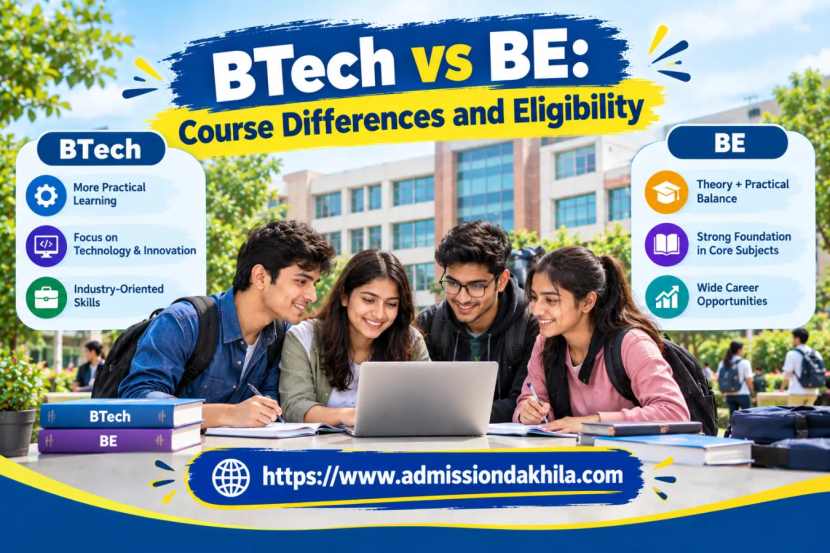
BTech vs BE: Course Differences and Eligibility
1. Introduction to BTech vs BE
Engineering is one of the most popular undergraduate study options for students who want to build careers in technology, manufacturing, construction, computing, electronics, automation and scientific innovation. After completing Class 12, many students consider engineering because it provides opportunities in private companies, public-sector organizations, research institutions and entrepreneurship.
However, students often encounter two similar degree names while exploring colleges: Bachelor of Technology (BTech) and Bachelor of Engineering (BE). This leads to an important question: What is the difference between BTech and BE, and which course should you choose after Class 12?
Both qualifications provide a foundation in engineering and technical problem-solving. They generally require four years of undergraduate study and offer specializations such as Computer Science Engineering, Mechanical Engineering, Civil Engineering, Electrical Engineering, Electronics and Communication Engineering, and other emerging fields.
The difference is not always as significant as students assume. The degree title alone does not tell you whether a programme offers better laboratories, stronger industry connections, more internships or superior placement opportunities. These factors depend heavily on the institution and the specific course.
For example, a student interested in software development may compare a BTech in Computer Science with a BE in Computer Engineering. Rather than choosing solely by the degree name, the student should examine programming subjects, data structures, artificial intelligence electives, internships, project opportunities and placement records.
Similarly, a student interested in civil or mechanical engineering should compare workshop facilities, laboratory equipment, industry projects, faculty experience and practical training.
The purpose of this guide is to explain the BTech vs BE comparison in straightforward language. It covers eligibility, entrance examinations, fees, admission procedures, syllabus, career scope, salary expectations and higher education options.
Students can also use Admission Dakhila to explore engineering colleges, understand admission pathways and prepare a shortlist of institutions that match their academic profile and budget.
BTech is not automatically better than BE, and BE is not automatically better than BTech. Both are recognized undergraduate engineering degree pathways when awarded by appropriately authorized institutions. The better choice depends on your preferred specialization, the college's academic quality, practical training, fees, placement opportunities and career goals. For engineering admission guidance, students can explore college and course information through Admission Dakhila at admissiondakhila.com.
2. What Is BTech?
BTech stands for Bachelor of Technology. It is an undergraduate degree designed to develop knowledge and skills in engineering, applied sciences, technology and technical problem-solving.
The programme generally lasts four years and is divided into eight semesters. Students study foundational engineering subjects before progressing to branch-specific courses, laboratory sessions, projects, internships and elective subjects.
BTech programmes are available at various institutions, including government engineering colleges, technical universities, private universities and other eligible institutions.
2.1 Main features of BTech
Common features of a BTech programme include:
-
Four-year undergraduate study in the standard entry route.
-
Eight semesters in many conventional programmes.
-
Core engineering subjects and specialization-specific courses.
-
Laboratory work, practical assignments and technical projects.
-
Opportunities for internships and industry exposure.
-
Preparation for employment, entrepreneurship and postgraduate study.
The actual curriculum varies by institution and specialization. Some programmes emphasize software development and computing applications, while others focus on design, manufacturing, infrastructure, electronics, energy or industrial systems.
2.2 What do students learn in BTech?
The subjects depend on the selected branch. First-year students may study mathematics, physics, programming, engineering fundamentals and communication skills, depending on the curriculum.
Students then progress to more specialized subjects.
For example, BTech Computer Science students may study:
-
Programming and problem-solving
-
Data structures and algorithms
-
Database management systems
-
Operating systems
-
Computer networks
-
Software engineering
-
Artificial intelligence and machine learning
-
Cybersecurity and cloud computing
Mechanical Engineering students may study thermodynamics, manufacturing processes, machine design, fluid mechanics and industrial automation.
Civil Engineering students may learn structural engineering, construction materials, geotechnical engineering, transportation engineering and environmental engineering.
2.3 Who should choose BTech?
BTech may suit students who enjoy mathematics, scientific reasoning, designing solutions, building systems or working with technology.
It can be appropriate for students interested in software development, engineering design, industrial operations, infrastructure projects, robotics, electronics, renewable energy and many other technical fields.
However, students should not assume that every BTech course is automatically more practical than every BE course. The actual balance between theory and application must be evaluated through the curriculum and teaching methods of the particular institution.
3. What Is BE?
BE stands for Bachelor of Engineering. It is an undergraduate degree that develops students' understanding of engineering principles, scientific concepts, technical design and problem-solving.
Like BTech, a conventional BE programme generally lasts four years and includes classroom instruction, laboratory sessions, examinations, projects and specialization-specific subjects.
BE programmes are offered by universities and institutions that award this qualification under their applicable academic and regulatory arrangements.
3.1 Main features of BE
A typical BE programme may include:
-
Engineering mathematics and foundational sciences.
-
Core subjects related to the selected branch.
-
Laboratory experiments and technical assignments.
-
Design, analysis and problem-solving exercises.
-
Final-year projects and elective subjects.
-
Preparation for employment or postgraduate education.
The relative importance of theory, practical training and industry projects depends on the university's curriculum.
3.2 What do students learn in BE?
A BE degree develops technical knowledge relevant to the chosen engineering discipline.
For instance, a student pursuing BE in Computer Science may learn programming, algorithms, operating systems, computer architecture, databases, networks and software development.
A BE student in Electrical Engineering may study electrical circuits, electrical machines, power systems, control systems and power electronics.
The curriculum generally combines conceptual learning with technical application. Students may complete laboratory experiments, design assignments, group projects and internships where these are included or arranged by the institution.
3.3 Who should choose BE?
BE can be a good choice for students who want a structured engineering education and a strong foundation in their chosen technical discipline.
Students should assess each BE programme individually, just as they would evaluate a BTech programme. A university's academic reputation, faculty, curriculum, facilities, practical exposure and career support are more useful decision-making factors than the degree title alone.
4. BTech vs BE: Key Differences
The following table summarizes the major comparison points.
|
Comparison factor |
BTech |
BE |
|---|---|---|
|
Full form |
Bachelor of Technology |
Bachelor of Engineering |
|
Qualification level |
Undergraduate |
Undergraduate |
|
Typical duration |
4 years |
4 years |
|
Standard semester structure |
Usually 8 semesters |
Usually 8 semesters |
|
Academic focus |
Engineering and technology |
Engineering and technical sciences |
|
Practical training |
Depends on curriculum |
Depends on curriculum |
|
Theoretical learning |
Included |
Included |
|
Eligibility |
Institution-specific Class 12 requirements |
Institution-specific Class 12 requirements |
|
Entrance examinations |
JEE Main, state exams or institutional exams, where applicable |
JEE Main, state exams or institutional exams, where applicable |
|
Specializations |
Computer Science, Mechanical, Civil and others |
Computer Science, Mechanical, Civil and others |
|
Employment opportunities |
Depend on skills, branch and institution |
Depend on skills, branch and institution |
|
Higher education |
MTech, MS and other eligible programmes |
MTech, MS and other eligible programmes |
4.1 Difference in course approach
Traditionally, BTech has sometimes been associated with applied technology and practical implementation, while BE has sometimes been associated with the scientific principles and theoretical foundations of engineering.
This is a broad historical distinction, not a universal rule.
Modern engineering education combines theory, design, computation, experimentation and practical application. A BE programme can have extensive industry projects, and a BTech programme can contain demanding theoretical coursework.
Therefore, students should compare the actual curriculum rather than relying on general descriptions of the two degrees.
4.2 Difference in degree-awarding institutions
The qualification awarded depends on the institution's academic structure and approved programme.
Some institutions award BTech, while others award BE. Certain universities offer both degree titles across different programmes. For example, Sathyabama Institute of Science and Technology lists both BE and BTech engineering programmes for the 2026–27 academic year.
This illustrates why students should check the precise degree title and programme details on an institution's official website.
4.3 Difference in recognition
Students should verify that the institution is legally authorized to award the qualification and that the programme meets the applicable regulatory and university requirements.
Recognition is not established merely by the letters BE or BTech. The awarding institution, programme status and relevant rules matter.
4.4 Which difference matters most?
For most students, the most important factors are:
-
The quality of teaching and faculty.
-
The relevance and depth of the curriculum.
-
Laboratories, workshops and technical infrastructure.
-
Internship and project opportunities.
-
Placement performance and the types of jobs offered.
-
Total fees and the availability of scholarships.
-
Recognition and eligibility for future education or employment.
The practical conclusion: BTech and BE are broadly comparable undergraduate engineering pathways. A strong programme in either category may be a better choice than a weaker programme carrying the other title.
5. BTech vs BE Eligibility Criteria
Eligibility is one of the most important parts of the BTech vs BE comparison. Although the two degrees have similar academic entry routes, exact requirements vary between institutions, states, entrance examinations and engineering branches.
Students applying for 2027 admission should read the latest prospectus for every institution on their shortlist.
5.1 Class 12 educational qualification
For the conventional first-year engineering route, applicants generally need to pass Class 12 or an equivalent examination from a recognized board.
Physics and Mathematics are commonly required subjects. The third relevant subject and any additional subject requirements depend on the applicable admission rules.
Depending on the programme and current regulations, eligible subjects may include Chemistry, Computer Science, Electronics, Information Technology, Biology, Biotechnology, Informatics Practices or specified technical and vocational subjects.
The National Testing Agency's JEE information describes Physics and Mathematics as compulsory subjects for relevant BE/BTech admissions through JEE Main, alongside an accepted third subject. Students should consult the current examination bulletin and the admission rules of their target institutions.
5.2 Minimum marks in Class 12
There is no single percentage requirement that applies to every BTech and BE college in India.
Depending on the institution, students may encounter minimum aggregate requirements such as 45%, 50%, 60% or another specified threshold. Some institutions also calculate marks in particular subjects separately.
Category-based relaxations may apply under the relevant admission rules.
For example, an institution may require an overall minimum percentage as well as a separate minimum in Physics and Mathematics. Another institution may use a different subject combination or entrance-exam-based eligibility structure.
Students must not assume that satisfying the minimum marks requirement guarantees admission. Entrance-exam rank, seat availability, counselling rules and branch preferences can also influence the outcome.
5.3 Eligibility for students from different streams
Students from the Science stream with the required subjects generally have the most straightforward route into conventional engineering programmes.
Students from other academic backgrounds should carefully check whether their subject combinations meet the current rules for the specific course. Some alternative subject pathways may be permitted under applicable regulations, while others may not satisfy the requirements for a particular branch or institution.
Do not rely on a general online statement that students from any stream can enter every engineering course.
5.4 Can diploma holders apply?
Yes, diploma holders may be eligible for lateral-entry admission into the second year of certain BTech or BE programmes, subject to the applicable rules.
Eligibility may depend on:
-
A recognized engineering or technology diploma.
-
The diploma branch and its relationship to the intended degree.
-
Minimum marks or grade requirements.
-
State-level lateral-entry examinations or counselling.
-
The institution's approved intake and seat availability.
Some pathways may also permit eligible BSc graduates who meet additional subject and academic requirements. The rules differ across states and universities.
The AICTE Approval Process Handbook 2024–2027 provides the broader regulatory framework for technical education, while individual admission authorities publish the operational requirements for their programmes.
5.5 Age limit
Age limits are not identical across all engineering programmes and entrance examinations. Some admission routes may have no general upper-age limit, while specific institutions or examinations can impose additional conditions.
Check the latest admission bulletin before applying.
5.6 BTech vs BE eligibility summary
|
Requirement |
What students should check |
|---|---|
|
Class 12 |
Recognized board or equivalent qualification |
|
Required subjects |
Physics, Mathematics and the accepted third subject or combination |
|
Minimum marks |
College-, course- and category-specific requirement |
|
Entrance examination |
Whether JEE Main, a state exam or an institutional test is required |
|
Diploma route |
Whether lateral entry is offered |
|
Age |
Applicable examination and institutional rules |
|
Documents |
Mark sheets, identity documents, certificates and other required records |
Students who are uncertain about eligibility can use Admission Dakhila to explore suitable college options and then confirm their individual eligibility directly with the relevant institution.
6. BTech vs BE Admission Process in 2027
The admission process for BTech and BE generally involves checking eligibility, applying through the relevant admission channel, appearing for an entrance examination where required, and completing counselling or institutional selection.
The exact process depends on the state, institution and admission category.
6.1 Step 1: Select your engineering branch
Start by deciding which engineering subjects match your interests and career plans.
Popular options include:
-
Computer Science and Engineering
-
Information Technology
-
Artificial Intelligence and Machine Learning
-
Data Science
-
Mechanical Engineering
-
Civil Engineering
-
Electrical Engineering
-
Electronics and Communication Engineering
-
Chemical Engineering
-
Biotechnology Engineering
Students should compare course content and career opportunities before selecting a specialization.
6.2 Step 2: Check college eligibility
Shortlist institutions that accept your Class 12 subjects, marks and entrance-examination qualifications.
Review the official prospectus for the 2027 intake when available. Do not assume that admission requirements for 2026–27 will remain unchanged for every institution in 2027–28.
6.3 Step 3: Apply for entrance examinations
Depending on the college, you may need to apply for JEE Main, a state engineering entrance examination or an institutional examination.
Some colleges also have admission routes based on qualifying examination marks or other permitted selection criteria.
6.4 Step 4: Participate in counselling or selection
Eligible candidates may need to register for centralized counselling, submit their preferences, verify documents and participate in seat allocation.
For example, the Gujarat Admission Committee for Professional Courses publishes BE/BTech admission instructions, while Maharashtra operates a centralized admission process for engineering courses.
Private universities may have their own application and selection processes.
6.5 Step 5: Confirm the seat and pay fees
Once a seat is offered, carefully review the admission letter, course name, degree-awarding institution, fee schedule and reporting instructions.
Pay fees only through verified official channels. Keep receipts and copies of submitted documents.
6.6 Documents commonly required
Students may be asked to provide:
-
Class 10 mark sheet and certificate.
-
Class 12 mark sheet and certificate.
-
Entrance-exam scorecard, if applicable.
-
Transfer or migration certificate, where required.
-
Identity and passport-size photographs.
-
Category or reservation certificate, if applicable.
-
Domicile certificate, where required.
-
Medical or other declarations specified by the institution.
Requirements differ, so use the official checklist for the selected college.
7. Entrance Exams for BTech and BE
The entrance examination depends on the institution and its admission policy. BTech and BE applicants may take the same examination when both programmes are offered through the same admission system.
|
Entrance exam |
General purpose |
|---|---|
|
JEE Main |
Admission to participating engineering institutions, including NITs and other eligible institutes |
|
JEE Advanced |
Admission to IIT undergraduate programmes, subject to eligibility and admission rules |
|
State engineering entrance exams |
Admission to participating state institutions |
|
University entrance tests |
Admission to programmes offered by the relevant university |
|
Merit-based admission |
Available at some institutions under their applicable rules |
7.1 JEE Main
JEE Main is a major national engineering entrance examination. It is used for admission to participating institutions under their applicable eligibility and counselling rules.
Candidates should check the current NTA bulletin for subject combinations, qualifying requirements, examination dates and other admission conditions.
7.2 JEE Advanced
JEE Advanced is relevant to eligible applicants seeking admission to IIT undergraduate programmes. Candidates must satisfy its examination-specific eligibility conditions in addition to meeting the applicable admission requirements.
7.3 State entrance examinations
Several states conduct entrance examinations or organize centralized counselling for BE/BTech admissions.
Depending on the state, admission may involve an entrance score, JEE Main score, qualifying examination marks or a combination of permitted criteria.
7.4 Private university entrance examinations
Some private universities conduct their own entrance examinations, while others accept national or state examination scores or offer alternative selection routes.
Students should check which exams their preferred institutions accept before registering.
7.5 Can you get BTech or BE admission without JEE Main?
Yes, it may be possible.
Some colleges accept state-level entrance scores, university entrance-test results or qualifying examination marks under their admission policies. However, eligibility for admission without JEE Main does not mean that all institutions or branches are available through that route.
Students should compare approved admission pathways, fees, eligibility and academic quality before making a decision.
8. Course Duration and Semester Structure
Both BTech and BE normally follow a four-year structure for students entering after Class 12.
Year 1
Engineering foundations
Mathematics, sciences, introductory programming, engineering fundamentals and communication skills.
Year 2
Core engineering subjects
Branch-specific theory, laboratories, technical assignments and applied problem-solving.
Year 3
Advanced subjects and industry exposure
Specialized electives, technical projects, internships and career preparation where available.
Year 4
Advanced projects and graduation
Final-year project, advanced electives, practical assessment and recruitment preparation.
The precise structure varies by institution. Some programmes use credit-based systems, internships, industry-linked projects or other academic arrangements.
Students entering through lateral entry may complete a shorter remaining course period, commonly three years after an eligible diploma, depending on the programme rules.
9. Difference in Syllabus and Teaching Methods
A frequent misconception is that BTech is always practical and BE is always theoretical. In reality, both courses combine conceptual knowledge and practical engineering work.
9.1 Theoretical subjects
Engineering students need to understand the scientific and mathematical principles behind the systems they design and operate.
Depending on the branch, subjects can include mathematics, mechanics, electronics, thermodynamics, programming, materials science, control systems and engineering design.
9.2 Laboratory learning
Laboratories help students apply classroom concepts through experiments, simulations, measurements and technical exercises.
For example, electronics students may work with circuits and embedded systems, while mechanical engineering students may study manufacturing processes and machine components.
9.3 Projects and internships
Projects help students demonstrate that they can apply their knowledge to real or simulated problems.
A Computer Science student might develop a web application, a Civil Engineering student might prepare a structural design project, and an Electrical Engineering student might work on an energy monitoring system.
Internships can expose students to workplace expectations and practical engineering processes. Their availability and quality depend on the institution, student preparation and employer partnerships.
9.4 How to compare actual syllabuses
Before choosing between BTech and BE, download the latest curriculum for both programmes.
Compare:
-
Core subjects and elective options.
-
Laboratory hours and equipment.
-
Programming and digital skills, where relevant.
-
Project work and final-year requirements.
-
Internship or industrial-training arrangements.
-
Opportunities for interdisciplinary learning.
-
Course updates related to current industry requirements.
The better curriculum is the one that provides relevant knowledge, rigorous fundamentals and meaningful opportunities to apply what students learn.
10. Popular Engineering Specializations
BTech and BE offer multiple specialization choices. Students should consider their interests, aptitude, academic preparation and career plans.
10.1 Computer Science Engineering
Computer Science Engineering focuses on computing systems, programming, algorithms, databases, operating systems, networks and software development.
Possible career paths include software developer, systems engineer, application developer, data engineer and other computing-related roles.
10.2 Information Technology
Information Technology emphasizes computing infrastructure, software systems, databases, networks, cybersecurity and the management of digital services.
It can suit students interested in IT operations, software development, systems administration and enterprise technology.
10.3 Artificial Intelligence and Machine Learning
AI and Machine Learning programmes explore data-driven models, algorithms, statistical methods and intelligent systems.
Students should examine the depth of mathematics, programming, data science and project work in the curriculum rather than choosing the course only because AI is popular.
10.4 Mechanical Engineering
Mechanical Engineering deals with machines, manufacturing, thermal systems, mechanical design, materials and industrial processes.
Potential career areas include manufacturing, automotive engineering, product design, maintenance and industrial automation.
10.5 Civil Engineering
Civil Engineering focuses on infrastructure, structures, construction, transportation, water systems and geotechnical engineering.
Career opportunities may include site engineering, structural design, project coordination, infrastructure planning and construction management, subject to qualifications and employer requirements.
10.6 Electrical Engineering
Electrical Engineering covers circuits, electrical machines, power systems, control systems and energy technologies.
Graduates may work in electrical design, power generation and distribution, industrial systems, renewable energy or related technical fields.
10.7 Electronics and Communication Engineering
Electronics and Communication Engineering includes electronic circuits, communication systems, signal processing, embedded systems and related technologies.
Possible careers include electronics design, telecommunications, embedded development, testing and hardware-related engineering.
10.8 Other specializations
Students may also explore Chemical Engineering, Biotechnology, Aerospace Engineering, Automobile Engineering, Robotics, Instrumentation and other disciplines.
Before choosing an emerging specialization, confirm the course content, available facilities, faculty expertise and actual career pathways.
11. BTech vs BE Fees in India
Fees can vary substantially across engineering institutions. The degree title alone does not determine the cost of a programme.
Government colleges may offer comparatively lower tuition fees than many private institutions, but costs differ by institution, state, category, specialization and admission route.
Private universities may charge higher tuition fees, particularly for programmes with specialized facilities or additional services.
11.1 Major expenses to consider
When calculating the cost of an engineering degree, include:
-
Tuition fees.
-
Admission and registration charges.
-
Examination and laboratory fees.
-
Hostel accommodation and meals.
-
Transport expenses.
-
Books, software and equipment.
-
Internship travel or project expenses, if applicable.
-
Other compulsory institutional charges.
11.2 How to compare total course costs
Do not compare colleges using only their advertised annual tuition fees.
For example, a college with lower tuition may require substantial transport costs, while another institution may offer a more convenient hostel package. Scholarships and fee concessions can also change the final cost.
Request a written fee structure and calculate the estimated four-year expense before accepting admission.
11.3 Scholarships and financial assistance
Depending on eligibility, students may be able to access government scholarships, state schemes, institution-specific merit scholarships, category-based assistance or other financial support.
Verify the eligibility conditions, renewal requirements, deadlines and disbursement rules through official sources.
12. BTech vs BE: Career Opportunities and Salary
Both degrees can lead to engineering employment, technology roles, postgraduate study and entrepreneurial opportunities.
Career outcomes depend on the specialization, skills, academic performance, work experience, location, employer requirements and quality of professional preparation.
12.1 Career options after BTech
Depending on the branch, BTech graduates may pursue roles such as:
-
Software developer.
-
Computer systems engineer.
-
Mechanical design engineer.
-
Civil site engineer.
-
Electrical engineer.
-
Electronics engineer.
-
Data analyst or data engineer.
-
Quality assurance engineer.
-
Technical support engineer.
-
Production or manufacturing engineer.
12.2 Career options after BE
BE graduates may pursue similar roles when their specialization and skills match the employer's requirements.
For example, a BE Computer Engineering graduate may apply for suitable software development positions, while a BE Mechanical Engineering graduate may seek work in manufacturing, product development or industrial operations.
In many recruitment processes, employers assess the relevant degree, technical ability, projects, internships, communication skills and interview performance rather than preferring BE or BTech solely by name. However, individual job advertisements can specify particular qualifications.
12.3 BTech vs BE salary expectations
There is no reliable universal salary difference attributable only to the BTech or BE title.
Compensation varies according to job function, employer, experience, location, skill level and market conditions. Students should avoid assuming that one degree guarantees a higher package.
When comparing colleges, examine median placement figures where available, the number of students placed, job profiles, recruiting companies and whether published salary figures refer to the highest package or a typical outcome.
12.4 How to improve employability
Engineering students can strengthen their prospects by:
-
Building strong fundamentals in their chosen branch.
-
Completing relevant projects.
-
Developing programming or technical tools where appropriate.
-
Seeking internships and practical experience.
-
Improving communication and teamwork.
-
Preparing for technical interviews and aptitude assessments.
-
Building a portfolio or documenting project work.
-
Keeping up with developments in their chosen field.
The college provides the learning environment, but students also need to build demonstrable skills.
13. Higher Education After BTech and BE
Both BTech and BE graduates may be eligible for higher education, depending on the programme-specific requirements.
13.1 MTech
MTech is a postgraduate engineering degree that enables students to deepen their knowledge in a particular technical field.
Admission requirements may include a relevant bachelor's degree, minimum marks, an entrance examination or an institution-specific selection process.
13.2 MS
A Master of Science degree may be an option for students seeking advanced study or research in engineering, computing and related disciplines.
Requirements vary by country and university. Applicants may need academic transcripts, language-test scores, recommendations, a statement of purpose or other documents.
13.3 MBA
Engineering graduates can consider an MBA if they want to move towards management, consulting, operations, marketing, product management or business leadership.
Admission may require an entrance test, academic eligibility and other selection components.
13.4 Research and doctoral study
Students interested in advanced research can explore eligible postgraduate and doctoral pathways. Requirements depend on the subject, institution and research programme.
13.5 GATE eligibility
GATE is relevant to various postgraduate and other technical opportunities. The GATE 2027 eligibility information includes eligible students in the third year or higher of specified undergraduate degree programmes, as well as graduates meeting the stated conditions. Students should read the official eligibility criteria for their intended examination year and target institution.
Both BE and BTech graduates should verify the specific programme's accepted qualifications rather than assuming that every postgraduate course has identical rules.
14. BTech vs BE: Which Is Better for IT Jobs?
For students targeting IT jobs, the curriculum and skills developed during the degree often matter more than whether the qualification says BTech or BE.
A BTech in Computer Science and a BE in Computer Engineering can both provide relevant preparation for software development, provided the student develops the required knowledge and practical ability.
14.1 Subjects that matter for IT careers
Students targeting software and IT roles should look for subjects such as:
-
Programming languages.
-
Data structures and algorithms.
-
Database management systems.
-
Operating systems.
-
Computer networks.
-
Software engineering.
-
Web or application development.
-
Cloud computing and cybersecurity, where relevant.
For AI or data-related careers, statistics, mathematics, machine learning and data-processing skills may also be important.
14.2 Practical experience matters
Students can improve their preparation through internships, coding projects, open-source contributions, technical competitions and structured practice.
A course title alone does not guarantee access to a particular role. Recruiters may assess coding ability, technical fundamentals, problem-solving and communication during selection.
14.3 Which should IT aspirants choose?
Compare the specific BE and BTech colleges available to you. If one offers stronger computing subjects, more relevant projects, experienced faculty and better access to suitable internships, that programme may be preferable regardless of its degree title.
15. BTech vs BE: Which Is Better for Government Jobs?
Both qualifications may be suitable for government and public-sector recruitment when the relevant notification accepts the degree and branch.
Potential opportunities vary by employer and can include engineering departments, technical services, public-sector organizations, infrastructure bodies, research establishments and other government agencies.
15.1 Check the recruitment notification
Before applying, verify:
-
Accepted degree qualifications.
-
Eligible engineering branches.
-
Minimum academic requirements.
-
Age limits and applicable relaxations.
-
Required examinations or professional registration.
-
Any experience or other conditions.
A recruitment notification may accept BE/BTech in a particular discipline, or it may specify a narrower qualification. Do not assume that every engineering degree is accepted for every technical vacancy.
15.2 Is BE better for government jobs?
No general rule says that BE is better than BTech for government employment, or vice versa.
The applicable recruitment rules and the candidate's eligibility are what matter. Students should prioritize a recognized qualification in the appropriate branch and prepare for the required selection process.
16. Advantages and Disadvantages of Both Degrees
16.1 Advantages of BTech
-
Offers a structured undergraduate engineering education.
-
Provides access to multiple engineering specializations.
-
Can support private-sector employment and higher education.
-
May include practical projects, laboratories and internships.
-
Offers pathways into technology-focused careers.
16.2 Potential limitations of BTech
-
Programme quality varies significantly by institution.
-
Fees can be substantial at some private colleges.
-
A degree alone does not guarantee a job or high salary.
-
Students may need additional practice and practical experience.
-
Emerging specializations may vary in curriculum quality.
16.3 Advantages of BE
-
Builds a foundation in engineering principles and applications.
-
Offers a range of technical specializations.
-
Can support engineering careers and postgraduate study.
-
May include substantial laboratory and project work.
-
Can provide a suitable pathway into private or public-sector technical roles.
16.4 Potential limitations of BE
-
Programme quality depends on the institution.
-
Practical exposure and placement support differ between colleges.
-
Some students may need to develop additional industry-specific skills.
-
The degree title alone does not indicate the strength of a programme.
16.5 Overall comparison
The advantages and limitations listed above apply broadly to engineering education rather than exclusively to one degree title.
A student should evaluate the actual institution, academic structure, facilities, financial requirements and career support before making a final decision.
17. How to Choose the Right Engineering College
Selecting the right college is often more important than choosing between BTech and BE as degree titles. A thoughtful comparison can help students avoid unnecessary expenses and select a programme aligned with their goals.
17.1 Verify recognition and affiliation
Check the institution's legal status, degree-awarding authority, university affiliation and any applicable programme approvals. Confirm that the exact course and campus are covered by the relevant authorizations.
17.2 Compare academic quality
Review faculty qualifications, curriculum updates, laboratory facilities, library resources and project opportunities.
For computing programmes, look at access to relevant software, computing laboratories and technical projects. For core engineering branches, check the quality and availability of laboratories, workshops and equipment.
17.3 Evaluate placements carefully
Do not make a decision based solely on the highest salary package advertised by a college.
Ask for the placement report and check:
-
Number of eligible students.
-
Number of students placed.
-
Median salary, if published.
-
Types of companies and job profiles.
-
Internship opportunities.
-
Placement data for your chosen branch.
-
Whether the information is independently verifiable.
17.4 Consider location and living costs
Students choosing colleges in Noida, Greater Noida, Delhi NCR or other education hubs should compare accommodation, commuting, food and other living expenses.
A college's location may affect internship access and convenience, but it should not replace an assessment of academic quality.
17.5 Compare fees and scholarships
Calculate the complete estimated cost for the full programme. Ask whether scholarships are renewable and whether eligibility depends on entrance-exam rank, Class 12 marks, category or continued academic performance.
17.6 Explore colleges through Admission Dakhila
Admission Dakhila can serve as a starting point for exploring engineering courses, comparing potential colleges and understanding admission options.
Students should use the information to prepare a shortlist and then verify official eligibility criteria, fees, placement data and deadlines directly with each institution.
18. Common Mistakes Students Should Avoid
18.1 Choosing a course based only on its name
BTech is not automatically superior to BE, and BE is not automatically more theoretical or less industry-oriented. Compare the actual curriculum and facilities.
18.2 Ignoring eligibility conditions
Students sometimes apply without checking required subjects, minimum marks, examination rules or branch-specific conditions. Review eligibility before paying an application fee.
18.3 Believing every placement claim
A highest-package figure may represent one exceptional offer rather than the typical outcome. Ask for branch-specific placement data and the number of students placed.
18.4 Ignoring total expenses
Tuition is only one part of the total cost. Include hostel, transport, food, examination charges and other compulsory expenses.
18.5 Selecting a specialization only because it is trending
Artificial intelligence, data science and cybersecurity attract considerable attention, but students should consider their interests and aptitude. A strong foundation and suitable learning environment are essential.
18.6 Missing official admission deadlines
Entrance examinations, counselling registrations, document verification and college reporting have separate deadlines. Check official websites regularly and maintain a personal admission calendar.
19. Admission Dakhila: Engineering Admission Guidance
Choosing between BTech and BE is only the first step in planning an engineering education. Students must also identify a suitable specialization, compare colleges, assess eligibility, understand fees and follow the correct admission process.
Admission Dakhila aims to help students and parents navigate education-related information and explore college and admission options.
Through AdmissionDakhila.com, engineering aspirants can begin researching relevant courses and colleges, prepare a shortlist and identify questions to ask admission offices.
Before finalizing an institution, students should independently confirm:
-
Whether the desired BTech or BE programme is offered.
-
Whether they meet the current eligibility criteria.
-
Which entrance examinations or admission routes are accepted.
-
The total fee structure and available financial assistance.
-
The institution's academic facilities and placement information.
-
The official application deadline and required documents.
The best admission decision combines accurate information, realistic financial planning and a clear understanding of personal career goals.
20. Conclusion: BTech vs BE — Which Course Should You Choose?
BTech and BE are two established undergraduate engineering degree pathways in India. Both generally require four years of study after Class 12 and can lead to careers in engineering, software development, manufacturing, construction, electronics, research and other technical fields.
The main difference is often associated with the academic conventions of the awarding institution and the way a programme is structured. However, there is no universal rule that BTech is always more practical or BE is always more theoretical. Modern programmes in both categories can combine conceptual learning, laboratory work, projects and industry exposure.
When deciding between BTech and BE, consider the following factors:
-
Eligibility: Confirm that your Class 12 subjects, marks and entrance-exam qualifications satisfy the admission rules.
-
Curriculum: Compare core subjects, electives, practical work and specialization options.
-
College quality: Evaluate recognition, faculty, facilities and academic support.
-
Career opportunities: Review relevant job profiles, internships and verifiable placement information.
-
Financial planning: Calculate total course costs and explore scholarships.
-
Future education: Check whether your chosen qualification supports your intended postgraduate pathway.
For students interested in technology careers, a well-structured programme in Computer Science, Information Technology, Artificial Intelligence or another relevant branch may be suitable. Students interested in infrastructure, machines, electrical systems or industrial design can explore the corresponding engineering disciplines.
Ultimately, choose the best institution and programme for your goals, not simply the degree title.
If you are planning engineering admission for 2027, start comparing eligible colleges early. Visit Admission Dakhila to explore engineering education options, organize your shortlist and move towards an informed admission decision. Always confirm final admission details with the relevant institution or official counselling authority.
21. Frequently Asked Questions (FAQs)
The following 10 FAQs are designed for long-tail search queries, conversational search and featured-snippet opportunities. Keep the questions visible on the published page, and ensure that the answers match the article's main content.
FAQ 1. What is the main difference between BTech and BE?
BTech stands for Bachelor of Technology, while BE stands for Bachelor of Engineering. Both are undergraduate engineering degrees that generally last four years. Their academic focus can vary by institution, so students should compare the actual curriculum, practical training, facilities and career opportunities rather than relying only on the degree title.
FAQ 2. Is BTech better than BE?
Neither BTech nor BE is universally better. The right choice depends on the institution, engineering specialization, curriculum, faculty, practical exposure, fees and placement opportunities. Students should compare specific programmes before deciding.
FAQ 3. What is the eligibility for BTech and BE admission after Class 12?
Students generally need to pass Class 12 or an equivalent examination with Physics, Mathematics and the other subjects accepted by their target programme. Minimum marks and entrance-exam requirements vary by institution and admission route. Applicants should check the latest official eligibility criteria.
FAQ 4. Can I pursue BTech or BE without JEE Main?
Yes, some institutions offer admission through state entrance examinations, university entrance tests or qualifying-examination-based routes where permitted. However, the available options depend on the college and programme. JEE Main is required for certain admission pathways, so students must verify each institution's rules.
FAQ 5. Is BTech more practical than BE?
Not necessarily. BTech has traditionally been associated with applied technology, while BE has sometimes been associated with engineering principles. In practice, both can include theoretical subjects, laboratories, design work, internships and projects. The curriculum of the specific institution determines the actual learning experience.
FAQ 6. Which course has higher salary prospects, BTech or BE?
Neither degree guarantees a higher salary simply because of its title. Salary depends on the specialization, technical skills, employer, experience, location and job role. Students should compare relevant placement reports and focus on building practical skills and professional experience.
FAQ 7. Can BE graduates apply for MTech and GATE?
BE graduates may be eligible for MTech programmes and GATE when they satisfy the applicable examination and programme requirements. Eligibility depends on the recognized qualification, relevant branch and other conditions specified by the examination or admitting institution.
FAQ 8. Can diploma holders get direct admission to the second year of BTech or BE?
Eligible diploma holders may be able to enter the second year through a lateral-entry pathway. Admission depends on the diploma qualification, branch compatibility, marks, entrance requirements and availability of seats. Students should confirm the applicable state or university rules.
FAQ 9. Which engineering branch is best for future career opportunities?
There is no single best branch for every student. Computer Science, Information Technology, AI-related disciplines, Mechanical Engineering, Civil Engineering, Electrical Engineering and Electronics and Communication Engineering offer different career pathways. Students should compare their interests, strengths, course content and employment options.
FAQ 10. How can Admission Dakhila help students compare BTech and BE colleges?
Admission Dakhila provides an education-information starting point for students exploring engineering courses and colleges. Students can use AdmissionDakhila.com to begin researching options, prepare a shortlist and identify admission questions. They should confirm eligibility, fees, approvals and deadlines through official institutional sources.