Engineering Colleges Accepting JEE Main Without Advanced: Complete Admission Guide 2027
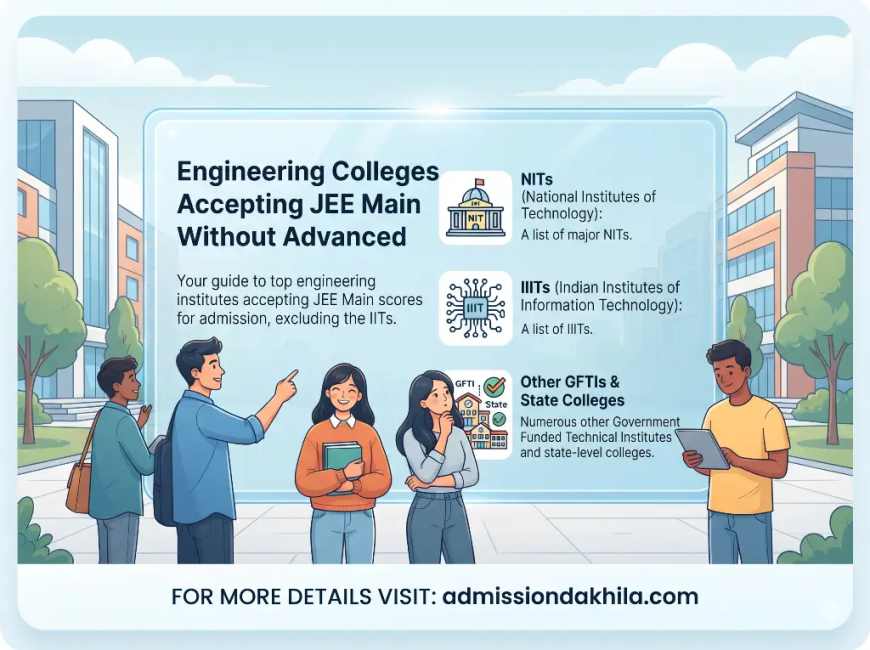
Engineering colleges accepting JEE Main without requiring JEE Advanced include the National Institutes of Technology (NITs), Indian Institutes of Information Technology (IIITs), the Indian Institute of Engineering Science and Technology, Shibpur (IIEST), and participating Government Funded Technical Institutes (GFTIs). Students can also explore state government engineering colleges and private universities that accept JEE Main scores, subject to their admission policies. IIT undergraduate admission generally requires JEE Advanced qualification. Students can use Admission Dakhila at admissiondakhila.com to explore college options, eligibility and admission guidance.
1. Introduction
Engineering remains a popular career choice for students who want to work in technology, software development, electronics, infrastructure, manufacturing, artificial intelligence and scientific research. In India, the Joint Entrance Examination (JEE) is one of the principal routes into undergraduate engineering programmes.
However, students sometimes believe that they must clear both JEE Main and JEE Advanced to study engineering at a reputable college. This is incorrect.
JEE Main alone can open the door to many engineering colleges in India. Depending on their scores, eligibility and counselling results, students can pursue BTech or BE programmes at NITs, IIITs, IIEST Shibpur, participating GFTIs, state government institutions and private universities.
The crucial point is to distinguish between colleges that require JEE Advanced and those that accept JEE Main. IIT undergraduate admissions generally use JEE Advanced, whereas the NIT+ system uses JEE Main for the relevant programmes.
For students planning admission in 2027, researching these options early can help them create a realistic college shortlist, compare branches and understand the costs involved.
Admission Dakhila provides an education-focused platform where students can explore engineering colleges, compare possible admission routes and plan their next steps. Students should still verify all final admission conditions on the official college, examination and counselling websites.
Yes. You can get admission to many engineering colleges through JEE Main without clearing JEE Advanced. NITs, IIITs, IIEST Shibpur and participating GFTIs offer eligible undergraduate engineering programmes through JEE Main and the applicable counselling process. State colleges and private universities may also accept JEE Main scores. Your admission depends on your rank, category, Class 12 eligibility, course preference and the institution's admission rules. For help comparing options, visit Admission Dakhila.
2. Understanding JEE Main and JEE Advanced
Before exploring colleges, students should understand the difference between the two examinations.
What is JEE Main?
JEE Main is a national-level entrance examination conducted by the National Testing Agency (NTA). Paper 1 is used for admission consideration to undergraduate BE and BTech programmes at NITs, IIITs, other centrally funded institutions and participating institutions under the applicable rules.
JEE Main is also used to determine eligibility for JEE Advanced, the examination associated with admission to IIT undergraduate programmes.
For engineering applicants, JEE Main performance can serve two purposes:
-
It can provide a route to engineering admission at participating institutions.
-
It can provide eligibility for attempting JEE Advanced if the student meets the relevant conditions.
Students who do not take JEE Advanced, or who do not qualify in it, can still pursue engineering through institutions that use JEE Main or other accepted admission routes.
What is JEE Advanced?
JEE Advanced is a separate examination primarily used for admission to undergraduate programmes at the Indian Institutes of Technology (IITs), subject to the applicable admission rules.
Students who want an IIT seat generally need to meet JEE Advanced eligibility and qualification requirements. Simply having a JEE Main score does not ordinarily provide a seat in an IIT's regular undergraduate engineering programme.
JEE Main vs JEE Advanced
|
Feature |
JEE Main |
JEE Advanced |
|---|---|---|
|
Main admission routes |
NITs, IIITs, participating GFTIs and other accepting institutions |
IIT undergraduate programmes |
|
Required for NIT admission through JoSAA |
Yes, for the relevant programmes |
No |
|
Required for IIIT admission through JoSAA |
Yes, for the relevant programmes |
No |
|
Required for regular IIT undergraduate admission |
Not sufficient by itself |
Generally yes |
|
Used for state/private colleges |
Accepted by some institutions |
Usually not required unless specified |
|
Other entrance routes available |
Depends on the institution |
Separate IIT admission pathway |
These are general distinctions. Always check the current admission brochure for the institution and programme you intend to apply to.
3. Why Choose Colleges That Accept JEE Main?
Students do not need to treat JEE Advanced as the only measure of their engineering potential. A well-chosen college can offer a meaningful engineering education through several other admission routes.
More college options
JEE Main is accepted by several categories of institutions. Depending on rank and eligibility, students may consider national-level institutes, state colleges and private universities.
A broader shortlist reduces the risk of depending on just one examination or one highly competitive college.
Access to different engineering branches
Students may find opportunities in:
-
Computer Science and Engineering
-
Information Technology
-
Artificial Intelligence and Machine Learning
-
Electronics and Communication Engineering
-
Electrical Engineering
-
Mechanical Engineering
-
Civil Engineering
-
Chemical Engineering
-
Biotechnology
-
Data Science and related interdisciplinary fields
Not every branch is available at every college, and some newer specialisations have different eligibility or seat-allocation rules.
Multiple budget options
Government-funded colleges, state institutions and private universities can have significantly different fee structures.
Students should consider tuition fees, hostel charges, mess expenses, transport, examination charges and other costs rather than judging affordability by tuition alone.
A practical route after JEE Main
Students who have not qualified for JEE Advanced, do not wish to appear for it or prefer a different institution can focus on JEE Main-based counselling and other eligible admission pathways.
The goal is not simply to secure a college seat. It is to find a recognised programme that matches the student's interests, financial circumstances and career plans.
4. Types of Engineering Colleges Accepting JEE Main
The main categories to research are explained below.
National Institutes of Technology (NITs)
NITs are public engineering institutions that participate in the JEE Main-based admission process for relevant undergraduate programmes. Eligible candidates generally apply through JoSAA and may have additional options through CSAB, according to the applicable year's rules.
Indian Institutes of Information Technology (IIITs)
IIITs offer programmes in computer science, information technology, electronics and related fields, depending on the campus. Participating IIIT undergraduate programmes in the JoSAA process use JEE Main rather than requiring JEE Advanced as their entrance examination.
IIEST Shibpur
The Indian Institute of Engineering Science and Technology, Shibpur, is part of the NIT+ admission system. Relevant undergraduate programmes use JEE Main through the applicable central counselling process.
Government Funded Technical Institutes (GFTIs)
Participating GFTIs offer engineering and other technical programmes. The courses and available seats differ by institute, and the applicable admission rules determine whether JEE Main is accepted.
State government engineering colleges
Many state government colleges use state-level entrance examinations, JEE Main ranks or a combination of admission criteria. Their counselling procedures can be separate from JoSAA.
Private engineering colleges and universities
Some private institutions accept JEE Main scores for BTech admission. Others conduct their own entrance examinations, consider Class 12 marks or provide multiple application routes.
Do not assume that every private engineering college accepts JEE Main. Confirm the current admission policy for the exact campus and course.
5. NITs Accepting JEE Main Without Advanced
National Institutes of Technology are among the most sought-after public engineering institutions in India. Their relevant undergraduate engineering admissions use JEE Main through the prescribed counselling system, so students do not need to qualify for JEE Advanced to enter an NIT.
JoSAA's 2026 admission framework identifies 31 NITs and provides the central seat-allocation process for participating institutions. The final 2027 institute list and admission rules should be checked when officially published.
Examples of NITs to consider
|
College |
Location |
Popular areas to explore |
|---|---|---|
|
NIT Tiruchirappalli |
Tiruchirappalli, Tamil Nadu |
CSE, ECE, Mechanical, Civil |
|
NIT Karnataka, Surathkal |
Surathkal, Karnataka |
CSE, ECE, Electrical, Chemical |
|
NIT Warangal |
Warangal, Telangana |
CSE, ECE, Mechanical, Civil |
|
Motilal Nehru National Institute of Technology |
Prayagraj, Uttar Pradesh |
CSE, Electrical, Mechanical, Civil |
|
Malaviya National Institute of Technology |
Jaipur, Rajasthan |
CSE, ECE, Electrical, Mechanical |
|
National Institute of Technology Calicut |
Kozhikode, Kerala |
CSE, ECE, Electrical, Mechanical |
|
National Institute of Technology Rourkela |
Rourkela, Odisha |
CSE, ECE, Chemical, Mechanical |
|
National Institute of Technology Delhi |
Delhi |
CSE, ECE, Electrical |
|
National Institute of Technology Kurukshetra |
Kurukshetra, Haryana |
CSE, IT, Electrical, Mechanical |
|
National Institute of Technology Jalandhar |
Jalandhar, Punjab |
CSE, ECE, Mechanical, Industrial |
The branch names above are illustrative rather than a confirmed 2027 course list. Check each institution's current programme offerings.
What rank do you need for an NIT?
There is no single JEE Main rank that guarantees admission to every NIT. Closing ranks vary by:
-
Engineering branch and programme.
-
Institute and campus.
-
Category and applicable reservation.
-
Home-state and other-state quotas.
-
Gender-related seat categories where applicable.
-
Counselling round and seat availability.
Computer Science at a highly sought-after NIT may require a much stronger rank than some other branches or institutions. Students should compare official opening and closing ranks for the correct category and quota rather than relying on one general cutoff.
How to improve your NIT shortlist
Create three groups: ambitious colleges, realistic options based on previous closing ranks, and alternatives with comparatively broader admission possibilities. Include branches you genuinely want to study, not just colleges with familiar names.
Review the official JoSAA portal at josaa.nic.in for participating institutes, seat-allocation rules and published opening and closing ranks.
6. IIITs Accepting JEE Main Without Advanced
Indian Institutes of Information Technology are another important option for students who want to study technology without taking JEE Advanced.
Participating IIITs offer undergraduate programmes through JEE Main and the relevant counselling process. Their programmes often focus on computing, information technology, electronics, communications and related areas.
Examples of IIITs
|
Institute |
Location |
Areas to investigate |
|---|---|---|
|
ABV-IIITM Gwalior |
Gwalior, Madhya Pradesh |
IT, computing and management-related technology |
|
IIIT Allahabad |
Prayagraj, Uttar Pradesh |
IT and electronics |
|
IIITDM Jabalpur |
Jabalpur, Madhya Pradesh |
Computing, electronics and design |
|
IIITDM Kancheepuram |
Chennai, Tamil Nadu |
Information technology, electronics and design |
|
IIIT Guwahati |
Guwahati, Assam |
CSE and ECE |
|
IIIT Kota |
Rajasthan |
CSE and ECE |
|
IIIT Sri City |
Andhra Pradesh |
Computing and electronics |
|
IIIT Una |
Una, Himachal Pradesh |
CSE and ECE |
|
IIIT Vadodara |
Gujarat |
Computer science and IT-related programmes |
Verify the precise official institute name, current location, courses and counselling participation before applying.
Are IIITs a good choice for Computer Science?
They can be suitable for students interested in programming, algorithms, data structures, software engineering, artificial intelligence, cybersecurity and information technology.
However, students should compare curriculum, faculty, laboratories, internships, placement reports, total cost and campus facilities. The IIIT name alone does not guarantee identical opportunities at every campus.
Also, do not confuse the IIITs that participate in JoSAA with institutions that conduct their own admissions. For example, International Institute of Information Technology Hyderabad has its own admission pathways, which must be checked separately.
7. IIEST Shibpur and GFTIs
Indian Institute of Engineering Science and Technology, Shibpur
IIEST Shibpur is a public technical institution in West Bengal. Its relevant undergraduate programmes are included in the NIT+ system and use JEE Main through the applicable counselling framework.
Students interested in traditional engineering disciplines should examine the institute's current course list, academic requirements and fees before selecting it.
Government Funded Technical Institutes
GFTIs are institutions supported wholly or partly by government funding that participate in the relevant central admission process. The category includes different types of technical institutions, and their courses, locations and specialisations vary.
Examples of institutes to investigate through the official participating-institute list include:
-
Birla Institute of Technology, Mesra — Ranchi, Jharkhand.
-
Assam University — Silchar, Assam, for relevant participating programmes.
-
Other GFTIs appearing in the applicable JoSAA seat matrix.
Do not assume that every programme offered by an institute is allocated through JEE Main. Check the specific course and the official admission brochure.
The 2026 JoSAA business rules distinguish IIT/IISc admissions through JEE Advanced from relevant NIT+, IIEST, IIIT and GFTI admissions through JEE Main.
8. State Government Engineering Colleges Accepting JEE Main
Students should not restrict their research to NITs and IIITs. State engineering colleges can offer additional options, particularly when a student wants to remain near home or control education costs.
Some state institutions use JEE Main scores through their own counselling systems. Others require a state entrance examination, and some use more than one route.
Examples to research
-
Delhi Technological University (DTU), Delhi.
-
Netaji Subhas University of Technology (NSUT), Delhi.
-
Institute of Engineering and Technology, Lucknow (IET Lucknow).
-
Bundelkhand Institute of Engineering and Technology (BIET Jhansi).
-
Harcourt Butler Technical University (HBTU Kanpur).
-
Madan Mohan Malaviya University of Technology (MMMUT Gorakhpur).
-
J.C. Bose University of Science and Technology, YMCA in Faridabad.
These institutions have distinct admission rules, and their participation in a particular counselling system or acceptance of JEE Main can vary by programme and year. For example, DTU and NSUT are associated with Delhi's separate counselling arrangements, while eligible Uttar Pradesh programmes may be covered by the state's technical admission process.
Before applying, check the relevant official counselling portal, domicile conditions, category rules and whether the college accepts JEE Main for the intended course in 2027.
9. Private Engineering Colleges Accepting JEE Main
Private universities can be useful alternatives for students who want more choices of location, specialisation or admission route. Some accept JEE Main scores directly; others consider the score alongside board marks or their own entrance examination.
Examples of private institutions to investigate
|
College or university |
Location |
What to verify |
|---|---|---|
|
Jaypee Institute of Information Technology |
Noida, Uttar Pradesh |
Current BTech admission route and programme-wise criteria |
|
Thapar Institute of Engineering and Technology |
Patiala, Punjab |
JEE Main and board-based selection rules |
|
The LNM Institute of Information Technology |
Jaipur, Rajasthan |
Accepted entrance routes and eligibility |
|
Nirma University |
Ahmedabad, Gujarat |
All-India and state admission routes |
|
Shiv Nadar University |
Greater Noida, Uttar Pradesh |
Current BTech eligibility and accepted scores |
|
Amrita Vishwa Vidyapeetham |
Multiple campuses |
Whether JEE Main or AEEE is accepted for the chosen programme |
|
Manipal University Jaipur |
Jaipur, Rajasthan |
Current BTech entrance and selection requirements |
|
Bennett University |
Greater Noida, Uttar Pradesh |
Current accepted entrance scores and merit criteria |
This is a research shortlist, not a guarantee of 2027 eligibility or an official ranking. Confirm whether the college accepts JEE Main for the exact programme and whether a separate application, counselling registration or additional test is required.
For example, Amrita's published engineering admissions information states that JEE Main scores are considered alongside its AEEE route.
Should you choose a private college?
A private college may be appropriate if its academic quality, faculty, facilities, industry exposure and total fees suit your requirements. A higher fee does not automatically mean better placements, just as a lower fee does not necessarily indicate weaker education.
Compare verified placement reports, median salary where available, eligible-student counts, internship support and the actual number of students placed. Treat the highest package as a limited data point rather than a prediction of your own salary.
10. Engineering Colleges in Delhi NCR
Delhi NCR is a popular area for engineering aspirants because it includes universities, government institutions, private colleges and technology employers.
Students who prefer the region can investigate the following institutions and routes:
-
DTU and NSUT through the applicable Delhi counselling system.
-
IIIT Delhi through its own published admission process.
-
Jaypee Institute of Information Technology, Noida.
-
Shiv Nadar University, Greater Noida.
-
Bennett University, Greater Noida.
-
Other eligible private engineering colleges in Noida, Greater Noida, Ghaziabad and nearby areas.
Not all of these institutions use the same admission process. Some may accept JEE Main; others may consider additional entrance scores, board performance or separate selection requirements.
How to compare NCR colleges
Consider travel time, hostel availability, tuition fees, internship access, class sizes, laboratories, course accreditation and placement transparency.
Students comparing colleges in Noida and Greater Noida should also check whether the advertised placement data is for the entire university, a specific department or the particular BTech batch.
Admission Dakhila can be used as a starting point for exploring college options and organising your shortlist. Confirm all critical information with the institutions before paying an application or admission fee.
11. Popular BTech Branches Available Through JEE Main
The right branch can influence your academic experience, internship opportunities and future career. Students should select a course based on aptitude and interests rather than choosing a branch only because it is popular.
Computer Science and Engineering (CSE)
CSE focuses on programming, algorithms, databases, operating systems, computer networks, software development and computing fundamentals.
Possible careers include software developer, systems engineer, cloud engineer, cybersecurity analyst and software test engineer.
Artificial Intelligence and Machine Learning
AI and ML programmes focus on data, statistical methods, machine learning algorithms and intelligent systems. Depending on the curriculum, students may study Python, linear algebra, probability, neural networks and data engineering.
These fields are worth considering if you enjoy mathematics, programming and problem-solving.
Information Technology (IT)
IT covers software systems, networks, databases, web applications and enterprise technology. It can lead to roles in software development, application support, network administration and IT consulting.
Electronics and Communication Engineering (ECE)
ECE covers electronic circuits, communication systems, embedded systems, signal processing and semiconductor-related topics. Career pathways may include electronics design, telecommunications, embedded software and hardware engineering.
Electrical Engineering
Electrical engineering focuses on electrical machines, power systems, control systems and electrical networks. It can be relevant to energy, industrial automation, infrastructure and electric mobility.
Mechanical Engineering
Mechanical engineering involves design, manufacturing, materials, thermodynamics, fluid mechanics and machine systems. Potential career areas include automotive engineering, production, industrial design and manufacturing operations.
Civil Engineering
Civil engineering deals with buildings, transportation, construction, structures, water systems and infrastructure. Graduates can pursue roles in construction, consulting, infrastructure planning and public-sector engineering.
How to choose between branches
Ask yourself three questions:
-
Which subjects do I genuinely enjoy?
-
What kind of work do I want to do after graduation?
-
Can I afford and realistically access the college and branch I am considering?
Compare the syllabus and career paths before finalising your preferences. A strong academic fit can be more valuable than selecting an unfamiliar specialisation simply because it appears trendy.
12. Eligibility Criteria for Admission
Qualifying JEE Main is not the only requirement for engineering admission. Candidates must also meet the academic and programme-specific conditions.
Class 12 subjects
For many conventional BTech programmes, Physics and Mathematics are required, together with an approved third subject. The precise subject combinations and other conditions must be checked in the current admission bulletin.
Minimum Class 12 marks
For NITs, IIITs and other applicable centrally funded institutions, the general eligibility framework has included a requirement of at least 75% in Class 12 or placement in the top 20 percentile of the respective board. The prescribed threshold for SC/ST candidates has been 65%, subject to the applicable rules.
These criteria should be rechecked against the official rules for the 2027 admission cycle. Individual state and private institutions can have different requirements.
JEE Main rank and score
Different institutions use different measures, including All India Rank, category rank, percentile or a combination of entrance and board performance.
Do not treat a percentile as a rank or assume that a particular score guarantees a seat.
Age and attempt rules
Check the current JEE Main information bulletin for the applicable eligibility and examination-attempt rules. Colleges can also impose additional conditions.
Other admission requirements
Depending on the college, you may need:
-
Valid JEE Main scorecard.
-
Class 10 and Class 12 certificates or marksheets.
-
Category or reservation certificates, where applicable.
-
Domicile certificate for relevant state quotas.
-
Identity and photograph documents.
-
Counselling registration and fee payment.
-
Medical or other programme-specific documentation.
Always use the official checklist for the relevant counselling round.
13. Admission Process Through JEE Main
The general admission process involves examination, result evaluation, college research, application and seat allocation. Exact procedures differ between central counselling and institutions with separate admission systems.
Step 1: Appear for JEE Main
Register on the official NTA portal, follow the examination instructions and appear for the relevant paper. Review the latest notices at jeemain.nta.nic.in.
Step 2: Check your result
After the result is announced, record your percentile, rank and other relevant details. Read the official scorecard carefully.
Step 3: Prepare a college shortlist
Identify institutions that accept JEE Main and compare their courses, fees, location and previous closing ranks.
Divide your list into ambitious, realistic and alternative choices.
Step 4: Register for the appropriate counselling process
For participating NITs, IIITs, IIEST and GFTIs, check JoSAA and any applicable CSAB rounds.
For state government colleges, check the relevant state counselling portal. For private institutions outside central counselling, check their individual admission websites.
Step 5: Fill in college and branch preferences
Choose only programmes you would seriously consider joining. Preference order matters in seat allocation, so understand how the applicable counselling system processes choices.
Step 6: Complete document verification and payment
Follow the official instructions for seat acceptance, verification, fees and reporting. Missing a deadline can lead to loss of an allotted seat.
Step 7: Confirm final admission
Follow the institution's reporting instructions and ensure that your documents, payments and eligibility are accepted.
14. JoSAA and CSAB Counselling
JoSAA is the central seat-allocation authority for participating institutions in the NIT+ system and IITs. The admission examination differs by institute category: relevant NIT+, IIEST, IIIT and GFTI programmes use JEE Main, while regular IIT undergraduate admissions use JEE Advanced.
What is JoSAA?
JoSAA coordinates seat allocation for participating institutions through a common online process. Candidates register, fill preferences and participate in seat allocation according to the applicable rules.
What is CSAB?
The Central Seat Allocation Board conducts specified additional counselling processes for participating NIT+ institutions. Whether a candidate can participate depends on the relevant year's rules and eligibility.
Important counselling advice
-
Read the current business rules before filling choices.
-
Review the seat matrix and previous closing ranks.
-
Check category and home-state eligibility.
-
Understand seat acceptance, withdrawal and reporting conditions.
-
Keep track of every deadline.
-
Do not assume that a seat is confirmed until all required formalities are complete.
The official sources are JoSAA and CSAB.
15. Expected Fees and Other Expenses
The cost of an engineering degree depends on the institution, branch, residential arrangements and applicable fee category. Government-funded colleges and private universities can have substantially different fee structures.
Instead of relying on an unverified single estimate, compare the current official fee schedule for each shortlisted institution.
|
Expense |
What to check |
|---|---|
|
Tuition fees |
Semester-wise and annual charges |
|
Hostel |
Room type, occupancy and availability |
|
Mess |
Monthly or semester meal charges |
|
Admission fees |
One-time charges and deposits |
|
Examination fees |
Semester and examination-related costs |
|
Books and equipment |
Laptop, textbooks, software and laboratory supplies |
|
Transport |
Bus, metro, fuel or other commuting costs |
|
Other charges |
Insurance, student activities and miscellaneous fees |
Government college costs
Public institutions can be more affordable for some students, but fees differ by institute and category. Scholarships and fee waivers may also be available subject to eligibility.
Private college costs
Private institutions may charge higher tuition or have different payment structures. Review the full four-year cost rather than comparing only the first-semester amount.
How to manage your budget
Calculate tuition, accommodation, meals, travel and essential study equipment for the entire course. Then investigate scholarships, educational loans and financial assistance using official information.
Do not make a payment based solely on a counselling agent's verbal promise. Obtain a written fee schedule and verify the institution's payment instructions.
16. How to Select the Right Engineering College
A useful college shortlist balances academic quality, affordability, admission probability and personal preferences.
Evaluate academic quality
Check the course curriculum, faculty qualifications, laboratory facilities, accreditation and academic support. Look for evidence of practical projects, research and internships.
Compare placements carefully
Review the latest official placement report. Consider median salary where published, branch-wise placement figures, the number of eligible students and the number placed.
A single highest package does not represent the outcome of every graduate.
Consider location
Some students prefer studying close to family; others prioritise a particular city or industry ecosystem. Include travel, accommodation, local costs and campus accessibility in the decision.
Check recognition and accreditation
Confirm the degree-awarding institution, programme recognition and applicable accreditation information. Verify the campus and specific course rather than relying only on a parent organisation's reputation.
Compare the total cost with career outcomes
Calculate the complete cost of the degree, then consider internships, academic opportunities, financial support and likely career pathways.
Use previous closing ranks intelligently
Previous cutoffs can help estimate competitiveness, but they cannot guarantee future admission. Changes in seat numbers, preferences, category rules and examination performance can alter outcomes.
A balanced choice list is usually more effective than selecting only the most competitive colleges.
17. What If Your JEE Main Rank Is Low?
A disappointing rank does not mean that an engineering career is impossible. It means you should widen your search and make choices carefully.
Explore additional colleges
Consider state institutions, private universities and other eligible colleges that accept JEE Main. Check their independent application procedures and deadlines.
Be flexible about branches
If you are interested in engineering broadly, compare several disciplines. Do not select a course you dislike just to enter a particular campus.
Investigate state counselling
Some states use separate counselling systems and eligibility rules. Determine whether your home-state status, entrance score or academic qualifications create additional options.
Consider other entrance examinations
Depending on eligibility and timing, students can investigate university-specific examinations and other state entrance tests. Verify the official examination schedule before registering.
Review financial and academic priorities
A college with reasonable fees, sound teaching and good practical opportunities can be a better fit than a costly institution selected solely for its name.
Important: Never pay an intermediary who guarantees a government seat or promises admission regardless of eligibility. Confirm every offer directly with the college.
18. Career Opportunities After BTech
An engineering degree can lead to many careers, but outcomes depend on the student's skills, branch, projects, internships and experience.
Software and technology
CSE, IT and relevant interdisciplinary graduates may work as software developers, data engineers, cloud engineers, cybersecurity professionals or application developers.
Electronics and hardware
ECE and related graduates may pursue embedded systems, telecommunications, chip design, testing and electronics manufacturing.
Core engineering
Mechanical, electrical, civil and chemical engineering graduates can enter manufacturing, energy, construction, infrastructure, industrial operations and design.
Research and higher education
Students interested in specialised work can consider postgraduate study, research programmes or professional certifications relevant to their field.
Government and public-sector opportunities
Eligible engineering graduates can pursue applicable government examinations and public-sector recruitment opportunities, subject to each notification's educational and other criteria.
Build practical skills during college
Students should use their degree to develop practical competence through projects, internships, technical clubs, laboratories and communication skills.
The college matters, but consistent learning and professional development are also important factors in long-term career growth.
19. Common Admission Mistakes to Avoid
Mistake 1: Assuming JEE Advanced is compulsory for all engineering colleges
It is not. Many institutions use JEE Main or other admission routes.
Mistake 2: Assuming JEE Main guarantees admission
A score is only one part of eligibility and selection. Rank, category, subject requirements, seat availability and institutional rules also matter.
Mistake 3: Using outdated cutoff data
Use previous closing ranks as a guide, not a promise. Confirm the correct year, category, quota and branch.
Mistake 4: Ignoring separate applications
Some colleges accept JEE Main but require candidates to submit an independent application. Missing the college's deadline can eliminate an otherwise viable option.
Mistake 5: Comparing tuition alone
Include hostel, mess, travel, deposits and other compulsory charges when calculating the total cost.
Mistake 6: Choosing only CSE
CSE may be competitive. Students should explore other branches that align with their strengths and interests.
Mistake 7: Trusting unofficial admission guarantees
Use official counselling portals and college websites for final decisions, payments and admission confirmation.
20. How Admission Dakhila Can Help Students
Choosing an engineering college requires more than searching for a list of institute names. Students need to compare eligibility, admission procedures, course options, costs and career opportunities.
Admission Dakhila can serve as a starting point for students researching engineering colleges and planning admission.
Students can use the website to explore relevant education information, build a college shortlist and identify the questions they should ask before applying.
A practical college research checklist
Before deciding, write down:
-
Your JEE Main rank and category.
-
Your preferred branches.
-
Your preferred states or cities.
-
Your total budget for four years.
-
Colleges that accept your entrance score.
-
Official application deadlines.
-
Previous closing ranks and current eligibility.
-
Hostel, scholarship and placement information.
Admission Dakhila should complement—not replace—official NTA notices, counselling rules and college admission brochures.
Students planning for the 2027 intake should check the latest official announcements before submitting applications or fees.
21. Conclusion: Choose the Right Engineering College Without JEE Advanced
Not qualifying for JEE Advanced does not mean you have to give up your engineering ambitions. Students can explore a wide range of institutions through JEE Main, including NITs, IIITs, IIEST Shibpur, participating GFTIs, state government colleges and private universities.
The most suitable college depends on your JEE Main rank, academic eligibility, preferred branch, budget, location and long-term career goals. Compare previous closing ranks, verify current admission requirements and keep track of independent application deadlines.
For students planning admission in 2027, early preparation can make college selection more organised and reduce the risk of missing suitable opportunities.
Visit Admission Dakhila to explore engineering admission information, research college options and plan your next steps. Make your final decision using official college and counselling information so you can choose a programme that suits your academic interests and financial circumstances.