Highest-Paying Engineering Specializations in India: Complete Career & Salary Guide 2026–2027
Artificial Intelligence and Machine Learning (AI/ML), Computer Science Engineering (CSE), Data Science, Cybersecurity, Cloud Computing, and Semiconductor Engineering are among the highest-paying engineering specializations in India. Depending on skills, experience, employer, and college placement outcomes, graduates may begin with packages of approximately ₹4–15 LPA in many roles, while experienced specialists and professionals at leading product companies can earn substantially more. Students can explore engineering branches, admission options, and career guidance through Admission Dakhila at https://www.admissiondakhila.com.
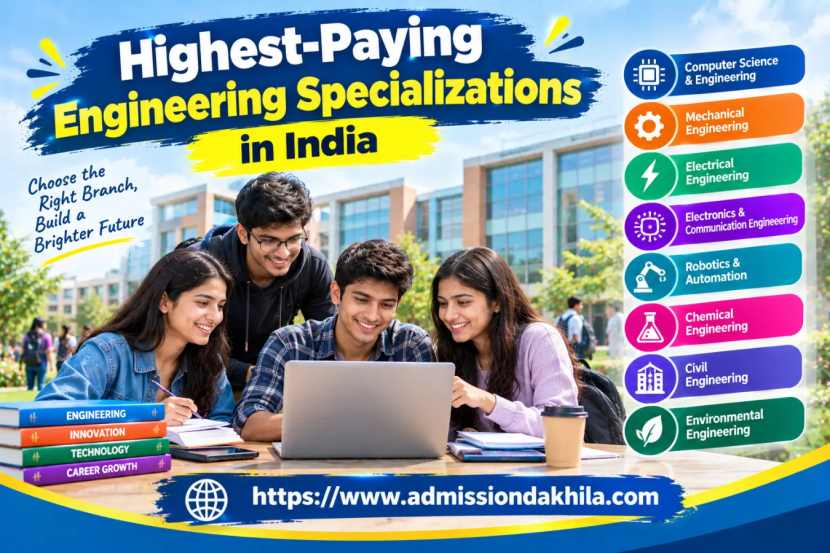
Highest-Paying Engineering Specializations in India
1. Introduction: Why Engineering Specialization Matters
Engineering continues to offer diverse career opportunities across software development, artificial intelligence, electronics, manufacturing, infrastructure, energy, healthcare technology, and other industries. However, earning potential differs significantly between roles, employers, locations, and experience levels.
A student choosing a B.Tech branch should look beyond the highest package advertised by a college. A single exceptional placement does not represent the salary that every student can expect. The average or median package, percentage of students placed, quality of training, and availability of relevant jobs provide a more realistic picture.
In 2026, reported hiring trends show strong salary momentum in AI, computer and network security, and semiconductors. One recent industry report covered by Business Standard found year-on-year salary growth of 12% for AI and 9% each for computer and network security and semiconductors. These trends support investigating specialized technical skills, although they do not guarantee that every graduate in these fields will earn a premium.
For students preparing for 2027 admissions, the objective should be to select a specialization that combines three elements:
-
Earning potential: The range of salaries available across entry-level and experienced roles.
-
Employability: The number and type of opportunities available to graduates with the right skills.
-
Personal suitability: Whether the student enjoys the subjects and can develop expertise in the field.
A high-paying career is generally built through education, practical experience, specialization, and continuous learning—not merely through the name of a degree.
If your goal is a high-paying engineering career in India, consider Computer Science Engineering, Artificial Intelligence and Machine Learning, Data Science, Cybersecurity, or Electronics and Communication Engineering with VLSI and semiconductor skills. The best option depends on your interests, technical abilities, college quality, and career goals. Compare the course curriculum, placement records, internships, and fees before applying. Admission Dakhila can help students explore engineering admission information and compare available options.
2. What Determines an Engineer's Salary in India?
Before comparing branches, students should understand why two graduates with the same degree may receive very different offers.
2.1 Technical skills and specialization
Employers often pay more for skills that are difficult to develop and important to business operations. Examples include machine learning, cloud architecture, chip design, cybersecurity, distributed systems, and advanced automation.
A general degree can provide a strong foundation, but practical specialization may improve access to particular roles.
2.2 College quality and placement opportunities
College reputation can influence access to recruiters, internships, alumni networks, research projects, and campus interviews. However, a well-known institution does not guarantee employment, and students from other institutions can build successful careers through strong projects, internships, and technical preparation.
When comparing colleges, examine the median package, branch-specific placements, placement participation, internship support, and total course cost.
2.3 Industry and employer
Product-based technology companies, global capability centres, semiconductor firms, specialist consulting businesses, and research-oriented employers may offer different compensation structures from traditional service companies or smaller organizations.
The same skill can command different salaries depending on the employer's business model and the complexity of the work.
2.4 Location and work experience
Major technology and industrial hubs can provide more specialist opportunities, although living expenses may also be higher. Bengaluru, Hyderabad, Pune, Chennai, Delhi NCR, and other centres have different employment strengths.
As professionals gain experience, their ability to design systems, solve complex problems, lead projects, and deliver measurable results can become more important than their original degree title.
2.5 Understanding salary packages
A CTC of ₹12 lakh per annum does not mean that an employee receives ₹1 lakh in monthly take-home pay. CTC may include employer contributions, variable bonuses, insurance, gratuity, and stock-based compensation.
Students should distinguish among:
-
CTC: Total annual cost of employing the person.
-
Fixed salary: The guaranteed salary component, subject to the employment agreement.
-
Variable pay: Performance-linked compensation.
-
Take-home salary: The amount received after applicable deductions.
This distinction is particularly important when comparing engineering placement offers.
3. Top 10 Highest-Paying Engineering Specializations in India
The following specializations offer different combinations of salary potential, technical depth, career flexibility, and industry demand. Salary ranges below are broad indicative estimates for planning, not official nationwide averages or guaranteed placement packages.
Salary guide: LPA means lakh rupees per annum. Actual compensation depends on experience, employer, location, skills, and college.
3.1 Computer Science Engineering (CSE)

gnindia.dronacharya.info
Computer Science Engineering is a versatile choice for students interested in programming, software development, operating systems, algorithms, computer networks, and digital products.
CSE graduates can enter several industries, including IT services, banking technology, e-commerce, healthcare technology, cloud computing, and enterprise software. The branch also allows students to move into AI, cybersecurity, data engineering, and other specialist fields through electives and independent projects.
Indicative salary range
-
Entry-level: ₹4–12 LPA
-
Experienced professionals: ₹12–30+ LPA
-
Senior specialist and leadership roles: potentially higher at competitive employers
These are broad planning ranges, not predicted salaries for every graduate. Industry salary surveys show substantial differences between mainstream IT roles and specialist technology positions.
Important subjects
-
Data structures and algorithms
-
Programming languages
-
Database management systems
-
Operating systems
-
Computer networks
-
Software engineering
Career opportunities
-
Software development engineer
-
Backend or full-stack developer
-
Systems engineer
-
Platform engineer
-
Software architect
-
Technical lead
Who should choose CSE?
Students who enjoy logical reasoning, coding, mathematics, and solving technical problems may find CSE suitable. It is also a strong option for those who want flexibility to change technical specializations later.
Career-building tip: Build applications that solve real problems, practise coding consistently, and learn software testing, version control, databases, and deployment rather than relying exclusively on classroom assignments.
3.2 Artificial Intelligence and Machine Learning Engineering

engg.jkkn.ac.in
Artificial Intelligence and Machine Learning engineering focuses on building systems that can identify patterns, make predictions, process language, recognize images, and support automated decisions.
AI is used in recommendation systems, fraud detection, industrial inspection, medical image analysis, conversational assistants, and intelligent business applications. Generative AI has also created opportunities for engineers who can build, evaluate, and deploy language-model-based systems.
Indicative salary range
-
Entry-level: ₹5–15 LPA
-
Experienced professionals: ₹12–35 LPA
-
Advanced AI and generative AI specialists: ₹35–60+ LPA at some employers
Specialist compensation can exceed these ranges, but premium packages are not typical of every entry-level position. A 2026 industry report cited by Business Standard reported AI salary growth of 12% year on year and a wide gap between early-career and highly experienced professionals.
Important subjects
-
Linear algebra and probability
-
Python programming
-
Machine learning algorithms
-
Neural networks and deep learning
-
Data preparation and model evaluation
-
Natural language processing
-
Computer vision
Career opportunities
-
Machine learning engineer
-
AI engineer
-
Applied AI developer
-
Computer vision engineer
-
Natural language processing engineer
-
AI research engineer
Who should choose AI/ML?
This specialization is suitable for students who enjoy mathematics, statistics, programming, and experimentation. Research-oriented positions may require postgraduate study or deeper mathematical preparation.
Career-building tip: Learn core computer science first, then build projects that demonstrate data preparation, model evaluation, deployment, and measurable results. Knowing how to use an AI tool is not the same as knowing how to engineer a reliable AI system.
3.3 Data Science and Data Engineering

scaler.com
Data Science combines statistics, programming, and analytical thinking to extract useful information from large datasets. Data Engineering focuses on the infrastructure, pipelines, and systems that collect, transform, store, and deliver that information.
Although the two fields overlap, they are not identical. Data scientists may build predictive models, while data engineers ensure that high-quality data reaches applications reliably.
Indicative salary range
-
Entry-level: ₹4.5–12 LPA
-
Experienced professionals: ₹12–30 LPA
-
Senior specialists: ₹30–50+ LPA at selected employers
Salary estimates vary by role and employer. Data engineering, advanced analytics, and machine learning-related work may command different compensation from entry-level reporting and dashboard roles.
Important subjects
-
Statistics and probability
-
Python and SQL
-
Database systems
-
Data visualization
-
Machine learning fundamentals
-
Data warehousing
-
Big data processing
Career opportunities
-
Data scientist
-
Data engineer
-
Business intelligence engineer
-
Analytics engineer
-
Machine learning data specialist
-
Data platform developer
Who should choose this specialization?
Students who enjoy mathematics, analytical reasoning, programming, and understanding business problems should explore data-focused courses.
Career-building tip: Create projects using realistic datasets. Explain the business question, the methods used, the limitations of your analysis, and the decisions that your results could support.
3.4 Cybersecurity Engineering

apporto.com
Cybersecurity engineering focuses on protecting computer systems, networks, cloud environments, applications, and digital information from unauthorized access and attacks.
As organizations depend on digital infrastructure, they need professionals who can identify weaknesses, investigate suspicious activity, secure applications, and design resilient systems.
Cybersecurity is especially attractive to students who enjoy networks, operating systems, problem-solving, and investigative technical work.
Indicative salary range
-
Entry-level: ₹4–10 LPA
-
Experienced professionals: ₹12–30 LPA
-
Senior security architects and specialist leaders: ₹30–55+ LPA at selected employers
The upper end is more relevant to experienced specialists and competitive employers than to typical fresh graduates. Industry reporting in 2026 identified computer and network security among the areas with strong salary growth.
Important subjects
-
Computer networks
-
Operating systems
-
Network security
-
Cryptography fundamentals
-
Secure software development
-
Cloud security
-
Digital forensics and incident response
Career opportunities
-
Security engineer
-
Security operations centre analyst
-
Penetration tester
-
Application security engineer
-
Cloud security specialist
-
Security architect
Who should choose cybersecurity?
Students who like investigating technical problems, understanding how systems work, and learning defensive security practices may find this field rewarding.
Career-building tip: Practise only in authorized labs and environments. Learn networking, Linux, scripting, security fundamentals, and incident analysis before chasing advanced certifications.
3.5 Cloud Computing, DevOps, and Site Reliability Engineering

accurate.in
Cloud computing engineers help organizations run applications and store information using cloud infrastructure. DevOps and Site Reliability Engineering (SRE) focus on automating software delivery, improving system reliability, and maintaining applications at scale.
These fields often suit CSE and IT students who enjoy infrastructure, programming, deployment automation, and solving operational problems.
Indicative salary range
-
Entry-level: ₹5–12 LPA
-
Experienced professionals: ₹12–30 LPA
-
Senior cloud architects and SRE specialists: ₹30–50+ LPA at selected employers
Compensation depends heavily on cloud platform expertise, security knowledge, system complexity, and the employer's scale.
Important subjects and skills
-
Computer networks
-
Linux and operating systems
-
Cloud architecture
-
Containers and orchestration
-
Infrastructure as code
-
CI/CD pipelines
-
Monitoring and reliability engineering
Career opportunities
-
Cloud engineer
-
DevOps engineer
-
Site reliability engineer
-
Cloud security engineer
-
Infrastructure automation engineer
-
Cloud solutions architect
Career-building tip: Deploy an application, automate its deployment, monitor its performance, and document how you would handle failures. Demonstrable operational skills are more valuable than listing cloud services without practical experience.
3.6 Electronics and Communication Engineering with VLSI and Semiconductor Design

educationtimes.com
Electronics and Communication Engineering (ECE) provides a foundation in electronic circuits, digital systems, signals, communications, and embedded hardware.
Students can specialize further in Very Large Scale Integration (VLSI), chip design, verification, semiconductor technology, and embedded systems. These areas connect hardware engineering with computing and are relevant to smartphones, automotive electronics, communications equipment, and industrial devices.
Indicative salary range
-
Entry-level: ₹4–12 LPA
-
Experienced specialists: ₹12–30 LPA
-
Senior chip-design and verification professionals: potentially ₹30–50+ LPA at selected employers
These figures are directional. Semiconductor compensation differs between design, fabrication, testing, equipment, and other job families. Recent industry reporting identified semiconductor salaries among those recording strong growth in India.
Important subjects
-
Digital and analog electronics
-
Semiconductor devices
-
Digital logic design
-
Computer architecture
-
Verilog or SystemVerilog
-
VLSI design
-
Embedded systems
Career opportunities
-
VLSI design engineer
-
Design verification engineer
-
Embedded systems engineer
-
Electronics design engineer
-
Semiconductor test engineer
-
Hardware validation engineer
Who should choose ECE?
Students interested in physics, electronics, mathematics, and the interaction between hardware and software should consider this branch.
Career-building tip: Practise digital design, circuit simulation, microcontroller projects, and hardware description languages. For chip-design careers, investigate whether the college offers relevant labs, projects, and industry connections.
3.7 Robotics, Automation, and Mechatronics Engineering

linkedin.com
Robotics and Mechatronics combine mechanical engineering, electronics, control systems, and programming. The goal is to design machines and automated systems that can sense their surroundings, make decisions, and perform physical tasks.
Applications include industrial robots, warehouse automation, manufacturing inspection, autonomous systems, and precision equipment.
Indicative salary range
-
Entry-level: ₹4–10 LPA
-
Experienced professionals: ₹10–25 LPA
-
Advanced robotics, controls, and automation specialists: ₹25–40+ LPA at selected employers
Opportunities vary according to industrial investment, location, technical skills, and whether a role is primarily mechanical, electrical, software-focused, or research-oriented.
Important subjects
-
Mechanics and machine design
-
Control systems
-
Sensors and actuators
-
Embedded programming
-
Robotics kinematics
-
Industrial automation
-
Computer vision and motion planning
Career opportunities
-
Robotics engineer
-
Automation engineer
-
Controls engineer
-
Mechatronics engineer
-
Industrial IoT engineer
-
Autonomous systems developer
Career-building tip: Build practical projects involving sensors, motors, microcontrollers, and control algorithms. A portfolio that demonstrates a working system can help show employers that you understand the interaction between software and hardware.
3.8 Electrical Engineering with EV and Renewable Energy Specialization

aus.edu
Electrical Engineering offers career paths in power generation, power systems, electrical machines, control systems, energy storage, electric mobility, and renewable energy.
Students can develop specialized expertise in power electronics, battery systems, EV charging, solar and wind energy, grid integration, and energy management.
Indicative salary range
-
Entry-level: ₹3.5–9 LPA
-
Experienced professionals: ₹9–22 LPA
-
Senior specialists and technical leaders: ₹22–40+ LPA in selected roles
Compensation differs substantially between public-sector positions, manufacturing companies, utilities, energy developers, and technology-focused EV businesses.
Important subjects
-
Electrical machines
-
Power systems
-
Power electronics
-
Control engineering
-
Battery management systems
-
Renewable energy technologies
-
Electrical safety and protection
Career opportunities
-
Electrical design engineer
-
Power systems engineer
-
EV systems engineer
-
Battery technology engineer
-
Renewable energy engineer
-
Power electronics engineer
Career-building tip: Learn relevant simulation tools, electrical safety, testing methods, and power electronics. If you are interested in electric vehicles, explore battery management, charging systems, and motor control rather than assuming that all EV roles are software jobs.
3.9 Mechanical Engineering with Automotive, Aerospace, or Advanced Manufacturing Skills

asfanco.com
Mechanical Engineering is a broad discipline involving machines, materials, thermal systems, product design, manufacturing, and mechanical analysis.
The branch can lead to automotive engineering, aerospace components, industrial equipment, manufacturing automation, and product development. Its earning potential may improve when traditional engineering knowledge is combined with simulation, robotics, advanced materials, or electric-vehicle technology.
Indicative salary range
-
Entry-level: ₹3.5–8 LPA
-
Experienced professionals: ₹8–20 LPA
-
Senior design, specialist, and engineering management roles: ₹20–40+ LPA in selected organizations
These are broad estimates rather than uniform industry averages. Employer type, plant location, technical responsibilities, and the degree of specialization can substantially change compensation.
Important subjects
-
Engineering mechanics
-
Thermodynamics
-
Fluid mechanics
-
Manufacturing processes
-
CAD and computer-aided engineering
-
Materials science
-
Machine design
Career opportunities
-
Mechanical design engineer
-
Automotive engineer
-
Manufacturing engineer
-
Thermal systems engineer
-
Aerospace systems engineer
-
Quality and reliability engineer
Career-building tip: Develop CAD, simulation, manufacturing, and problem-solving skills. Internships and practical exposure to industrial equipment can help bridge the gap between theoretical learning and workplace requirements.
3.10 Chemical Engineering and Petroleum Engineering

sheffield.ac.uk
Chemical Engineering applies chemistry, physics, mathematics, and process design to the production and transformation of materials. Petroleum Engineering focuses on the exploration, extraction, and production of oil and gas resources.
Career opportunities can exist in energy, petrochemicals, pharmaceuticals, specialty chemicals, process manufacturing, and materials development. Petroleum-related jobs may also depend on project investment, commodity cycles, field locations, and the global energy market.
Indicative salary range
-
Entry-level: ₹3.5–9 LPA
-
Experienced professionals: ₹8–22 LPA
-
Senior process, energy, and specialist roles: ₹22–40+ LPA in selected companies
Some field-based or highly specialized positions can pay more, but they may involve remote locations, demanding schedules, or industry-specific risks.
Important subjects
-
Process calculations
-
Thermodynamics
-
Fluid mechanics
-
Heat and mass transfer
-
Chemical reaction engineering
-
Process control
-
Reservoir and drilling fundamentals for petroleum-focused study
Career opportunities
-
Process engineer
-
Production engineer
-
Chemical plant engineer
-
Process safety engineer
-
Petroleum engineer
-
Energy and materials specialist
Career-building tip: Evaluate the quality of laboratories, industrial internships, process simulation training, and recruitment links before selecting a program. Consider the industries and locations in which you would be comfortable working.
4. Salary Comparison Table: Engineering Specializations in India
The following table provides a simplified comparison for prospective students. These are broad indicative salary bands, not a statistically uniform ranking of all engineering graduates.
|
Engineering specialization |
Indicative entry-level salary |
Potential with experience |
|---|---|---|
|
Computer Science Engineering |
₹4–12 LPA |
₹12–30+ LPA |
|
AI and Machine Learning |
₹5–15 LPA |
₹12–35+ LPA |
|
Data Science and Engineering |
₹4.5–12 LPA |
₹12–30+ LPA |
|
Cybersecurity Engineering |
₹4–10 LPA |
₹12–30+ LPA |
|
Cloud, DevOps and SRE |
₹5–12 LPA |
₹12–30+ LPA |
|
ECE with VLSI and semiconductors |
₹4–12 LPA |
₹12–30+ LPA |
|
Robotics and Mechatronics |
₹4–10 LPA |
₹10–25+ LPA |
|
Electrical, EV and renewable energy |
₹3.5–9 LPA |
₹9–22+ LPA |
|
Mechanical and advanced manufacturing |
₹3.5–8 LPA |
₹8–20+ LPA |
|
Chemical and Petroleum Engineering |
₹3.5–9 LPA |
₹8–22+ LPA |
*Source note: Salary bands are editorial estimates intended for broad career planning. They are not official branch-wise salary statistics, and the upper ends are not typical outcomes for all graduates. Specialist technology salary data and reported industry trends show considerable variation by experience and employer.
The main lesson is that salary potential cannot be separated from the job a graduate eventually performs. A CSE graduate in an entry-level support role and a CSE graduate building large-scale distributed systems may have very different compensation. The same is true for a general ECE graduate and a specialist working in semiconductor design.
5. Which Engineering Branch Is Best for Freshers?
For students entering the workforce immediately after B.Tech, the best specialization is one that provides accessible entry-level roles, practical training, and opportunities to build valuable skills.
Best choices for students interested in coding
CSE, AI/ML, Data Science, Cybersecurity, and Cloud Computing are worth comparing if you enjoy programming and computers.
CSE provides broad flexibility, while specialized courses can offer a more focused curriculum. Before selecting a specialized degree, check whether it covers fundamental subjects such as data structures, algorithms, databases, operating systems, and networks.
A specialized degree with weak fundamentals may limit flexibility later. Conversely, a strong CSE program with AI, security, or cloud electives can provide a useful combination of breadth and depth.
Best choices for students interested in electronics
ECE with VLSI, embedded systems, or semiconductor design can suit students interested in hardware and electronics.
Compare laboratory facilities, faculty expertise, design projects, and industry exposure. The presence of a specialization in a course title alone does not prove that a college has strong placement opportunities in that field.
Best choices for students interested in machines and manufacturing
Mechanical, Electrical, Robotics, and Mechatronics programs can lead to careers in industrial automation, product design, energy, and manufacturing.
Students should investigate the practical components of each course, including workshops, simulation tools, laboratory hours, internships, and industry-linked projects.
Best choices for students who enjoy mathematics and analysis
AI/ML, Data Science, Electrical Engineering, and certain areas of Electronics Engineering involve substantial mathematics.
Students who are comfortable with probability, statistics, algebra, calculus, and analytical problem-solving may find these subjects engaging.
A practical rule for choosing your first engineering job
Do not choose a branch solely because a social media post describes it as the highest-paying option. Compare the actual entry-level jobs available, the skills required, and the type of work you want to perform every day.
6. Highest-Paying Engineering Careers After Experience
A graduate's first salary is only one stage of a longer career. Engineers can increase their earning potential by becoming specialist contributors, architects, technical leads, managers, or research professionals.
6.1 Artificial intelligence and generative AI specialists
Experienced AI engineers may work on model training, evaluation, deployment, inference optimization, and the integration of AI into business applications.
Some Indian employers offer high compensation for specialists who can build production-ready systems. However, these positions often require substantial technical expertise rather than familiarity with AI tools alone.
Useful career progression:
-
Junior software or machine learning engineer
-
Machine learning engineer
-
Senior AI engineer
-
AI architect or technical lead
-
Principal engineer or research specialist
6.2 Cybersecurity architects and security leaders
Experienced security professionals may design enterprise security systems, assess organizational risks, guide incident response, and establish security standards.
Possible career progression includes security analyst, security engineer, senior security engineer, security architect, and security leadership roles.
The highest-paying positions generally require sound technical judgement, experience with complex systems, and the ability to communicate risk to business leaders.
6.3 Cloud architects and reliability engineers
Cloud and SRE professionals can move into roles responsible for the architecture, reliability, scalability, security, and cost of major technology platforms.
Engineers who understand both software development and infrastructure may be well positioned for these responsibilities.
6.4 Semiconductor design specialists
Experienced engineers in chip design, verification, physical design, and embedded systems can develop highly specialized expertise.
The field rewards strong electronics fundamentals, tool proficiency, debugging skills, and the ability to work with complex design constraints. Some roles also require postgraduate qualifications or substantial industry experience.
6.5 Engineering managers and technical leaders
Not every high-paying engineering career requires a narrow technical specialization. Experienced engineers may advance into technical management, product development leadership, operations management, or research leadership.
These roles typically combine technical knowledge with communication, planning, decision-making, and team development.
Important: Management is not automatically a better path than technical specialization. Senior individual contributors can also progress into well-paid positions without managing large teams.
7. Engineering Specializations with Strong Future Scope
Students preparing for 2027 admissions should consider long-term industry relevance as well as current salaries.

Artificial Intelligence and Machine Learning
AI is being applied to software, manufacturing, healthcare, finance, and customer services. Students should build mathematics, programming, model evaluation, and deployment skills rather than relying on short-term technology trends.

Semiconductor and VLSI Engineering
Chip design and electronics offer a pathway for students interested in hardware, digital systems, embedded devices, and semiconductor manufacturing. The field requires specialized laboratories and rigorous technical training.

Cybersecurity and Cloud Security
As organizations rely on connected systems and cloud infrastructure, securing applications and information remains an important technical responsibility. Practical experience is essential.

Electric Vehicles and Power Electronics
EV engineering combines mechanical systems, electrical engineering, embedded software, battery technologies, and power electronics. Students can enter through several underlying engineering branches.

Renewable Energy and Energy Systems
Renewable energy, energy storage, power systems, and grid integration offer opportunities for electrical, mechanical, and related engineering graduates.

Robotics and Industrial Automation
Automation connects sensors, electronics, software, and machines. It can be relevant to manufacturing, logistics, inspection, and industrial production.
The future scope of a field is not the same as a guaranteed job forecast. Investment cycles, technology changes, competition, and the quality of available training all influence hiring.
Students should therefore favour transferable foundations and practical learning. These remain useful even if the most popular technology changes during their degree.
8. Eligibility and Admission Process for B.Tech in India
Most four-year B.Tech programs require students to complete Class 12 or an equivalent qualification with the subjects specified by the institution and its applicable admission rules.
8.1 Educational eligibility
Many engineering programs require Physics and Mathematics, along with an additional qualifying subject such as Chemistry, Computer Science, Biology, or another subject accepted under the applicable rules.
The exact subject combination and minimum marks depend on the institution, program, entrance route, and current regulatory requirements.
Students should confirm the official eligibility criteria for every college before applying.
8.2 Common engineering entrance examinations
Depending on the institution and state, admission may involve examinations such as:
-
JEE Main
-
JEE Advanced, for eligible candidates seeking admission through participating IIT routes
-
State-level engineering entrance examinations or counselling systems
-
University-specific entrance examinations
-
Other accepted admission routes published by individual institutions
Not every examination is accepted by every college. Students should verify the accepted score, eligibility conditions, application deadline, and counselling process for their chosen institutions.
8.3 Typical admission process
-
Research branches and colleges. Shortlist courses according to your interests, academic record, budget, location, and career objectives.
-
Check eligibility. Review Class 12 subject requirements, minimum marks, and any other applicable conditions.
-
Apply through the appropriate route. Complete the entrance examination or institution-specific application, as required.
-
Participate in counselling or selection. Follow the official process for choice filling, merit lists, seat allocation, and document verification.
-
Compare the offer carefully. Check the full fee structure, scholarship eligibility, hostel costs, refund rules, and course curriculum.
-
Confirm admission. Complete the required formalities using the institution's official instructions and deadlines.
8.4 Documents students may need
The list can differ by institution, but commonly requested documents include:
-
Class 10 marksheet or certificate
-
Class 12 marksheet or qualifying examination documents
-
Entrance examination scorecard, where applicable
-
Valid identity document
-
Recent photographs
-
Transfer or migration certificate, where required
-
Category or other supporting certificates, where applicable
-
Counselling allotment letter, where applicable
Always follow the institution's official document checklist.
8.5 How Admission Dakhila can help
Students researching engineering colleges can use Admission Dakhila to explore admission-related information, compare available course options, and organize their college shortlist.
Visit https://www.admissiondakhila.com to research engineering admission opportunities and prepare for your next steps. Before making a final decision, confirm all admission details, fees, and placement claims directly with the relevant college.
9. How to Choose the Right Engineering Specialization
A structured decision-making process can help students avoid choosing a branch based on salary headlines alone.
Step 1: Identify your strongest interests
Ask yourself which activities you genuinely enjoy:
-
Coding and building software
-
Mathematics and statistical analysis
-
Electronics and circuit design
-
Machines and manufacturing
-
Physics and energy systems
-
Research and experimentation
Your interests do not have to determine your career permanently, but they can help you identify a suitable starting point.
Step 2: Compare the curriculum
Two colleges may offer similarly named programs but teach different subjects or provide different levels of practical exposure.
Examine the semester-wise curriculum, elective options, laboratory facilities, internship opportunities, and final-year project requirements.
Step 3: Review branch-specific placements
Do not rely exclusively on a college's highest package. Ask for the branch-wise median salary, number of students eligible for placement, number placed, internship outcomes, and recruiter profiles.
Check whether reported figures refer to the specific program you are considering.
Step 4: Calculate the total cost
Include tuition fees, hostel and food costs, transport, examination fees, equipment, and other expenses.
A high-fee college is not automatically the best choice. Compare the total investment with the quality of education, practical exposure, and realistic career outcomes.
Step 5: Consider your preferred working environment
Some careers involve software development and remote collaboration. Others may involve factories, laboratories, manufacturing plants, energy facilities, or field assignments.
For example, a student who enjoys hardware and laboratory work may prefer ECE or semiconductor engineering over a software-focused program.
Step 6: Evaluate flexibility
A strong engineering foundation can provide options when your interests change. CSE students can explore security or AI, while ECE students may move into embedded programming, hardware verification, or related computing fields.
Interdisciplinary learning is valuable, but it should build on a solid understanding of the main discipline.
Step 7: Create a skill-development plan
Choose a few realistic projects that connect your coursework to real applications.
For a CSE student, this might be a web application or a database-backed system. For an electrical engineering student, it could be a supervised power-electronics or energy-monitoring project. For a robotics student, it could involve sensors and motion control.
The aim is to demonstrate that you can apply what you learn.
10. Essential Skills for Higher-Paying Engineering Jobs
Regardless of specialization, several skills can improve a student's ability to compete for technical roles.
Technical skills
-
Programming and scripting, where relevant
-
Mathematics and analytical reasoning
-
Data interpretation
-
Debugging and testing
-
Industry-standard tools and software
-
System design and documentation
-
Laboratory and equipment skills for core engineering branches
The exact combination should match your chosen field. A semiconductor engineer needs different specialist tools from a data scientist or a mechanical design engineer.
Communication skills
Engineers need to explain technical ideas, write documentation, work with colleagues, and present solutions to clients or managers.
Clear communication can help technical work translate into business outcomes.
Problem-solving skills
Employers value people who can break a complex problem into smaller parts, test possible solutions, identify errors, and justify their decisions.
Internship and project experience
Internships and well-designed projects give students opportunities to apply concepts in realistic settings. They can also help students understand which areas of engineering they enjoy most.
Continuous learning
Tools and industry requirements change. Engineers who update their skills, understand new methods, and retain strong fundamentals can adapt more effectively.
Certificates can be useful when they support genuine skills, but collecting certificates without practical understanding is unlikely to be a substitute for technical competence.
11. Common Mistakes Students Should Avoid
Mistake 1: Choosing a branch only because of the highest package
The largest package advertised by a college may represent one student, a particular recruiter, or a compensation structure that includes variable pay or stock. It is not a reliable forecast for every graduate.
Mistake 2: Assuming every AI degree guarantees an AI job
Entry-level AI positions can require strong mathematics, programming, data skills, and project experience. Some graduates begin in general software or analytics roles before moving into AI.
Mistake 3: Ignoring core engineering subjects
Specialized tools are useful, but they cannot replace an understanding of algorithms, electronics, mechanical systems, electrical fundamentals, or other core subjects.
Mistake 4: Selecting a college without checking placement details
A college's overall placement statistics may not accurately reflect the prospects of a particular branch. Seek branch-specific information and ask how the statistics are calculated.
Mistake 5: Overlooking fees and living expenses
Consider the complete cost of the degree, including accommodation, travel, and other expenses. Evaluate scholarships and financing carefully before accepting an offer.
Mistake 6: Waiting until the final year to build practical skills
Start early with small projects, programming practice, laboratory work, competitions, and internships. Gradually improve the quality of your work as your technical knowledge grows.
Mistake 7: Treating salary as the only measure of success
Job satisfaction, career stability, working conditions, location, learning opportunities, and personal interests also matter. A slightly lower starting salary may be acceptable if the role offers stronger learning and long-term progression.
12. Frequently Asked Questions About the Highest-Paying Engineering Specializations in India
These FAQs are written to address common student questions and support clear, concise answers for search engines and voice-based queries.
FAQ 1. Which engineering specialization has the highest salary in India?
Computer Science Engineering, Artificial Intelligence and Machine Learning, Data Science, Cybersecurity, Cloud Computing, and Semiconductor Engineering offer strong salary potential. The highest-paying option depends on the job role, experience, employer, technical skills, and college placement outcomes. Students should compare realistic salary ranges instead of relying only on exceptional placement packages.
FAQ 2. Which B.Tech branch is best for a high salary in 2027?
For students interested in technology, CSE, AI/ML, Data Science, and Cybersecurity are worth considering. ECE with VLSI or semiconductor specialization is another option for students interested in electronics. The best branch depends on your interests, the quality of the course, practical training, and long-term career plans.
FAQ 3. Can an engineering fresher earn ₹10 lakh per annum?
Yes, some engineering freshers receive packages of ₹10 LPA or more, particularly at competitive product companies and in certain specialist roles. However, many graduates earn less. Programming ability, internships, projects, employer selection, interview performance, and college placement opportunities all influence starting compensation.
FAQ 4. Is CSE better than AI and Machine Learning?
CSE generally provides broader exposure to computer science fundamentals, while AI/ML programs focus more heavily on intelligent systems and machine learning. Neither is automatically better for every student. Compare the actual curriculum, faculty, laboratory facilities, placement outcomes, and opportunities to study complementary subjects.
FAQ 5. Which engineering branch is best for the future?
AI/ML, CSE, Cybersecurity, Semiconductor Engineering, Robotics, EV Engineering, and Renewable Energy are promising areas to investigate. However, future hiring depends on technology adoption, investment, economic conditions, and the availability of qualified professionals. Students should prioritize transferable skills and practical learning.
FAQ 6. Is Data Science better than Computer Science Engineering?
Data Science is suitable for students who enjoy statistics, programming, data analysis, and predictive modelling. CSE offers a wider foundation in software, algorithms, systems, and computing. Students who want flexibility across software development, infrastructure, and emerging technologies may prefer CSE, while those strongly interested in analytics may prefer Data Science.
FAQ 7. Which engineering specialization is best without extensive coding?
Electrical, Mechanical, Chemical, and Civil Engineering can offer careers focused on physical systems, design, manufacturing, infrastructure, and industrial operations. However, many modern engineering roles still require some programming, simulation, or digital tools. Students should choose based on their interests rather than expecting any branch to be entirely coding-free.
FAQ 8. Can students from private engineering colleges get high-paying jobs?
Yes. Graduates from private engineering colleges can obtain well-paying jobs by developing strong technical skills, completing relevant internships, building projects, and preparing for interviews. College placement support and recruiter access can help, but students should also evaluate independent job opportunities and their own skill development.
FAQ 9. Which engineering branch offers opportunities abroad?
CSE, AI/ML, Cybersecurity, Semiconductor Engineering, Electrical Engineering, Mechanical Engineering, and Chemical Engineering can provide international career opportunities. Eligibility depends on employer requirements, experience, immigration rules, professional qualifications, and the specific role. A degree alone does not guarantee an overseas job.
FAQ 10. How can Admission Dakhila help students choose an engineering college?
Admission Dakhila helps students explore engineering admission information, research available courses, and organize their college search. Visit https://www.admissiondakhila.com to explore engineering-related resources. Before applying, verify the college's recognition, eligibility requirements, fees, placement statistics, and admission deadlines through official sources.
13. Conclusion: Choose an Engineering Specialization That Matches Your Goals
The highest-paying engineering specializations in India include Computer Science Engineering, Artificial Intelligence and Machine Learning, Data Science, Cybersecurity, Cloud Computing, and Electronics and Communication Engineering with semiconductor expertise. Robotics, Electrical Engineering, EV technology, Mechanical Engineering, and Chemical Engineering can also lead to rewarding careers when supported by strong technical skills and relevant industry experience.
However, there is no single branch that guarantees the highest salary for every student. Your earning potential will depend on the quality of your education, practical experience, specialization, employer, location, and ability to solve real-world problems.
Before selecting a B.Tech program for 2027 admission, compare the course curriculum, total fees, laboratory facilities, internships, branch-wise placement records, and long-term career opportunities.
Plan your engineering admission with Admission Dakhila. Visit https://www.admissiondakhila.com to explore engineering courses, research college options, and prepare an informed admission shortlist. Verify all admission and placement details with the relevant institution before making your final decision.
Your goal should not simply be to select the branch with the highest advertised package. Choose a specialization you can develop expertise in, and build the skills that help turn your degree into a sustainable career.