JEE Main 2027 Eligibility Criteria Explained: Complete Admission Guide
The JEE Main 2027 eligibility criteria allow candidates who passed Class 12 or an equivalent examination in 2025 or 2026, or who are appearing in 2027, to take the examination. There is no upper age limit for appearing in JEE Main 2027. Candidates must have a qualifying examination recognised under the NTA's rules and satisfy the subject requirements for their chosen paper. No universal minimum percentage in Class 12 is prescribed merely to appear for JEE Main; however, admission to NITs, IIITs, and other institutions may require 75% aggregate marks or a qualifying position in the applicable board examination criteria, with specified relaxations for SC and ST candidates. Students should verify the official NTA bulletin and the admission rules of their target institutes. Admission Dakhila helps students understand engineering admission options and plan their next steps.
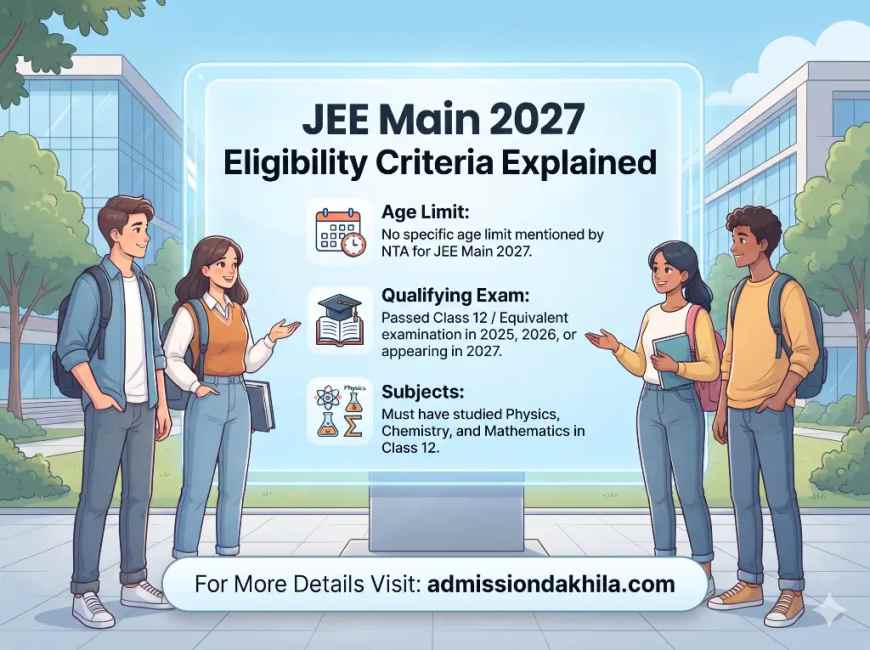
JEE Main 2027 Eligibility Criteria Explained
1. Introduction to JEE Main 2027 Eligibility
The Joint Entrance Examination (JEE) Main is a national-level entrance examination conducted by the National Testing Agency for admission to undergraduate engineering, architecture and planning programmes at participating institutions. It is an important route for students targeting National Institutes of Technology (NITs), Indian Institutes of Information Technology (IIITs), and other participating technical institutions.
Before starting preparation or submitting an application, students should determine whether they meet the eligibility conditions for the examination and their preferred programme.
JEE Main eligibility is not a single condition. It involves multiple factors, including the year in which a candidate passed Class 12, whether the qualifying examination is recognised, the subjects studied, and any separate admission rules imposed by a particular college.
For example, a student may be eligible to sit for JEE Main but may not satisfy the Class 12 percentage requirement for admission to a particular NIT. Similarly, a student interested in architecture must check the subject combination and programme-specific requirements rather than assuming that eligibility for the BTech paper automatically guarantees eligibility for every other paper.
The distinction is important because eligibility to appear for an entrance examination and eligibility to receive admission are not always the same.
Admission Dakhila provides educational information to help students understand these requirements, compare suitable institutions and make informed decisions about their engineering education.
Students who passed Class 12 in 2025 or 2026, or will appear for their Class 12 examination in 2027, are eligible to appear for JEE Main 2027, subject to the official qualifying-examination rules. There is no upper age limit for the examination. However, admission to a particular engineering college depends on its subject, board-marks and other eligibility requirements. For the latest eligibility details and help exploring engineering admission options, students can visit **Admission Dakhila at https://www.admissiondakhila.com**.
2. JEE Main 2027 Eligibility Criteria at a Glance
The following table summarises the principal eligibility conditions published for JEE Main 2027. Candidates should refer to the official information bulletin for the complete wording and exceptions.
|
Eligibility factor |
JEE Main 2027 rule |
|---|---|
|
Class 12 passing year |
2025 or 2026 |
|
Candidates appearing in Class 12 |
Class 12 examination in 2027 |
|
Upper age limit |
No upper age limit for appearing |
|
Class 12 marks for appearing |
No universal minimum percentage prescribed solely for appearing |
|
Recognised qualification |
Class 12 or an eligible equivalent examination |
|
Subject requirements |
Depend on the paper and intended programme |
|
Admission to NITs, IIITs and other institutions |
Separate admission conditions may apply |
|
Improvement examination |
First successful qualifying-examination year remains important |
|
Registration |
Through the official JEE Main website |
Source: JEE Main 2027 information bulletin and eligibility information.
Important: This summary should not be treated as a substitute for the official bulletin. Candidates should verify the rules for their exact qualification, subject combination and intended institution before applying.
3. Class 12 Passing-Year Eligibility for JEE Main 2027
The year in which a student passed or will appear for the qualifying examination is one of the most important eligibility conditions.
Which Class 12 passing years are eligible?
For JEE Main 2027, candidates who passed the qualifying examination in 2025 or 2026, as well as candidates appearing in 2027, are eligible to appear, subject to the other applicable conditions.
This means students should check the year in which they first passed their qualifying examination rather than relying on the year in which they last took an improvement examination.
Students who passed Class 12 in 2025
Students who successfully completed Class 12 in 2025 can appear for JEE Main 2027 if they meet the remaining eligibility requirements.
They should confirm their subject combination, qualification details and intended programme's admission conditions before registering.
Students who passed Class 12 in 2026
Candidates who passed Class 12 in 2026 can also apply for JEE Main 2027. They should prepare their board details and academic records in advance to avoid errors in the application form.
Students appearing for Class 12 in 2027
Students currently studying in Class 12 and appearing for their board examinations in 2027 can apply for JEE Main 2027, provided they meet the applicable subject and examination requirements.
These students should plan their board examination preparation alongside JEE Main preparation because board results may affect final admission eligibility.
Can students who passed Class 12 in 2024 or earlier apply?
Candidates who passed their Class 12 or equivalent examination in 2024 or earlier fall outside the permitted passing-year window specified for JEE Main 2027. They should not assume that taking improvement examinations or retaking individual subjects automatically restores eligibility.
Candidates with unusual academic histories should consult the official NTA information bulletin and seek clarification from the relevant authority where necessary.
Does the first passing year matter?
Yes. The first successful passing year is particularly important when determining eligibility. A candidate who passed Class 12 in an earlier year and later improves marks should not assume that the improvement-examination year becomes the new qualifying year.
Always use the applicable official rule when entering the qualifying-examination details.
4. Age Limit for JEE Main 2027
Is there an age limit for JEE Main 2027?
No. There is no upper age limit for appearing in JEE Main 2027, according to the published eligibility criteria. Candidates who satisfy the qualifying-examination conditions can appear irrespective of age.
This makes the examination accessible to eligible candidates who may have taken a gap year or followed a non-traditional educational path, subject to the permitted qualifying-examination years.
Can a candidate older than 25 take JEE Main 2027?
Age alone does not prevent a candidate from appearing for JEE Main 2027. However, the candidate must still satisfy the permitted passing-year requirement and all other applicable conditions.
For example, a candidate's age may not be a barrier, but passing Class 12 outside the eligible years can still make the candidate ineligible.
Is there an age limit for admission to NITs and IIITs?
The absence of an upper age limit for the examination does not mean that every institution has identical admission rules. Candidates should review the admission policy of the relevant institute and the applicable counselling authority.
The safest approach is to check both the JEE Main eligibility criteria and the admission requirements of the target programme.
5. Educational Qualification Requirements
Candidates must have passed, or be appearing in, an examination recognised under the official qualifying-examination rules.
The information bulletin identifies recognised Class 12 examinations and specified equivalent qualifications. These include the final examination of the 10+2 system conducted by recognised central or state boards and certain other recognised qualifications.
Recognised Class 12 boards
Students from recognised boards, including CBSE and CISCE, may qualify if they meet the other requirements. Candidates studying under a state board should check that their board and examination meet the official conditions.
Intermediate and pre-university examinations
Certain intermediate or two-year pre-university examinations conducted by recognised boards or universities may be accepted as qualifying examinations.
Candidates should confirm the exact qualification category in the bulletin rather than assuming that all certificates with similar names are automatically accepted.
National Institute of Open Schooling
Candidates with qualifications from the National Institute of Open Schooling (NIOS) should carefully check the official requirements for the qualifying examination and the subjects studied.
Open-school candidates should retain their marksheets, certificates and subject records because admission authorities may need to verify these details.
Diploma and other equivalent qualifications
A diploma or alternative qualification should not automatically be treated as equivalent to Class 12 for every JEE Main paper or admission route. Candidates must verify whether their specific qualification is listed in the official rules and whether it satisfies the requirements of the intended programme.
6. Subject Requirements for BTech and BE
Subject eligibility matters because engineering programmes generally require a relevant combination of subjects in the qualifying examination.
Which subjects are required for BTech admission?
For admission to B.E. or B.Tech programmes, candidates should check the subject combination prescribed by the official JEE Main bulletin and the admission requirements of their intended institutions.
Physics and Mathematics are central to the conventional BTech eligibility route. The other required subject combination must be checked against the official bulletin and the institute's rules; candidates should not rely on informal summaries that treat every third-subject combination as universally accepted.
Can a student without Mathematics apply for BTech?
Students who did not study Mathematics should not assume that they qualify for the conventional B.E./B.Tech route through JEE Main. They must verify the exact paper-specific requirements in the official information bulletin.
Mathematics is a fundamental requirement for the standard BTech eligibility pathway, and programme admission rules may impose additional subject conditions.
Is Chemistry compulsory?
Subject requirements can depend on the specific examination paper and the programme for which admission is sought. Candidates should consult the 2027 bulletin rather than relying on an older year's rules or general statements about all engineering courses.
For admission to NITs, IIITs and other participating institutes, students should also verify the relevant subject combination prescribed by the applicable admission authority.
Why should students verify their subjects carefully?
An application may be accepted for examination purposes without guaranteeing admission to a particular course. Subject eligibility should therefore be checked before registration and again before counselling.
Admission Dakhila recommends comparing the official subject requirements with the subjects printed on the candidate's Class 12 marksheet.
7. Minimum Marks Required for JEE Main 2027
One of the most frequently asked questions is whether a student needs 75% marks in Class 12 to appear for JEE Main.
Is 75% required to appear for JEE Main 2027?
No. The 75% Class 12 marks requirement is not a universal minimum requirement merely to sit for JEE Main 2027. Candidates must distinguish between eligibility to take the examination and eligibility for admission to particular institutions.
A student with less than 75% in Class 12 may still be eligible to appear for JEE Main, provided the candidate meets the qualifying-examination and other applicable conditions.
Is 75% required for NIT admission?
For admission to NITs, IIITs and other participating institutions covered by the relevant admission rules, candidates generally need either at least 75% aggregate marks in the Class 12 qualifying examination or a position within the top 20 percentile of successful candidates in their respective board examinations. The minimum aggregate requirement is generally relaxed to 65% for SC/ST candidates under the applicable rules.
Candidates should confirm the precise conditions in the current JoSAA/CSAB and institute admission documents before relying on this rule.
What if a student scores 60%, 65% or 70%?
Students with these marks should not automatically conclude that they are ineligible for JEE Main itself. They should evaluate their eligibility for the examination separately from admission eligibility.
|
Class 12 result |
General guidance |
|---|---|
|
Below 60% |
May be eligible to appear; verify individual admission requirements |
|
60%–64% |
Check qualifying-examination eligibility and target colleges |
|
65%–74% |
May satisfy some institution-specific requirements, but verify the applicable rules |
|
75% or above |
May satisfy the general percentage threshold where applicable; other requirements remain |
|
Top 20 percentile in the relevant board |
May satisfy the alternative admission criterion where accepted |
This table is a general guide, not a guarantee of admission. The top-20-percentile criterion depends on the applicable board, examination year and official admission rules.
Should students take improvement examinations?
Improvement examinations may help candidates improve their academic performance, but they should understand the rules governing the first passing year and the admission authority's method of evaluating improved marks.
Students should check whether their improvement results can be considered for the intended institution's percentage or percentile requirement. An improvement examination does not automatically reset the original passing year for JEE Main eligibility.
8. Eligibility for NITs, IIITs and GFTIs
JEE Main is a major route to undergraduate engineering admission at participating National Institutes of Technology, Indian Institutes of Information Technology and Government-Funded Technical Institutions.
However, qualifying for the examination does not guarantee admission to these institutions.
NIT admission eligibility
Candidates targeting NITs should verify:
-
Whether their Class 12 passing year is permitted.
-
Whether they meet the required aggregate-marks or top-20-percentile condition.
-
Whether their subjects satisfy the intended BTech branch requirements.
-
Whether they meet the programme's other admission conditions.
-
Whether they satisfy the relevant counselling and seat-allocation rules.
Admission also depends on the candidate's JEE Main rank, category, preferences, seat availability and applicable counselling rules.
IIIT admission eligibility
IIITs have programme-specific admission requirements and participate in applicable centralised admission processes or other notified procedures, depending on the institution.
Students should check the individual institute's eligibility rules rather than assuming that all IIIT programmes have identical requirements.
GFTI admission eligibility
Government-Funded Technical Institutions can offer a variety of undergraduate technical programmes. Their admission conditions may differ by institution and course.
Students should review the official programme details and counselling notices before selecting their preferences.
What if a student does not meet the NIT eligibility criteria?
A student who is eligible for JEE Main but does not satisfy the admission criteria for a particular NIT may still have other educational options, depending on their qualifications.
These can include eligible private engineering colleges, state-level counselling routes, university-specific admission processes or other undergraduate programmes. The exact options depend on the student's marks, subjects, entrance examination results and the admission policies of the institutions concerned.
Admission Dakhila can help students explore college options and compare programme information before deciding where to apply.
9. JEE Main Eligibility for BArch and BPlanning
JEE Main includes papers for architecture and planning as well as engineering. Students should check the eligibility requirements for the paper and programme they intend to pursue.
Eligibility for BArch
Paper 2A is intended for Bachelor of Architecture programmes. It includes Mathematics, an aptitude test and a drawing test.
Architecture admission has specific academic and regulatory requirements. Candidates should verify the prescribed qualifying-examination subjects and marks under the current bulletin and the applicable Council of Architecture requirements.
Do not assume that eligibility for Paper 1 automatically satisfies every BArch admission condition.
Eligibility for BPlanning
Paper 2B is intended for Bachelor of Planning programmes. It includes Mathematics, an aptitude test and planning-based questions.
Candidates should verify the qualifying-examination subject and marks requirements for their intended programme and institution.
Can students apply for more than one paper?
JEE Main's application process provides options for candidates seeking to take the relevant papers, subject to the combinations and fee rules in the official bulletin.
Candidates interested in engineering as well as architecture or planning should carefully select the correct paper or combination during registration.
10. Eligibility for Improvement and Compartment Students
Students who have taken improvement examinations or are appearing in compartment examinations should review their academic history carefully.
Improvement examination candidates
If a candidate first passed Class 12 in 2025 or 2026, an improvement attempt does not ordinarily change that first passing year for JEE Main eligibility. The official bulletin specifically explains that the year in which the candidate first passed the qualifying examination is relevant.
For example, a student who passed Class 12 in 2025 and improved marks in 2026 should not assume that the passing year has changed to 2026.
Compartment examination candidates
Candidates who have not yet passed the qualifying examination must check their status against the official eligibility rules and the timing of their results.
A candidate appearing for a qualifying examination in 2027 may be eligible to appear for JEE Main 2027, subject to the applicable rules. However, final admission depends on successfully meeting the qualification and documentation requirements within the relevant deadlines.
Students who passed only some subjects
Candidates with a complicated academic record, including separate subject passes across different years, should review the official bulletin's explanation of the first passing year and qualifying-examination conditions.
If the circumstances are unclear, contact the official examination authority rather than relying on general advice.
11. Eligibility for Open School and Equivalent Qualifications
Candidates educated through open schooling or an alternative recognised qualification should confirm that their examination is accepted under the JEE Main 2027 information bulletin.
NIOS students
NIOS candidates should review their qualifying-examination status, subject combination and state-of-eligibility details.
The name of the qualification, the examination year and the subjects recorded on the marksheet should be checked carefully before completing the application.
Candidates with foreign qualifications
Students who completed their qualifying examination outside India should verify whether the qualification is recognised as equivalent to Class 12 under the applicable rules.
The bulletin specifies that some candidates with examinations not listed among the named qualifying examinations may need an equivalence certificate from the Association of Indian Universities.
Diploma holders
Diploma holders should not assume that every diploma is accepted as a substitute for the standard Class 12 qualifying examination. They should verify the listed qualification rules and the requirements of the programme to which they seek admission.
12. Eligibility for Indian Nationals and Other Candidates
JEE Main has provisions covering candidates with different nationalities and educational backgrounds. Candidates should review the official bulletin for their specific situation.
Indian nationals
Indian nationals who meet the qualifying-examination and other eligibility requirements may apply through the official registration process.
Non-Indian nationals and OCI candidates
Foreign nationals and Overseas Citizens of India (OCI) candidates should check the relevant nationality, qualification and admission provisions. Eligibility to sit for an examination does not necessarily confer eligibility for every category of seat.
State of eligibility
The state of eligibility generally depends on the state from which the candidate passed the qualifying examination, not simply the state in which the candidate lives.
For example, a student residing in Uttar Pradesh but passing Class 12 from an eligible institution in Delhi should carefully follow the bulletin's state-code rules rather than selecting a state based only on residence.
Candidates who took improvement examinations in a different state should also check the specific rules for determining the state of eligibility.
13. JEE Main 2027 Reservation and Category Rules
Candidates applying under reserved categories should select their category accurately and check the applicable official requirements.
The information bulletin describes reservation provisions and relevant documentation requirements. The exact rules depend on the category and the applicable admission authority.
General category
General-category candidates must satisfy the common examination eligibility criteria and any applicable admission requirements.
General-EWS
Candidates claiming Economically Weaker Section benefits should verify the applicable certificate requirements, validity conditions and prescribed format.
OBC-NCL
Candidates claiming Other Backward Classes–Non-Creamy Layer benefits should check the central-list and certificate conditions applicable to the relevant admission process. A state-level classification alone may not establish eligibility for a central admission benefit.
SC and ST
SC and ST candidates should follow the official documentation requirements and the relevant rules governing reservation and any applicable academic eligibility relaxation.
Persons with disabilities
Candidates seeking provisions for persons with disabilities or persons with benchmark disabilities should review the official instructions for certificates, examination accommodations, scribe eligibility and compensatory time where applicable.
Practical advice: Do not select a category solely because it appears on a state certificate. Verify the certificate requirements for the specific examination and admission process.
14. JEE Main Eligibility Versus Admission Eligibility
This distinction is central to understanding the entire eligibility process.
|
Factor |
Examination eligibility |
College admission eligibility |
|---|---|---|
|
Main purpose |
Determines whether you can take JEE Main |
Determines whether you can receive admission |
|
Passing year |
Must fall within the permitted years |
Must satisfy the relevant admission rules |
|
Class 12 marks |
No universal 75% requirement solely to appear |
Percentage or top-percentile conditions may apply |
|
Subjects |
Must meet the paper's conditions |
May include branch-specific requirements |
|
Age |
No upper age limit for appearing in 2027 |
Institute-specific rules may apply |
|
Rank |
Not required just to register |
May be essential for competitive admission |
|
Documents |
Required for correct application and verification |
Used to confirm eligibility and seat allocation |
Students should evaluate both sets of requirements before deciding whether to apply and which colleges to target.
Example: A student with 68% in Class 12
Suppose a candidate passed Class 12 in 2026 with 68% marks and meets the other examination requirements. The candidate may be eligible to take JEE Main 2027.
However, the candidate should separately check the applicable admission criteria for NITs, IIITs and other institutions. The examination eligibility decision does not itself establish eligibility for admission.
Example: A student who passed in 2024
Even if this candidate has a strong academic record, the published passing-year rule excludes candidates who passed Class 12 in 2024 or earlier from JEE Main 2027. Strong marks do not override the permitted qualifying-examination years.
This illustrates why eligibility should be checked before spending time or money on an application.
15. Documents Required to Apply for JEE Main 2027
The exact documents and fields required should be checked against the official online application instructions. Candidates should prepare the relevant details before beginning registration.
Commonly useful records include:
-
Class 10 certificate or marksheet for verifying personal details and date of birth.
-
Class 12 marksheet or qualifying-examination details, where available.
-
Class 12 roll number, registration number or enrolment number for candidates appearing in 2027.
-
A valid mobile number and email address.
-
A recent photograph and signature in the prescribed format.
-
Category certificate, where applicable.
-
Disability-related documentation, where applicable.
-
Details of the qualifying board and state of eligibility.
-
Payment method for the application fee.
Some records may be needed during counselling or admission rather than at the initial application stage. Do not upload additional documents unless the application instructions require them.
Why is document accuracy important?
Incorrect details may cause problems during verification, counselling or admission. Candidates should ensure that their name, date of birth and qualifying-examination details match the relevant official records.
Read the application instructions carefully and keep the final confirmation page for future reference.
16. How to Check Your JEE Main 2027 Eligibility
Candidates can use the following practical process before registering.
Step 1: Confirm your passing year
Check whether you passed in 2025 or 2026, or will appear in 2027.
Step 2: Verify your qualification
Ensure that your Class 12 or equivalent examination meets the official rules.
Step 3: Check your subjects
Match your subjects to the paper and course you want to pursue.
Step 4: Review admission requirements
Check the percentage, top-percentile and other requirements for your preferred institutions.
Step 5: Read the official bulletin
Confirm the rules and complete the application through the official website.
For official information, visit the JEE Main website and read the latest information bulletin before submitting the form.
17. JEE Main 2027 Registration and Important Dates
Eligibility and registration are related but separate matters. An eligible candidate must still submit the application within the applicable registration window.
The published JEE Main 2027 schedule includes two examination sessions. The dates below are based on the published information bulletin and should be checked for subsequent official notices.
|
Event |
Published date |
|---|---|
|
Session 1 application window |
24 October–22 November 2026 |
|
Session 1 application with late fee |
23–26 November 2026 |
|
Session 1 correction window |
27–29 November 2026 |
|
Session 1 examination |
20, 21, 22, 23, 24 and 28 January 2027 |
|
Session 2 application window |
5 January–3 February 2027 |
|
Session 2 application with late fee |
4–7 February 2027 |
|
Session 2 examination |
2, 3, 4, 5, 6 and 7 April 2027 |
Important: As of 27 October 2026, Session 1 registration is open. Check the official portal for any changes to deadlines, fee instructions or application procedures before submitting your form.
How to apply
-
Visit jeemain.nta.nic.in.
-
Open the JEE Main 2027 application link for the relevant session.
-
Complete the registration process using valid contact details.
-
Enter personal and qualifying-examination information accurately.
-
Select the appropriate paper and other requested details.
-
Upload the required files in the prescribed formats.
-
Pay the applicable examination fee.
-
Submit the form and save the confirmation page.
Candidates should not submit duplicate application forms. Follow the official bulletin for the permitted application process and correction window.
18. Common JEE Main 2027 Eligibility Mistakes to Avoid
Many candidates misunderstand the difference between the examination's eligibility conditions and college admission rules. Avoiding these mistakes can help students prevent unnecessary confusion during registration and counselling.
Mistake 1: Assuming that 75% marks are compulsory to take JEE Main
The 75% requirement is generally associated with admission to specified institutions, not a universal requirement to sit for the examination. Check the separate rules for the colleges you intend to target.
Mistake 2: Ignoring the first passing year
Candidates who passed Class 12 in 2024 or earlier should not assume that an improvement examination makes them eligible for JEE Main 2027. The official bulletin specifies the first passing year as the relevant reference point.
Mistake 3: Assuming that age is the only eligibility condition
There is no upper age limit for appearing, but the qualifying-examination year, subjects and other requirements still apply.
Mistake 4: Choosing the wrong examination paper
BTech, BArch and BPlanning have different paper structures and programme requirements. Select the paper that corresponds to your intended course.
Mistake 5: Entering the wrong state of eligibility
The state code is generally linked to where the candidate passed the qualifying examination, not simply their residential address.
Mistake 6: Relying on outdated information
Eligibility rules and admission procedures can change. Always consult the official 2027 bulletin rather than depending solely on previous years' articles, social media posts or unofficial advice.
Mistake 7: Assuming that qualifying guarantees admission
Admission depends on the relevant institution's requirements, rank, category, counselling process and seat availability.
Mistake 8: Waiting until the final day to apply
Last-minute registration increases the risk of payment failures, incorrect details and missed deadlines. Complete the application early and retain the confirmation page.
19. Preparation and College Selection Tips for JEE Main 2027 Aspirants
Once you have confirmed your eligibility, the next step is to develop an examination and admission plan.
Start with the official syllabus
Review the JEE Main 2027 syllabus and divide it into manageable topics. Give appropriate attention to Physics, Chemistry and Mathematics for Paper 1.
Students should combine concept revision, practice questions and mock tests rather than focusing only on memorising formulas.
Plan for both examination sessions
JEE Main 2027 has January and April sessions. Candidates should check the registration requirements for each session and understand how scores from multiple sessions are considered under the official result rules.
Preparing for the first session while maintaining a revision plan for the second can provide a structured approach to the examination cycle.
Research colleges before counselling
Create a shortlist of institutions using factors such as:
-
Accreditation and recognition.
-
Programme and specialisation availability.
-
Total tuition fees and additional expenses.
-
Hostel and transport facilities.
-
Placement statistics and internship opportunities.
-
Location, campus facilities and student support.
-
Eligibility criteria and admission process.
Do not select a college based only on its advertised placement package or ranking. Review the information published by the institution and compare the overall value of the programme.
Explore suitable options beyond NITs and IIITs
Students may also explore eligible state universities, private engineering colleges and other recognised institutions. Admission routes and requirements vary, so verify the official criteria for each institution.
Admission Dakhila can be used as an education-information resource for researching engineering colleges, understanding admission processes and comparing options. Always confirm final eligibility, fees and admission decisions with the official college or counselling authority.
20. Frequently Asked Questions About JEE Main 2027 Eligibility Criteria
These FAQs are written to answer common student questions directly and support search visibility for relevant long-tail queries.
Q1. What is the eligibility criteria for JEE Main 2027?
Candidates who passed Class 12 or an equivalent examination in 2025 or 2026, or are appearing in 2027, can appear for JEE Main 2027, subject to the qualifying-examination and other applicable conditions. There is no upper age limit for appearing.
Q2. Is there an age limit for JEE Main 2027?
No. JEE Main 2027 has no upper age limit for appearing. However, candidates must meet the permitted qualifying-examination year and other eligibility requirements. Individual institutions may also have their own admission conditions.
Q3. Can I appear for JEE Main 2027 with less than 75% in Class 12?
Yes, a candidate may be eligible to appear for JEE Main with less than 75% marks if the other examination eligibility conditions are met. Admission to particular institutions, including NITs and IIITs, may require a separate aggregate-marks or top-20-percentile condition.
Q4. Can students who passed Class 12 in 2024 apply for JEE Main 2027?
No. Under the published JEE Main 2027 passing-year rules, candidates who passed Class 12 or an equivalent examination in 2024 or earlier are not eligible to appear in JEE Main 2027.
Q5. Can a student appearing for Class 12 in 2027 apply for JEE Main?
Yes. Candidates appearing for their Class 12 or equivalent examination in 2027 can apply for JEE Main 2027, provided they satisfy the other applicable eligibility conditions.
Q6. Is Mathematics compulsory for JEE Main 2027 BTech?
Mathematics is a core subject in the JEE Main B.E./B.Tech examination and the conventional BTech admission route. Candidates must verify the prescribed qualifying-examination subject requirements in the official bulletin and the rules of their intended institutions.
Q7. Can NIOS students appear for JEE Main 2027?
Candidates with NIOS qualifications should check whether their specific qualifying examination and subject combination meet the requirements in the official JEE Main 2027 bulletin. They should also verify the relevant state-of-eligibility and admission rules.
Q8. Does an improvement examination change my JEE Main eligibility year?
No, not automatically. The official rules use the year in which the candidate first passed the Class 12 or equivalent examination. An improvement attempt does not ordinarily reset this passing year.
Q9. Can I apply for both JEE Main 2027 sessions?
Yes. The published schedule provides separate application opportunities for the January and April sessions. Candidates should follow the official instructions for applying to the second session, including fee payment and deadlines.
Q10. Where can I check the official JEE Main 2027 eligibility criteria?
Visit the official website at jeemain.nta.nic.in and read the JEE Main 2027 information bulletin. Students can also use Admission Dakhila at www.admissiondakhila.com to research engineering admission information and explore college options.
21. Conclusion: Check Your JEE Main 2027 Eligibility Before Applying
Understanding the JEE Main 2027 eligibility criteria is an essential first step for students planning to pursue engineering, architecture or planning after Class 12. The published rules permit candidates who passed their qualifying examination in 2025 or 2026, or are appearing in 2027, to take the examination. There is no upper age limit for appearing, but the qualifying-examination year, subject requirements and other applicable conditions must be checked carefully.
Students should remember that being eligible to appear for JEE Main does not automatically make them eligible for admission to every engineering college. Institutions may prescribe separate requirements for Class 12 marks, subject combinations, categories and other admission conditions.
Before registering, read the official NTA information bulletin, check the applicable deadlines, prepare the required documents and ensure that all details in the application form are correct. After confirming eligibility, develop a realistic preparation plan and shortlist colleges based on academic quality, fees, specialisations, facilities and career opportunities.
For additional information about engineering courses, college comparisons, admission processes and education opportunities, visit Admission Dakhila at https://www.admissiondakhila.com.
Make an informed decision, verify every important eligibility condition and begin your JEE Main 2027 preparation with confidence.