MBA Admission Documents Required in Private Colleges: Complete Checklist for Students
The documents required for MBA admission in private colleges generally include a completed application form, graduation marksheets, a degree or provisional certificate, Class 10 and Class 12 marksheets, identity proof, passport-size photographs, entrance exam scorecards where applicable, and proof of payment. Some colleges may also require a migration certificate, transfer certificate, character certificate, caste or category certificate, work experience proof, or a gap-year affidavit, depending on the applicant's circumstances. Students should check the official admission checklist of their selected college before submitting original documents or paying fees. Admission Dakhila helps students explore admission information and prepare for the MBA application process.
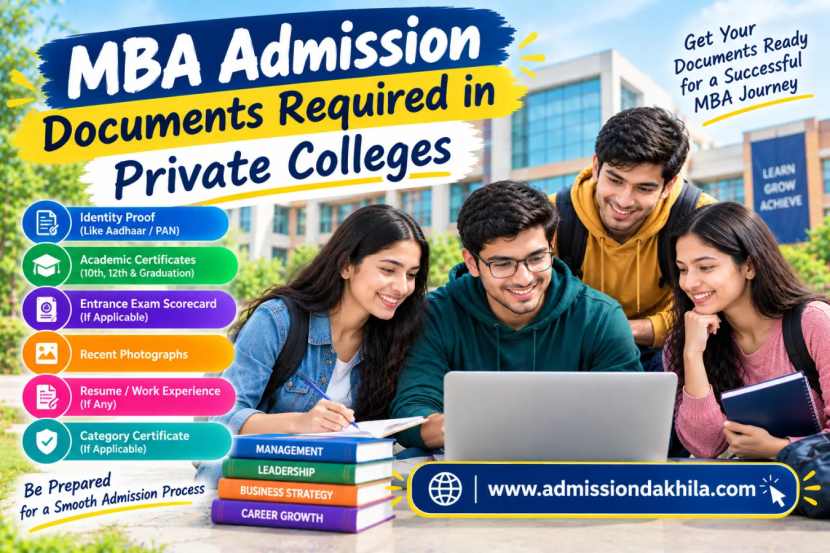
For MBA admission in private colleges in India, students usually need their graduation marksheets, degree or provisional certificate, Class 10 and Class 12 marksheets, identity proof, passport-size photographs, a completed application form, and an entrance exam scorecard if required by the college. Depending on the institution, students may also need a migration certificate, transfer certificate, category certificate, or work experience documents. Check the official college website and the latest admission instructions before final verification. Admission Dakhila can help students find useful MBA admission information and understand the documents they may need.
Getting admission to a Master of Business Administration (MBA) programme is an important step for students who want to develop management skills, improve their career opportunities, or move into leadership positions. Private colleges in India offer MBA programmes in areas such as marketing, finance, human resources, business analytics, international business, operations, and entrepreneurship.
While students often focus on entrance examinations, college rankings, specialisations, fees, and placements, one important part of the process deserves equal attention: preparing the correct admission documents.
The MBA admission documents required in private colleges may differ from one institution to another. Some colleges accept applications through national-level entrance examinations, while others conduct their own aptitude tests, interviews, group discussions, or other selection rounds. Certain institutions may consider eligible candidates through alternative admission routes, subject to their published criteria and applicable regulations.
Despite these differences, most MBA applicants need to provide academic records, identity documents, photographs, application details, and evidence that they meet the eligibility requirements. Additional documents may be necessary for students who have completed graduation recently, changed universities, taken a study break, belong to a reserved category, or have professional work experience.
Preparing these documents early can help students avoid last-minute confusion, incomplete applications, and delays during document verification.
In this guide, Admission Dakhila explains the common documents required for MBA admission in private colleges, how to organise them, which certificates may be needed in special circumstances, and what students should verify before confirming their admission.
1. What Are the Documents Required for MBA Admission?
MBA admission documents are official records used by colleges to verify a candidate's identity, educational qualifications, eligibility, entrance examination performance, and other relevant details.
Private colleges generally request documents in stages. Some are needed when submitting the application form, while others are collected during counselling, selection, fee payment, or final admission verification.
The exact requirements depend on the college, university affiliation, programme, admission route, and applicant's educational background.
The following table provides a general overview.
| Document | Why It May Be Required |
|---|---|
| Class 10 marksheet or certificate | Verifies secondary education and date of birth where applicable |
| Class 12 marksheet or certificate | Verifies higher-secondary education |
| Graduation marksheets | Establishes undergraduate academic performance |
| Degree or provisional certificate | Confirms completion of the qualifying degree |
| Entrance exam scorecard | Verifies the result of an accepted entrance examination |
| Government-issued identity proof | Confirms applicant identity |
| Passport-size photographs | Used in applications, records, or identification |
| Completed application form | Records personal and academic details |
| Migration certificate | May be required when moving between universities |
| Transfer certificate | May be required under the institution's admission rules |
| Character certificate | May be requested for admission records |
| Category certificate | Required when claiming an applicable reservation or category benefit |
| Work experience documents | Support claims of professional experience |
| Fee payment receipt | Confirms payment of the relevant amount |
| Anti-ragging declarations or undertakings | Required where applicable under institutional rules |
Important: This is a general checklist, not a universal list. A private college may require fewer or additional documents. Always follow its current official instructions.
2. Academic Documents Required for MBA Admission
Academic documents are among the most important records in the MBA admission process. Colleges use them to establish whether an applicant satisfies the minimum educational qualifications and to verify the marks entered in the application.
2.1 Class 10 Marksheet and Certificate
Students are commonly asked to submit their Class 10 marksheet and, where requested, the passing certificate.
These records may be used to verify:
-
The student's name and personal details.
-
Date of birth, where applicable.
-
School board and year of passing.
-
Secondary education details.
Students should ensure that the name and date of birth on their Class 10 records are consistent with the information provided in their application and identity documents.
If there is a spelling mistake or a difference in personal details, contact the relevant school board or college admission office for instructions before verification.
2.2 Class 12 Marksheet and Passing Certificate
A Class 12 marksheet or equivalent certificate is another commonly requested document.
Although MBA admission primarily depends on graduation eligibility and the institution's selection criteria, colleges may still request higher-secondary records to complete the candidate's academic history.
Applicants should keep a clear copy of their marksheet and passing certificate, if issued separately. Students who completed Class 12 through a recognised open-schooling board should provide valid documents accepted by the institution.
2.3 Graduation Marksheet
Graduation marksheets are essential because MBA applicants generally need to hold a recognised bachelor's degree or meet the applicable qualifying-degree requirements.
Students may need:
-
Semester-wise or year-wise marksheets.
-
Consolidated marksheet.
-
Final-year marksheet.
-
Provisional statement of marks, if the final record is pending.
The college may check the candidate's overall percentage, cumulative grade point average, passing status, and other academic requirements.
Students should not calculate or convert their CGPA into a percentage using an assumed formula. They should follow the conversion method prescribed by their university and provide an official conversion certificate when required.
2.4 Graduation Degree Certificate
The degree certificate provides formal evidence that the student has completed the undergraduate programme.
It may be issued by a university after the final examination results and other academic requirements have been fulfilled.
If the original degree certificate has not yet been issued, the college may accept a provisional degree certificate or another official completion document, depending on its rules.
Applicants should not assume that every private college accepts a provisional certificate indefinitely. Ask the admission office whether the final degree must be submitted by a specific deadline.
2.5 Consolidated Marksheet
Some universities issue a consolidated marksheet containing the results of multiple semesters or years.
This document can be useful during verification because it summarises the student's academic performance. However, certain colleges may still request individual semester marksheets.
If both documents are available, keep both ready rather than relying only on the consolidated record.
3. Identity Proof and Photographs
Identity documents help the college match the applicant's application details with official records.
3.1 Government-Issued Identity Proof
A college may accept an identity document such as Aadhaar, passport, voter ID, driving licence, or another approved form of identification, subject to its admission rules.
Students should check which documents the institution accepts instead of assuming that one particular identity card is compulsory everywhere.
The name on the identity document should ideally match the academic certificates. If a passport is required for an international applicant, ensure that it remains valid for the relevant period.
Use identity documents only through official application channels. Avoid sending sensitive personal information to unverified agents or unofficial social media accounts.
3.2 Passport-Size Photographs
Many colleges request recent passport-size photographs for admission records, identity cards, or institutional databases.
The required number, size, background colour, file format, and upload dimensions may differ between institutions.
Applicants should keep:
-
Recent printed passport-size photographs.
-
A clear digital photograph.
-
A digital signature image, if requested.
Use photographs that meet the college's instructions. Do not upload a heavily edited image or an image that does not resemble the applicant.
3.3 Signature Image
Online application portals may require a scanned signature.
The file should be legible and comply with the specified dimensions and file-size limit. Students should avoid submitting a cropped image in which the signature is incomplete or difficult to read.
If a college requests a handwritten signature on a printed form, follow its instructions regarding where and how to sign.
4. Entrance Examination Documents
MBA entrance examinations are used by many institutions to assess applicants' aptitude, reasoning, quantitative ability, language skills, and readiness for management education.
The entrance examination accepted by a college depends on its admission policy.
4.1 Entrance Exam Scorecard
A college may accept scores from examinations such as CAT, XAT, CMAT, MAT, or other recognised tests specified in its current admission notice.
The relevant document is generally the official scorecard or result record. Applicants should use the correct examination year and ensure that their registration details are accurate.
Do not assume that every private college accepts every national-level entrance examination. Check the official programme-specific eligibility and selection criteria.
4.2 Admit Card or Examination Registration Details
Some institutions may ask for an entrance exam admit card or registration details to cross-check the candidate's identity and examination information.
Although a scorecard may be sufficient for some colleges, keeping the admit card available can help resolve discrepancies during verification.
4.3 College-Level Entrance Test Documents
Certain colleges conduct their own aptitude tests or selection assessments. Applicants may need to provide:
-
Registration confirmation.
-
Admit card, where issued.
-
Test result or score report.
-
Interview invitation or selection communication.
Students should retain emails and downloadable records received from the institution until admission is complete.
4.4 Admission Through an Alternative Route
Some private institutions may offer admission routes that do not require a particular national entrance examination. Such routes may involve academic merit, a college-level assessment, an interview, or another permitted selection method.
However, students should distinguish between an alternative selection route and exemption from the institution's academic eligibility requirements.
Before accepting an offer, verify the college's recognition, university affiliation, programme approval where applicable, eligibility rules, and written admission policy. Be cautious of anyone promising guaranteed admission without proper eligibility or official verification.
5. Graduation and Degree Verification
Academic verification can require additional records when the applicant's degree has been issued by a different university, the original certificate is pending, or the academic record needs clarification.
5.1 Provisional Degree Certificate
A provisional degree certificate may be issued after a student has completed the qualifying degree but before the formal degree certificate becomes available.
Some institutions accept it temporarily. Others may require a final certificate within a specified period.
Students should ask whether the provisional certificate is acceptable for initial admission and whether a deadline applies to the submission of the original degree.
5.2 Migration Certificate
A migration certificate may be required when a student moves from one university to another.
It is different from a transfer certificate. The migration certificate generally relates to movement between universities, while a transfer certificate records the student's departure from an educational institution.
Whether an MBA applicant needs a migration certificate depends on the receiving institution's rules and the student's previous university.
Students should contact their previous university if the document has not been issued.
5.3 Transfer Certificate
A transfer certificate may be requested by the college as part of its admission records.
Not every MBA institution requires it in every situation. Some universities or affiliated colleges have specific procedures for collecting transfer documents, while others may rely on different records.
Check the admission instructions before applying for a new certificate, particularly if the previous institution follows a formal clearance process.
5.4 Character Certificate
A character certificate may be requested by some institutions to complete admission formalities.
It may be issued by the previous school, college, university, or another authorised institution, according to the receiving college's rules.
Students should confirm who is authorised to issue the certificate and whether it must have been issued within a particular period.
6. Additional Certificates Required by Some Colleges
Not every student needs every additional certificate. Requirements depend on the applicant's circumstances and the college's administrative rules.
6.1 Gap-Year Affidavit or Gap Certificate
Students who took a break between completing graduation and applying for an MBA may be asked to explain the gap.
Depending on the institution, acceptable evidence might include a declaration, affidavit, employment record, examination preparation details, or other supporting documents.
A gap year does not automatically make a candidate ineligible for MBA admission. The college's eligibility policy determines the effect, if any, of the gap.
Do not create a false affidavit or misrepresent employment, education, or personal circumstances. Ask the admission office for the exact format and supporting evidence required.
6.2 Caste or Category Certificate
Applicants seeking an applicable reservation benefit or category-based consideration may need a valid certificate issued by the competent authority.
The institution may specify the accepted format, issuing authority, validity requirements, or additional declarations.
Students should verify whether the certificate is relevant to that particular college and admission process. A document accepted for one examination or institution may not automatically satisfy another institution's requirements.
6.3 Income Certificate
An income certificate may be needed when applying for a scholarship, fee concession, financial assistance scheme, or another benefit that uses household income as an eligibility criterion.
It is not necessarily a compulsory document for every MBA applicant.
Applicants should check the relevant scheme's rules, required issuing authority, validity period, and income limits before submitting the certificate.
6.4 Disability Certificate
Candidates seeking an applicable disability-related accommodation or benefit may need an accepted disability certificate or other documentation specified by the institution.
The exact requirements depend on the relevant rules and the benefit being claimed. Students should ask the admissions or accessibility office what format and issuing authority are accepted.
6.5 Domicile Certificate
Some admission processes, scholarships, or state-linked benefits may require a domicile or residence certificate.
A domicile certificate is not a universal requirement for MBA admission in all private colleges. Its relevance depends on the applicable policy and the student's circumstances.
6.6 Scholarship Documents
Students applying for scholarships or fee support may be asked for additional records, such as:
-
Income certificate.
-
Bank account details in the required format.
-
Category certificate, where applicable.
-
Previous academic marksheets.
-
Fee structure or fee receipt.
-
Scholarship application form.
-
Other documents specified by the funding scheme.
Scholarship requirements should be checked separately from the college's basic admission checklist.
7. Documents for Working Professionals
Working professionals applying for an MBA, including a regular MBA or an executive management programme, may need to submit documents beyond standard academic records.
7.1 Work Experience Certificate
A work experience certificate may confirm the candidate's employment history, role, dates of service, or other information requested by the college.
It may be especially relevant for programmes that specify a minimum work experience requirement or consider professional experience during selection.
Applicants should provide genuine employment details and verify whether internships, freelance assignments, self-employment, or part-time roles qualify under the programme's rules.
7.2 Appointment Letter
An appointment letter can support a candidate's claim of employment.
Some institutions may accept it as supporting evidence, while others require an experience certificate, payslips, or other official documentation.
An appointment letter alone may not establish the full duration of employment, so check the college's requirements.
7.3 Salary Slips or Salary Certificate
Certain programmes may request salary slips, a salary certificate, or similar documents to verify employment or professional background.
These records are not generally universal requirements for every full-time MBA admission process.
Submit financial and employment records only through a verified official portal or to an authorised admissions representative.
7.4 Employer No-Objection Certificate
A No-Objection Certificate (NOC) may be relevant when a candidate's employer needs to acknowledge participation in a course or provide permission under an applicable employment policy.
It is more likely to be relevant to sponsored, part-time, or executive programmes than to ordinary full-time MBA admissions.
Candidates should confirm whether an NOC is compulsory before requesting one from their employer.
7.5 Updated Resume
Some institutions request a resume or curriculum vitae as part of the application or selection process.
A useful MBA application resume should accurately describe education, employment, responsibilities, skills, certifications, achievements, and extracurricular involvement.
Keep the resume consistent with the dates and details recorded in supporting documents.
8. Documents for Final-Year Students
Many students apply for MBA admission while completing the final year of their bachelor's degree.
Depending on the institution's policy, a final-year student may be considered provisionally, subject to meeting all qualifying requirements within the specified deadline.
Commonly Requested Documents
-
Class 10 marksheet.
-
Class 12 marksheet.
-
Available graduation marksheets.
-
Final-year examination registration or admit card, where requested.
-
Current university identity card, if requested.
-
Accepted entrance exam scorecard.
-
Provisional eligibility declaration or undertaking, if required.
-
Final degree or marksheets after results are declared.
What Happens If the Final Result Is Pending?
A college may issue a provisional offer or allow the candidate to continue through the admission process before the final graduation result is available.
However, the applicant must satisfy the stated eligibility conditions by the prescribed deadline. If the student fails to meet those conditions, the offer may be withdrawn under the institution's policy.
Before paying a non-refundable fee, confirm:
-
Whether final-year students are eligible to apply.
-
The minimum graduation requirement.
-
The deadline for submitting final results.
-
Whether a provisional certificate is accepted.
-
What happens if the final result is delayed.
Students should avoid assuming that an application automatically guarantees eligibility for final admission.
9. Documents for Reserved-Category Applicants
Students claiming a reservation or category-related benefit should carefully read the current admission notice.
The accepted categories, eligibility conditions, certificates, and benefit rules may vary by institution and applicable regulations.
Depending on the relevant policy, an applicant may need:
-
A valid category certificate.
-
An income or eligibility certificate.
-
A prescribed declaration.
-
A disability certificate, where applicable.
-
Other supporting documents required by the institution.
The certificate should match the category claimed in the application. If the document is outdated, issued by an unrecognised authority, or prepared in the wrong format, verification may be delayed.
Do not assume that the same category certificate is accepted by every institution. If an application asks for a particular format, follow that instruction.
10. Online Application and Fee Documents
In addition to academic certificates, students must often complete administrative steps through the college's online portal.
10.1 Completed Application Form
The application form records personal information, educational history, entrance examination details, contact information, and programme preferences.
Review the form before submission. Errors in names, marks, email addresses, phone numbers, or examination details can create problems during verification.
Save the application number and confirmation email after submitting the form.
10.2 Application Fee Receipt
If the college charges an application fee, keep the payment confirmation or receipt.
If the payment is deducted but the portal does not show a successful transaction, avoid paying repeatedly without checking the transaction status. Contact the official helpdesk and retain the transaction reference.
10.3 Admission Offer Letter
An admission offer letter records the institution's offer and may specify the programme, conditions, deadlines, and next steps.
Read it carefully. An offer may be conditional on document verification, eligibility confirmation, or payment by a stated date.
10.4 Fee Payment Receipt
After paying the admission or tuition fee, download the official receipt and save a copy.
The receipt may be useful for financial records, scholarship applications, refund queries, or resolving payment discrepancies.
Students should also obtain the official fee structure and refund policy before making a substantial payment.
10.5 Declarations and Undertakings
A college may require students to complete declarations relating to institutional policies, anti-ragging requirements, conduct, hostel rules, or other administrative matters.
Read each declaration before signing. Use the college's official format and submit only the information requested.
11. Original Documents Versus Photocopies
One of the most common questions among MBA applicants is whether colleges require original documents or photocopies.
The answer depends on the institution's admission and verification procedure.
11.1 Documents to Keep in Original
Applicants should generally carry their available original academic certificates and identity documents when the institution requires in-person verification.
Common examples include:
-
Class 10 and Class 12 certificates.
-
Graduation marksheets.
-
Degree or provisional certificate.
-
Entrance exam scorecard, if required.
-
Category certificate, where applicable.
-
Other documents specified in the official checklist.
Original documents may be inspected and returned, but procedures vary. Do not assume the college will retain or immediately return every document without checking its written policy.
11.2 Photocopies
Keep a set of clear photocopies of all relevant documents.
Some colleges request self-attested photocopies, while others ask for copies verified through a particular procedure. Follow the institution's instructions rather than self-attesting every document automatically.
11.3 Scanned Copies
Online admission systems may accept PDF, JPG, JPEG, or PNG files.
Before uploading:
-
Check the allowed file format.
-
Confirm the maximum file size.
-
Make sure the complete document is visible.
-
Avoid blurred or shadowed scans.
-
Check that all relevant pages are included.
-
Use the required file naming convention, if specified.
11.4 Should You Submit Original Documents to an Agent?
Be cautious about handing over original academic certificates to an unauthorised agent.
If the college needs originals for verification, use its official procedure and obtain a written acknowledgement if any document is retained. Keep personal records and receipts for any transaction.
12. MBA Admission Document Checklist
The following checklist can help students prepare for the application and verification stages.
Basic Application Documents
-
Completed MBA application form.
-
Application confirmation or registration number.
-
Recent passport-size photographs.
-
Accepted identity proof.
-
Signature image, if required.
-
Application fee receipt, where applicable.
Academic Documents
-
Class 10 marksheet or certificate.
-
Class 12 marksheet or certificate.
-
Graduation semester-wise or year-wise marksheets.
-
Consolidated marksheet, if available or required.
-
Graduation degree or provisional certificate.
-
Official CGPA-to-percentage conversion document, if required.
-
Final-year records for students whose results are pending.
Entrance Examination Documents
-
Accepted entrance exam scorecard.
-
Admit card, if requested.
-
College-level test result, if applicable.
-
Interview or selection communication, if applicable.
Additional Documents, Where Applicable
-
Migration certificate.
-
Transfer certificate.
-
Character certificate.
-
Gap-year affidavit or declaration.
-
Category certificate.
-
Income certificate.
-
Disability certificate.
-
Domicile certificate.
-
Work experience certificate.
-
Employer NOC.
-
Scholarship application records.
-
Required undertakings or declarations.
Final Admission Documents
-
Admission offer letter.
-
Fee payment receipt.
-
Signed admission forms.
-
Copies of the documents submitted.
-
Hostel forms and related records, if applicable.
-
Student undertaking or anti-ragging documents, if required.
This checklist is intended as a preparation aid. Remove documents that do not apply to your circumstances and add any institution-specific requirements.
13. Common Mistakes to Avoid During MBA Admission
Even eligible candidates can face delays when their documents are incomplete or inconsistent.
13.1 Name Mismatch
A difference between the name on the application, identity proof, and academic certificates can trigger additional verification.
Check spelling, initials, surname order, and other personal details. If a genuine discrepancy exists, ask the college which supporting document or correction process it accepts.
Do not edit or alter a certificate yourself.
13.2 Incorrect Marks or Percentage
Entering an incorrect percentage or CGPA can affect eligibility checks.
Use official academic records and the prescribed conversion formula. If the university has not issued a conversion formula, request clarification rather than guessing.
13.3 Missing Final-Year Results
Students who apply before graduation should track their result and degree deadlines.
If results are delayed, inform the admission office and ask whether an extension is permitted. Keep written communication as evidence of the instructions received.
13.4 Uploading Unclear Scans
A document may be rejected if the text, stamp, photograph, or signature is not legible.
Scan the entire page and review the file at normal viewing size before uploading it.
13.5 Missing a Required Certificate
Migration, transfer, category, and gap-related documents may take time to obtain.
Read the college checklist early and apply to the relevant issuing authority when necessary.
13.6 Ignoring Admission Deadlines
An applicant may miss an admission opportunity by delaying document submission or payment.
Create a simple deadline tracker containing the application date, test date, result date, interview date, verification date, and fee deadline.
13.7 Paying Without Checking Official Details
Before paying fees, verify the institution's official identity, programme details, recognition or affiliation where applicable, written offer, fee structure, and refund terms.
Use official payment links and retain receipts. Avoid payments to personal accounts unless the institution's verified procedure explicitly supports that method and you have independently confirmed its legitimacy.
14. How to Prepare Documents for Online MBA Admission
Online admission can make the application process convenient, but it also requires careful file preparation.
Step 1: Read the Official Admission Notice
Download the latest MBA admission brochure or checklist from the college's official website.
Identify the required academic qualifications, accepted entrance exams, upload specifications, verification dates, and fee deadlines.
Step 2: Create a Document Folder
Create a dedicated folder on your computer containing clearly named files.
For example:
-
Class-10-Marksheet.pdf -
Class-12-Marksheet.pdf -
Graduation-Marksheets.pdf -
Degree-Certificate.pdf -
Entrance-Exam-Scorecard.pdf -
Identity-Proof.pdf
Use file names that are easy to recognise. Avoid placing sensitive information in public folders or sharing links with unrestricted access.
Step 3: Check File Quality
Make sure that every document is readable and complete.
If the college asks for both sides of an identity document or multiple pages of a certificate, include all required pages. Check whether the portal accepts a single combined PDF or requires separate uploads.
Step 4: Complete the Application Carefully
Enter the details exactly as required. Check the spelling of your name, date of birth, graduation marks, examination registration number, and contact details.
Review all entries before submitting the application.
Step 5: Save the Confirmation
Download the submitted application, payment receipt, and confirmation email.
These records can help if you need to follow up with the admissions team or resolve a technical issue.
Step 6: Track Missing Documents
If a certificate is pending, check whether the college permits provisional submission.
Never upload a fabricated certificate or mark a requirement as completed when it is not. Explain the situation to the admissions office and follow its official instructions.
15. Document Verification and Final Admission
Document verification is the stage at which a college checks whether the information provided by the candidate is accurate and whether the applicant meets the admission requirements.
It may take place online, in person, or through a combination of both methods.
What Is Usually Checked?
The admissions team may verify:
-
Identity and personal details.
-
Academic qualifications.
-
Graduation percentage or CGPA.
-
Entrance examination scores.
-
Eligibility for the selected programme.
-
Validity of category or other supporting certificates.
-
Completion of required declarations.
-
Payment of the prescribed fees.
What Happens If a Document Is Missing?
The outcome depends on the nature of the missing document and the institution's rules.
A college may allow the applicant to submit a pending record by a specified deadline, request clarification, place admission on hold, or decline admission if an essential eligibility condition is not met.
Contact the admissions office promptly. Ask for the deadline and the acceptable alternative, if any, in writing.
Can Admission Be Cancelled After Verification?
Admission may be withdrawn or cancelled if an applicant is found ineligible, submits false documents, or fails to satisfy a stated condition, subject to applicable rules and the institution's policy.
Students should provide genuine records and read the offer letter carefully.
What Should You Do After Verification?
Once the documents have been verified, retain:
-
The admission confirmation.
-
Fee receipts.
-
A copy of the submitted documents.
-
Written confirmation of any pending requirement.
-
Contact details for the official admissions office.
If you plan to apply for a hostel, education loan, scholarship, or student identity card, check whether further documents are needed.
16. How Admission Dakhila Can Help MBA Aspirants
Choosing an MBA college involves more than filling out an application. Students must compare programme options, eligibility requirements, entrance examinations, fees, location, specialisations, and career opportunities.
Admission Dakhila can be presented as a useful starting point for students researching MBA admissions and organising their next steps.
Students can use Admission Dakhila to explore relevant admission information, understand common application requirements, and build a shortlist of colleges to investigate further.
Before making a final decision, applicants should confirm important details directly with the relevant institution, particularly:
-
MBA eligibility criteria.
-
Accepted entrance examinations.
-
Application and counselling dates.
-
Required documents.
-
Tuition fees and additional charges.
-
Scholarship availability.
-
Placement information.
-
Refund and withdrawal rules.
Admission information can change from one academic year to another. For that reason, students should use current official college notices for final confirmation.
A well-prepared applicant can save time by keeping academic records organised, checking eligibility early, and submitting accurate information.
17. Frequently Asked Questions About MBA Admission Documents
FAQ 1: What documents are required for MBA admission in private colleges?
The commonly required documents include Class 10 and Class 12 marksheets, graduation marksheets, a degree or provisional certificate, identity proof, passport-size photographs, an application form, and an entrance exam scorecard if applicable. Additional documents may include migration, transfer, character, category, or work experience certificates, depending on the college and applicant.
FAQ 2: Is a graduation marksheet compulsory for MBA admission?
Graduation marksheets are generally required to verify academic performance and eligibility. A college may request semester-wise records, a consolidated marksheet, or both. Final-year students may be allowed to apply provisionally if the institution's policy permits it.
FAQ 3: Can I take MBA admission without an entrance exam scorecard?
Some private colleges offer admission routes that do not require a particular national-level entrance exam. The college may use its own selection procedure or another permitted route. Applicants must still satisfy the institution's eligibility requirements and should verify the official admission policy.
FAQ 4: Is a migration certificate necessary for MBA admission?
A migration certificate may be required when a student moves from one university to another. It is not a universal requirement for every MBA applicant. Check the rules of the receiving college and the university to which it is affiliated.
FAQ 5: Can final-year graduation students apply for an MBA?
Many institutions allow eligible final-year students to apply provisionally. These candidates must meet the required graduation criteria and submit their final results or degree documents by the institution's deadline. The policy should be checked before applying.
FAQ 6: Do private MBA colleges require original documents?
Many colleges inspect original documents during verification, but the process varies. Applicants should bring originals when instructed and keep photocopies or digital copies for their records. Before any original document is retained, request written acknowledgement and follow the official procedure.
FAQ 7: Is a gap certificate compulsory for MBA admission?
A gap certificate or affidavit is required only by some institutions or in certain circumstances. Other colleges may accept a declaration or different supporting evidence. Applicants should ask the admissions office whether a gap document is needed and which format is accepted.
FAQ 8: Which documents are required for MBA admission for working professionals?
Working professionals generally need the standard academic and identity documents. Depending on the programme, they may also need a resume, experience certificate, appointment letter, salary evidence, employer NOC, or sponsorship documents. Check the specific programme requirements before submission.
FAQ 9: Can I apply for MBA admission if my original degree certificate has not been issued?
Some colleges accept a provisional degree certificate or other official proof of completion for initial admission. However, acceptance and submission deadlines vary. Contact the admissions office and obtain confirmation about the alternative document and the deadline for submitting the final degree.
FAQ 10: How can I check the correct MBA admission document list?
Download the current admission brochure or document checklist from the official college website. You can also contact the institution's authorised admissions office. Admission Dakhila can help you explore MBA admission information, but the college's official instructions should be treated as the final authority for document requirements.
Conclusion
Preparing the correct documents is an important part of applying for an MBA in a private college. Academic marksheets, degree certificates, identity proof, photographs, application forms, and entrance exam scorecards are among the most commonly requested records. Depending on the student's circumstances and the institution's rules, migration certificates, transfer certificates, gap-year affidavits, category certificates, work experience records, and other documents may also be necessary.
The best approach is to start early, read the latest admission brochure, organise clear digital and physical copies, check personal details carefully, and track every submission deadline. Students should never assume that all private colleges follow exactly the same procedure.
Before confirming admission, review the institution's eligibility rules, fee structure, programme details, written offer, and refund policy. Submit genuine documents and retain payment receipts and verification records.
If you are planning to pursue an MBA, use Admission Dakhila to begin exploring admission information and comparing your options. Make a shortlist of suitable colleges, verify their official requirements, prepare your documents, and take the next step towards your management education with confidence.
Admission CTA: Explore MBA admission opportunities with Admission Dakhila, shortlist colleges that match your goals, and confirm the cu